
How Long Should a Sofa Last? What Really Determines Its Lifespan
Reviewed & curated by Maria BanouHome Life AdvisorPublished July 29, 2026Updated September 4, 202630 minute read
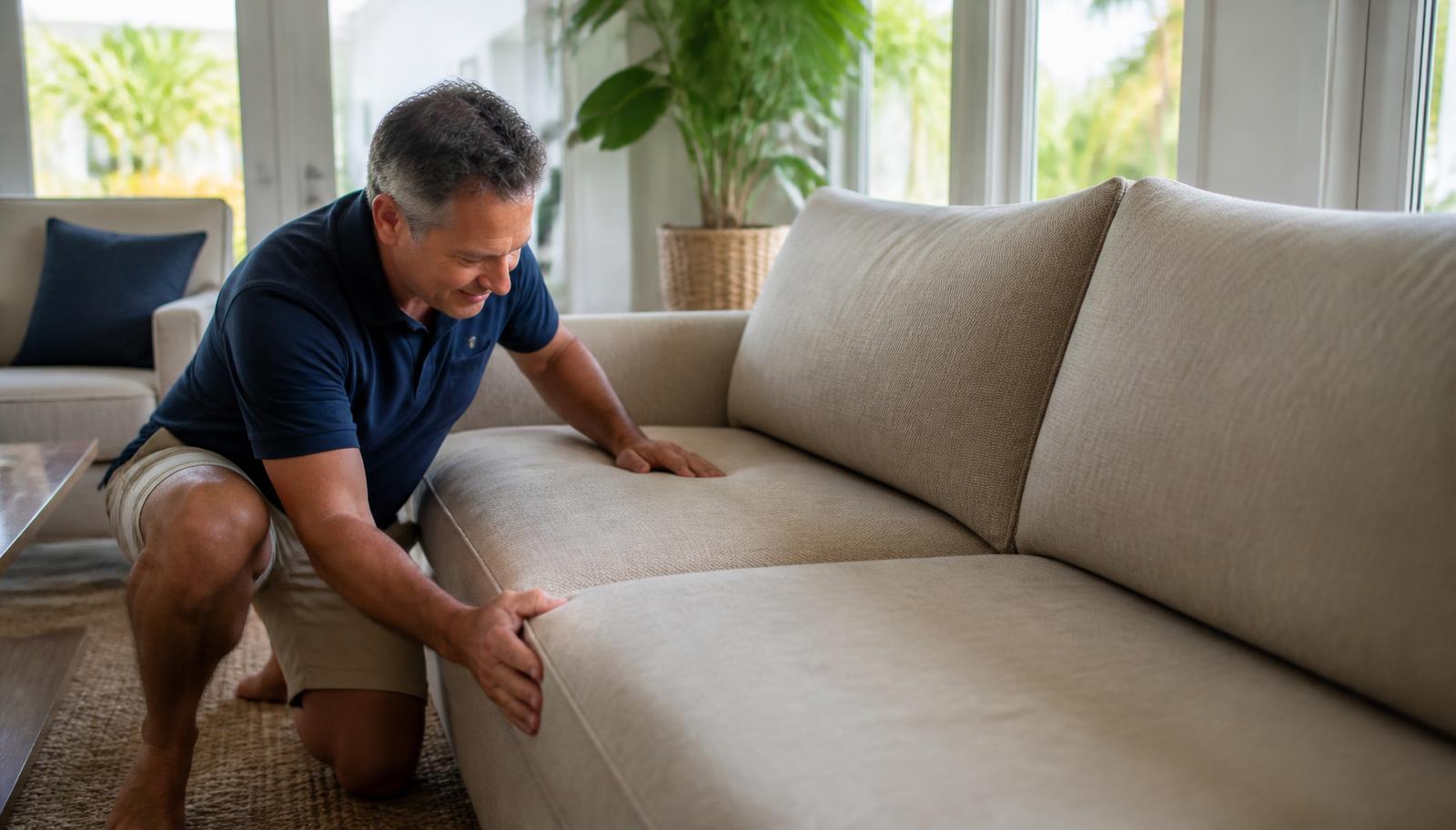
Most homeowners ask the question the same way: how many years should a sofa last? It is a fair question, and it almost never has a clean answer. Two sofas purchased the same month, in the same neighborhood, can end up in very different condition. One still feels supportive and welcoming. The other sags in the middle and nobody wants to sit there. Age was identical. Everything else was not. This guide walks through what actually determines a sofa's useful life — frame, suspension, cushions, upholstery, household use, Florida conditions, and changing comfort needs — and gives you a calm way to decide whether to maintain, repair, reupholster, or replace the sofa you already own.
Somewhere in most homes there is a sofa that has quietly earned its keep. It has held movie nights, naps, homework, holiday guests, a dog who is not technically allowed on it, and more ordinary evenings than anyone bothered to count.
And at some point, someone sits down, feels the cushion give a little more than it used to, and asks the question: how long should a sofa last, anyway?
I have spent years helping homeowners compare furniture, and I can tell you the honest answer is not a number. It is a set of conditions.
Two sofas bought the same week can age completely differently. One lives in a formal living room that hosts guests four times a year. The other absorbs a family of five, a golden retriever, and every weeknight from six to ten. Same purchase date. Very different lives.
Many homeowners find that once they understand what actually wears out — and in what order — the decision gets much easier. You stop guessing based on a birthday and start evaluating based on what the sofa is doing for the people who use it.
That is what this guide is for. Not to talk you into a new sofa. To help you look at the one you have with clearer eyes, and to make a smarter decision whenever the next one does come along.
Is There a Normal Lifespan for a Sofa?
There is no universal expiration date for a sofa.
You will see ranges quoted online — often something like seven to fifteen years — and those ranges are best treated as broad planning references, not guarantees. They describe averages across enormous variation. They do not describe your sofa, your household, or your room.
It may help to separate four different things that homeowners tend to blend together:
Calendar age. How long you have owned it. The least useful measure on its own.
Physical condition. Whether the frame, suspension, cushions, and upholstery are intact and doing their jobs.
Functional condition. Whether the moving parts — recliners, sleepers, removable cushions, legs, seams — still operate as intended.
Life fit. Whether the sofa still suits the room you have now, the people who live there now, and the way you use the space today.
A sofa can be strong in one column and weak in another. I have seen twelve-year-old sofas that were structurally excellent and still comfortable, and four-year-old sofas that had already lost their support because of how they were built and how hard they were used.
One thing that often surprises homeowners is that price does not settle the question either. A higher price can reflect better materials, more careful construction, and better warranty support — or it can reflect brand, styling, and where you bought it. Price is a signal worth considering. It is not proof.
Takeaway: A sofa's age is one clue, not the final decision.
What Parts of a Sofa Determine How Long It Lasts?
A sofa does not wear out as a single object. It is an assembly of parts, and those parts age at different speeds.
Here is what is actually under there, in plain language:
The frame. The skeleton. Usually wood, sometimes engineered wood, occasionally metal. It carries the load and holds the shape.
The joinery. How the frame pieces connect. Corner blocks, screws, dowels, staples, glue. Joinery is often what determines whether a frame stays tight over years of use.
The suspension. What sits between the frame and the cushions — typically sinuous steel springs, an eight-way hand-tied spring system, or webbing. This is what gives a seat its resilience.
Seat cushions. Foam cores, sometimes wrapped in fiber or down, sometimes built over a spring insert. These carry the most direct wear of anything in the sofa.
Back cushions. Often softer and more fiber-based, which means they compress and need fluffing more than they need replacing.
Upholstery. The fabric or leather you see and touch. It handles abrasion, sunlight, spills, oils, and pet claws.
Reclining or sleeper mechanisms. Mechanical parts, sometimes with motors and wiring. More function, more moving parts, more that may eventually need service.
Legs and support points. Where the load transfers to the floor. Center support matters a lot on longer sofas.
Zippers, seams, and decking. The unglamorous parts. The decking is the fabric platform under the cushions, and seam quality shows up years later.
One pattern I have seen over the years: homeowners tend to judge a sofa entirely by the two components they can see and feel — cushions and fabric — while the two that most affect long-term life, the frame and suspension, stay invisible until something goes wrong.
If you want to go deeper on materials before your next purchase, our Sofa Materials & Durability guide walks through the trade-offs without pushing any particular brand.
Takeaway: Ask which part is failing before you decide the whole sofa is finished.
How Does the Frame Affect Sofa Lifespan?
The frame is the part that determines whether a sofa is worth keeping at all.
Cushions can be replaced. Fabric can be cleaned or replaced. A frame that has genuinely failed changes the entire equation, because most other repairs assume there is something solid to build on.
What matters in a frame:
Material and construction. Kiln-dried hardwood frames are widely regarded as durable. Engineered wood and lighter frames can perform acceptably in lighter-use rooms and less well under heavy daily use. Neither is universally right — it depends on how the sofa will actually live.
Joinery. Corner-blocked and reinforced joints tend to stay tight longer than joints held mainly by staples.
Span and support. Longer sofas and sectionals carry more load across more distance. Center legs and mid-span support matter more than people expect.
Use pattern. Sitting on arms, kids landing on the seat, and moving the sofa frequently all put stress on joints that ordinary sitting does not.
Signs that may justify having someone qualified take a look:
- New or worsening instability when you sit or stand
- The sofa visibly leaning or no longer sitting level on a level floor
- Cracking sounds paired with noticeable movement
- An arm that shifts when you lean on it
- A leg or support that has broken or separated
- Visible structural damage
A word of caution in both directions. A squeak by itself does not prove a frame has failed — squeaks often come from springs, hardware, or a loose leg. And a sofa that has become genuinely unstable is not something to diagnose from an article. Please do not dismantle a sofa or attempt structural repairs yourself. A qualified furniture repair professional can evaluate it properly and tell you whether it is fixable.
Takeaway: A sound frame keeps repair options open. A failing frame usually closes them.
Why Do Sofa Cushions Often Wear Out First?
Seat cushions are almost always the first thing homeowners notice, and there is a reason: they absorb the most direct, repeated compression of any component in the sofa.
What is actually happening:
Foam softens. Foam loses some of its original firmness over time. Some initial softening is normal and expected, not a defect.
Fiber compresses. Cushions wrapped in polyester fiber or down lose loft and need regular fluffing to look and feel right.
Body impressions form. The seat you always use develops a shallow dip. Mild impressions are common. Deep, permanent impressions that no longer recover are a different signal.
Favorite seats wear faster. In nearly every household there is one seat that takes most of the use. It will age ahead of the others, sometimes dramatically.
Rotating and flipping loose seat cushions, when the design allows it, is one of the simplest habits that helps. It spreads wear across surfaces instead of concentrating it in one place. It will not restore foam that has already broken down, and it is not possible at all on attached-back or tight-seat designs.
Here is a distinction worth holding onto: a cushion that looks flat is not the same as a cushion that no longer supports you. Some cushions look tired and still feel fine. Others look presentable and let you sink until you feel the deck underneath. Trust what your body reports, not what the photo would show.
If cushion cores can be replaced or rebuilt — and on many sofas with removable, zippered cushions they can — that cost is worth comparing against the condition of the frame, suspension, and upholstery. Replacing cushions in a sofa that is otherwise sound is often a reasonable move. Replacing cushions in a sofa with a failing frame usually is not.
Takeaway: Cushion wear is common and often addressable. It is rarely the whole story.
How Does Upholstery Affect a Sofa's Useful Life?
Upholstery is the layer that shows age first and, ironically, the layer that least often determines whether a sofa is still usable.
Common upholstery changes:
- Abrasion and pilling on the seats and arms where contact is constant
- Fading where sunlight reaches the fabric daily
- Staining from spills, body oils, and everyday life
- Seam wear where stitching carries stress
- Leather drying or surface cracking in areas that get heavy contact or heat
- Pet damage — snags, punctures, and concentrated wear in one favorite corner
A useful way to sort what you are seeing:
Cosmetic aging. Even fading, mild pilling, a softened sheen. The sofa works fine; it just looks lived-in.
Cleanable issues. Surface soil and many fresh spills, treated by the correct method for that material.
Repairable damage. A separated seam, a torn cushion cover, a loose zipper. Often fixable at modest cost.
Material breakdown. Fabric thinning to the point of splitting, or a coated surface flaking away. This is not a cleaning problem.
Needs professional evaluation. Persistent odors, suspected moisture inside the cushions, or anything you suspect may involve mold. That is not a DIY judgment call.
Before treating anything, find the cleaning code on the manufacturer tag — usually W, S, WS, or X. Using the wrong method on the wrong material is one of the more common ways homeowners accidentally make a fixable problem permanent. A universal cleaner is not universal.
Leather deserves its own note, because it behaves differently from fabric and Florida homes ask more of it than most. I wrote about that in detail in Can Leather Furniture Crack in Florida? — worth reading if your sofa is leather and sits anywhere near a window or a vent.
If your sofa is leather and the surface feels dry to the touch, a conditioner made for finished leather, applied according to the manufacturer's guidance and tested in a hidden spot first, is one of the few maintenance products I genuinely believe in.
To be clear: this is for leather only. Do not use leather conditioner on fabric upholstery, and always confirm compatibility with your sofa's care instructions before applying anything.
Takeaway: Most upholstery wear is cosmetic or repairable. Confirm the cleaning code before you treat it.
How Do Florida Humidity, Heat, and Sunlight Affect a Sofa?
Florida does not automatically ruin furniture. I want to say that plainly, because there is a lot of alarmist content out there.
What Florida does do is add a few variables that homeowners in drier, cooler climates rarely think about.
Indoor humidity. Consistently high indoor humidity can encourage musty odors and, in poorly ventilated spots, mold growth on or inside upholstered pieces. Most homes with steady air conditioning stay in a reasonable range without special effort.
Air-conditioning patterns. A vent blowing directly and constantly onto leather can dry the surface faster than the rest of the piece. Depending on the room, redirecting a vent is a small change with real benefit.
Direct sunlight. Florida sun through a large window is a genuine fading source. South- and west-facing exposures do the most work. Fading is usually gradual and uneven — one arm lighter than the other is the classic tell.
Seasonal vacancies. Homes closed up for months with the air conditioning set high are the most common humidity-related problem I hear about. It may be worth arranging for the system to keep running at a moderate setting, and for someone to check on the home.
Placement. Sofas near exterior doors, sliders, or windows see more sun, more temperature swing, and more moisture exposure than a piece against an interior wall.
One helpful habit is simply knowing what your indoor humidity actually is rather than guessing at it. An inexpensive monitor in the main living area gives you real numbers, which makes it much easier to tell whether a musty smell is a furniture problem or a whole-room problem.
For the fuller picture on how moisture interacts with wood, fabric, and foam in Florida homes, Can Humidity Ruin Furniture? covers the practical side. And if you are still getting your bearings as a Florida homeowner generally, the Florida Homeowner Hub organizes the seasonal side of home care.
Takeaway: Florida adds variables, not inevitabilities. Monitor, adjust placement, and keep air moving.
How Does Daily Use Change Sofa Lifespan?
This is the factor most homeowners underestimate, and it is probably the single biggest driver of how differently two identical sofas age.
Consider what changes the load:
- Primary versus occasional seating. A family-room sofa used four hours a day is doing something structurally different from a formal living-room sofa used at holidays.
- Household size. More people means more compression cycles, more often.
- Pets. Claws, weight, oils, and the fact that most pets pick one spot and commit to it.
- Children. Enthusiastic landings, snacks, and the arm of the sofa used as a gymnastics apparatus.
- Eating and working on the sofa. More spills, more concentrated pressure in one posture.
- Sleeping on the sofa. Regular overnight use compresses cushions in ways daytime sitting does not.
- Sitting in the same spot every day. The most reliable way to age one cushion ahead of the rest.
- Frequent reclining. More cycles on mechanisms designed for a finite number of them.
- Moving or dragging. Hard on joints, legs, and floors.
- Seasonal-home use. Low use, but longer stretches of environmental exposure without supervision.
None of this is a criticism. Furniture is meant to be lived on. A sofa that shows wear from a full household has been doing its job.
What I would push back on is the expectation that a hardworking family-room sofa should age like a lightly used formal piece. It will not, and it was never going to. Setting a realistic expectation up front takes the disappointment out of year six.
Takeaway: Match your expectations to your actual use, not to a number in a brochure.
What Are the Signs a Sofa May Need Attention?
Here is a calm way to sort what you are noticing into three groups. Nothing on this list is a safety diagnosis — it is a triage tool to help you decide who, if anyone, should look at it next.
Watch and Maintain
- Mild pilling or light surface abrasion
- Gradual, even fading
- Back cushions that need fluffing
- Loose seat cushions with mild, recovering impressions
- Small spots that respond to the correct cleaning method
- Normal softening that has not affected comfort
Consider Repair or Professional Evaluation
- A seam that has started to separate
- A zipper or cushion cover that has failed
- A leg or hardware that has loosened
- Deep, permanent cushion impressions on an otherwise sound sofa
- Suspension that feels uneven from seat to seat
- A recliner or sleeper mechanism that hesitates, sticks, or operates unevenly
- Worn fabric on a piece you otherwise like
Consider Replacement
- Persistent instability or leaning that a repair professional has confirmed is not economically fixable
- Severe, widespread loss of support across multiple seats
- Multiple major components failing at once
- Damage that interferes with everyday use
- Repair costs that no longer make sense relative to the value of the piece
- A sofa that has become difficult to get out of or that obstructs safe movement through the room
A few of these deserve a specialist rather than a general handyman. Suspected mold, powered reclining components with electrical concerns, structural frame damage, and any sign of pest infestation are all situations to hand to an appropriately qualified professional. When you need help finding one, our Trusted Network can connect you with vetted local home maintenance and property care providers.
Takeaway: Sort the problem before you price the solution.
The Five-Part Sofa Life Check
When homeowners ask me to look at a sofa with them, I work through the same five lenses every time. It keeps the conversation out of "how old is it" and into "what is it actually doing."
This is not a guarantee of the right answer. It is a way to make sure you have not skipped a factor that matters.
1. Structure
*What to observe:* Does the sofa sit level? Does it feel stable when you sit down and stand up? Do the arms stay put when you lean on them?
*Maintainable:* Tightening or replacing a loose leg or visible hardware.
*May justify repair or evaluation:* New movement, leaning, or cracking sounds paired with motion.
*May support replacement:* Confirmed frame failure, especially on a lower-cost piece.
2. Comfort
*What to observe:* Sit in every seat, not just yours. Does the sofa support you, or do you sink and settle?
*Maintainable:* Rotating and fluffing cushions, adding a supportive cushion insert.
*May justify repair:* Replacing foam cores in a sofa with removable cushions.
*May support replacement:* Widespread loss of support across the whole piece.
3. Surface
*What to observe:* Is the upholstery showing cosmetic wear, or is the material genuinely breaking down?
*Maintainable:* Correct-code cleaning, prompt spill response, sun protection.
*May justify repair:* Seam repair, cushion cover replacement, reupholstery on a well-built piece.
*May support replacement:* Widespread material breakdown on a sofa with other problems.
4. Function
*What to observe:* Do recliners, sleepers, consoles, drawers, zippers, and legs all work as intended?
*Maintainable:* Keeping mechanisms clear of debris, following the manufacturer's guidance.
*May justify repair:* Mechanism service, especially when parts are still available.
*May support replacement:* Multiple mechanisms failing, or parts no longer available.
5. Life Fit
*What to observe:* Does this sofa still suit the room, the household, and how you live now?
*Maintainable:* Repositioning, changing the layout, adjusting traffic paths.
*May justify a change:* A different configuration serving the room better.
*May support replacement:* A sofa that no longer fits the space, the seating needs, or the mobility needs of the people using it.
Four green lights and one red one usually points toward a targeted fix. Three or more concerns, especially with Structure among them, usually points toward replacement.
Maintain, Repair, or Replace: A Quick Comparison
Use this as a scannable sorting guide. Where a situation appears in more than one column, it is because context decides.
Maintain and Monitor
- Minor pilling
- Light or even fading
- Loose cushions that need rotating
- Small spots that clean up correctly
- Normal softening without discomfort
- Cosmetic wear that does not affect use
Explore Repair or Reupholstery
- Worn fabric on a structurally sound sofa
- Cushion cores that can be replaced
- Loose or separated seams
- Legs or hardware that can be repaired
- A well-built or sentimentally important piece
- A mechanism that may have serviceable parts available
Consider Replacement
- Multiple major components failing together
- Persistent instability confirmed by a professional
- Severe loss of support that cushion work cannot address
- Damage that affects everyday use
- Repair costs that no longer make sense for your situation
- A sofa that no longer fits the room or the household
- A sofa creating access or mobility difficulties
Should You Repair, Reupholster, or Replace a Sofa?
There is no formula, but there is a reasonable order of questions.
Start with the frame. If the frame and suspension are sound, most other problems have solutions. If the frame has failed, most other spending is going into a piece that will not carry it.
Then comfort. Would fixing what is broken actually make the sofa comfortable again, or is the comfort problem more fundamental?
Then repairability. Are cushion cores replaceable? Are mechanism parts still made? Some manufacturers support older pieces well; others do not.
Then cost, honestly compared. Reupholstery is not automatically cheaper than replacement. On a well-built frame it can be excellent value. On an entry-level sofa with soft foam and a tired frame, it often costs more than the piece is worth and does not solve the comfort issue. I would rather you hear that from me than discover it after the quote.
Then meaning. Some pieces are worth keeping for reasons that have nothing to do with economics. A sofa that belonged to a parent, or one that was chosen for a home you love, carries value a spreadsheet does not capture. That is a legitimate reason to invest in it.
Then fit. If the sofa no longer suits the room or the household, repairing it well still leaves you with a piece that does not fit.
When the answer points toward repair, upholstery work, or specialty cleaning, the Trusted Network is where I would start for finding a qualified local professional.
Takeaway: Repair makes the most sense when the bones are good and the piece is worth the investment.
Can a Sofa Be Too Old Even If It Still Looks Good?
Yes — and this is one of the situations homeowners most often talk themselves out of.
A sofa can photograph beautifully and still fail the people using it. The upholstery is intact, the room looks put together, there is nothing you could point to as "damaged." But the seat has lost its support, the cushion no longer holds you up, and standing back up takes a small effort it did not used to take.
What can change even when appearance does not:
- Cushion cores compress past the point of recovery
- Suspension loses tension unevenly
- Seat height effectively drops as the seat deepens
- Your own comfort needs change with age, health, or activity level
- The household changes — a new baby, an adult child moving home, an aging parent visiting more often
Seat height and ease of standing are worth paying attention to as households age. A low, deep, soft sofa that was delightful at fifty can be genuinely difficult at seventy-five. That is not a defect in the sofa. It is a change in fit.
I want to be careful here: if you are experiencing pain, stiffness, or mobility difficulty, please talk with your doctor or a physical therapist. That is their expertise, not mine. What I can tell you is that furniture fit and ease of use are worth evaluating alongside whatever guidance you get, because the right seat height and firmness can make daily life noticeably easier.
Takeaway: Appearance is the least reliable measure of whether a sofa still works.
Can a Sofa Still Be Good but No Longer Fit Your Life?
Absolutely, and this is where my Home Life Advisor hat matters more than my furniture-comparison one.
Sometimes nothing is wrong with the sofa. Everything has changed around it.
Situations I see regularly:
- Moving from a large family home to something smaller, where a nine-foot sectional simply overwhelms the room
- Moving into an open floor plan, where a sofa that hugged a wall now has to define a space
- Retirement, where seating needs shift toward comfort and easy standing
- An adult child or a parent moving in, and the household suddenly needing more seats
- Kids leaving, and the household needing fewer
- A new television placement or a new conversation layout that the current piece fights
- Combining two households and ending up with more furniture than room
- Relocating to Florida and discovering the light, the layout, and the lifestyle are all different
- A sofa that blocks a walkway that everyone now navigates around out of habit
None of that means the sofa failed. It means the home changed.
If the sofa is fine but the room no longer works, start with layout rather than shopping. The Furniture & Space Planner helps you test how the pieces you already own fit the space you actually have.
If this is connected to a move, Should You Buy Furniture Before You Move? covers the timing question directly — and the Moving Hub organizes the rest of the transition.
Takeaway: "Still good" and "still right for us" are two different questions.
How Can You Help a Sofa Last Longer?
None of these guarantee anything. They are simply habits that tend to help.
- Read the manufacturer's care instructions and keep them where you can find them. Cleaning codes matter more than any general advice.
- Vacuum upholstery with the appropriate attachment on a regular schedule. Grit acts like sandpaper on fibers.
- Address spills promptly using the method appropriate for that material — blot, do not scrub.
- Rotate and flip loose seat cushions when the design allows, so wear spreads out.
- Vary where people sit when you reasonably can.
- Protect from prolonged direct sunlight with sheers, blinds, or window film where practical.
- Keep indoor conditions reasonable, especially in humid months and especially in homes left vacant.
- Lift rather than drag when moving furniture, and check leg hardware occasionally.
- Keep pets' nails trimmed and consider a washable throw on their preferred spot.
- Use upholstery protectors only when compatible with your specific material, and test in a hidden area first.
- Avoid unverified cleaning chemicals. The wrong product can set a stain or damage a finish permanently.
- Have specialty materials professionally cleaned when appropriate — some leathers and delicate fabrics are worth handing off.
For structured seasonal routines on furniture and the rest of the home, the Furniture Care Center keeps everything in one place.
Takeaway: Consistent, material-appropriate care beats occasional deep intervention.
What Should You Look for When Choosing Your Next Sofa?
When the time genuinely comes, here is how I would want you to shop — with your own household in mind rather than the showroom's lighting.
Start before you shop:
- Measure the room, the doorways, the hallway turns, and the delivery path
- Know your traffic paths and where people actually walk
- Decide how many seats you truly need, not the maximum that fits
Then evaluate the piece:
- Frame stability. Lift one front corner a few inches; the other front leg should come up with it rather than twisting.
- Suspension. Press into the seat deck near the front edge. It should feel resilient and even across the sofa.
- Cushion feel and construction. Ask what is inside. Ask whether cores are replaceable and whether covers unzip.
- Upholstery suitability. Match the material to your household — pets, kids, sun exposure, and cleaning habits.
- Seat height and depth. Sit for several minutes. Stand up. Sit again. Comfort at minute one and minute fifteen are different experiences.
- Arm height. Matters more than people expect for napping and for pushing up to stand.
- Mechanisms. If it reclines, cycle it several times and ask about service and parts.
- Sectional configuration. Confirm which pieces connect where, and whether it can be reconfigured later.
- Warranty and return policy. Read what is actually covered, for how long, and by whom.
- Documentation. Get the dimensions and construction details in writing.
What feels acceptable during a ten-minute showroom visit can feel very different after six months of daily use. That gap is where most furniture regret lives.
No single feature guarantees longevity. A great frame with the wrong cushion feel is still the wrong sofa for you. A perfect-feeling cushion on a weak frame will disappoint you later.
Before you commit to a size, How to Measure a Room for Furniture walks through the measurements most homeowners skip. For flow and walkway clearance, How Much Space Should You Leave Between Furniture? gives you the numbers.
And if you want to picture a different shape in your actual room before deciding, See It in Your Home lets you do exactly that.
Takeaway: Shop for your household's next ten years, not for the showroom's lighting.
Common Sofa-Lifespan Myths
"An expensive sofa will automatically last longer." Price often correlates with quality, but it does not prove it. Construction, materials, and how the sofa is used all matter more than the tag.
"Leather always lasts longer than fabric." Well-made leather is durable and ages attractively, but it needs specific care, is sensitive to heat and dryness, and can be damaged by claws. A high-performance fabric may serve some households better.
"A sofa should be replaced after a fixed number of years." Many sofas are perfectly serviceable well past any commonly quoted range. Evaluate the piece, not the calendar.
"Sagging always means the frame is broken." Sagging much more often comes from compressed cushion foam or a tired suspension — both of which are frequently addressable.
"Reupholstery is always cheaper than replacement." Sometimes it is excellent value; sometimes it costs more than the sofa is worth. It depends on the frame quality and the scope of the work.
"If a sofa still looks good, it is still comfortable." Appearance and support are independent. Sit in every seat before you decide.
"A warranty tells you how long a sofa will last." A warranty defines what the manufacturer will remedy under specific conditions. It is a coverage document, not a lifespan estimate.
"Firm cushions always last longer." Firmness at purchase says little about resilience over time. Foam density and construction matter more than initial feel.
"Children and pets automatically ruin furniture." They add wear, absolutely. With appropriate materials, washable covers, and a few habits, plenty of family sofas hold up very well.
"A sofa bought online cannot be evaluated carefully." You can still request dimensions, construction details, cushion composition, and warranty terms — and read the return policy closely before ordering.
Printable Sofa Age and Condition Checklist
Print this page or copy the checklist into a note, walk to your sofa, and work through it. Ten minutes with the actual piece beats an hour of reading.
CURRENT USE
- [ ] Approximate age of the sofa: __________
- [ ] How often it is used: __________
- [ ] Which seats get used most: __________
- [ ] Pets, children, guests, or sleeping use: __________
- [ ] Recent household or lifestyle changes: __________
STRUCTURE
- [ ] The sofa sits level on a level floor
- [ ] No significant movement or looseness when sitting or standing
- [ ] Arms and legs feel stable
- [ ] No new sounds paired with movement
- [ ] No visible structural damage (looking only, without dismantling anything)
COMFORT
- [ ] No deep permanent impressions in the cushions
- [ ] All seat positions feel comparable
- [ ] Support feels adequate after several minutes of sitting
- [ ] Seat height allows comfortable standing
- [ ] Comfort needs in the household have not changed
UPHOLSTERY
- [ ] Fading noted and located: __________
- [ ] Seams intact
- [ ] Pilling or abrasion noted: __________
- [ ] No cracking or peeling (where applicable)
- [ ] Stains, odors, or moisture concerns noted: __________
- [ ] Cleaning code confirmed before any treatment: __________
FUNCTION
- [ ] Recliners operate smoothly (tested carefully)
- [ ] Sleeper mechanism opens and closes properly
- [ ] Removable cushions and covers are intact
- [ ] Drawers or consoles operate correctly
- [ ] Any electrical or mechanical issue noted for professional service: __________
DECISION
- [ ] The main issue is: cosmetic / functional / structural
- [ ] Repair possibilities reviewed
- [ ] Repair and replacement value compared
- [ ] The sofa still fits the room
- [ ] The sofa still supports the household
- [ ] A qualified opinion is needed for: __________
Continue Your Homeowner Journey
If you are checking whether a replacement will actually fit. How to Measure a Room for Furniture — the measurements most homeowners skip, including the delivery path, are the ones that cause returns.
If the sofa is fine but the room no longer works. Furniture & Space Planner — test a different arrangement with the pieces you already own before spending anything.
If you want to picture a different sofa in your actual room. See It in Your Home — see how a different shape or scale reads in your space instead of imagining it.
If this decision is tied to a move or a downsize. Moving Hub — plan what travels with you, what gets replaced, and when to buy.
If you are not sure which resource fits your situation. Homeowner Toolkit — a short guided path to the right tool or guide for what you are working through.
Homeowners Also Ask
Can sofa cushions be replaced without replacing the sofa? Often yes, especially on sofas with removable, zippered cushions. Replacement foam cores can be sourced through the manufacturer or an upholstery shop. It tends to be worthwhile when the frame, suspension, and upholstery are still in good condition.
Does a reclining sofa wear out faster? Not necessarily, but it has more moving parts, and moving parts can eventually need service. Cycling mechanisms gently, keeping them clear of debris, and confirming that replacement parts are available before purchase all help.
Is sagging always caused by the frame? No. Sagging much more commonly comes from compressed cushion foam or a tired suspension system. Both are often addressable. Frame problems usually show up as instability or leaning rather than as a soft seat.
How often should sofa cushions be rotated? Many homeowners find that flipping and rotating loose seat cushions every few weeks works well, along with fluffing fiber-filled back cushions more frequently. Attached cushions cannot be rotated, so varying where people sit becomes more important.
Can faded upholstery still be usable? Yes. Fading is cosmetic and does not affect structure or support. If the fabric is still strong and the sofa is comfortable, fading alone is not a reason to replace it. Slipcovers or repositioning can reduce how noticeable it is.
Does direct sunlight shorten a sofa's life? Sustained direct sunlight fades upholstery and can dry out leather over time. It affects appearance and surface condition more than structure. Sheers, blinds, UV window film, or simply moving the piece a few feet can meaningfully reduce the exposure.
Is it worth reupholstering an old sofa? It depends on the frame. Reupholstering a well-built or sentimentally valuable sofa with a sound frame can be excellent value. Reupholstering an entry-level piece with a tired frame and compressed foam usually costs more than the result justifies.
Does a sofa warranty equal its expected lifespan? No. A warranty describes what the manufacturer will remedy under specific conditions and for a specific period. Many sofas outlast their warranties considerably; others develop issues the warranty does not cover. Read what is actually included.
Final Thought
A sofa is not really a product with a manufacturing date. It is where your household lands at the end of the day.
It is where conversations happen, where someone falls asleep during the second half of the movie, where guests are welcomed, where a child does homework with their feet up, where an ordinary Tuesday evening quietly passes. Its useful life is not measured only by whether it is still standing. It is measured by whether it still provides comfort, function, and a reasonable fit for the people and the home around it.
A sofa does not become unsuitable because it reached a certain birthday. And it does not become suitable again because it still looks presentable in photographs. The more useful question is whether it still supports your body, your room, and the way your household actually lives today.
Thoughtful evaluation helps in both directions — it keeps you from replacing furniture too soon, and it keeps you from holding onto something that no longer serves your home well.
When you think about your current sofa, are you judging it mainly by how old it is — or by how well it supports the life happening around it today?
Need a Second Opinion?
Whether you're relocating, downsizing, preparing for retirement, welcoming a new family member, furnishing a new home, or simply trying to make smarter home decisions, I'm here to help.
Recommended Next Resource
Your Resource Journey — the next step homeowners take after a resource like this one.
- Fusion Compare™Compare your options side by sideSee the real trade-offs between the choices in front of you.Estimated reading time: 7 min comparisonWhy this is recommendedComparing your options side by side is what turns background reading into a shortlist.Continue
- Decision GuideDecide with a complete guideEverything that matters for this decision, in the order it matters.Estimated reading time: 8 min readWhy this is recommendedYou've done the background — this guide brings the whole decision together in one place.Continue
- AssessmentCheck where you actually standA short evaluation that turns general guidance into your situation.Estimated reading time: 4 min assessmentWhy this is recommendedA short evaluation applies everything you've read to your own home rather than the general case.Continue
Furniture Collection
Choosing pieces that fit the room, the household and the years ahead.
Keep going
Helpful next steps
Complimentary, no-pressure resources that follow the decision you're working through.
Care Center
Care and maintenance guidance for what's already in your home.
Learn moreCan Humidity Ruin Furniture?
What Florida humidity does to wood, upholstery and finishes, and how to prevent it.
Learn moreFlorida Homeowner Annual Calendar
What to check, and when, through the year.
Learn moreMy Home — Care & Maintenance
Track what your home needs and when it was last done.
Learn moreWas this guide helpful?
If you have an idea or suggestion that could help more homeowners, we'd love to hear it.
Stay ahead of it
Keeping ahead of what your home needs?
Most expensive homeowner repairs start as small, ordinary maintenance that quietly went unnoticed.
About the author
About Maria Banou
Maria Banou is the founder of Total Home Fusion, a homeowner decision platform focused on helping people think through the practical choices surrounding where they live, what they buy for their homes, and how their homes support everyday life. Her work includes furniture selection, sleep comfort, room planning, relocation, downsizing, Florida homeowner considerations, aging-in-place planning, and practical home decision guidance.
- Furniture Selection
- Sleep Comfort
- Room Planning
- Downsizing & Relocation
- Florida Homeowner Guidance
- Aging in Place Planning
- Home Decision Guidance
Connected guidance
More Homeowner Insights
Related resources from the Fusion Library™, chosen to continue the same decision.

Can Sunlight Damage Furniture? What Every Homeowner Should Know
Sunlight is one of the things homeowners love most about a house and think about least when they arrange it. The light that makes a room feel open and alive is also, over years, quietly rearranging the color and condition of everything it touches. This guide explains how ultraviolet light and heat actually affect furniture, why two identical pieces in the same room can age differently, which materials are more sensitive than others, and what you can realistically do about it — without living behind closed blinds.
Knowledge GuideRead Article
UV Protection for Artwork and Family Photos: How to Preserve the Memories That Matter
Furniture gets replaced. Photographs usually do not. Most homeowners already know sunlight affects furniture, but far fewer think about it when they hang the things they love most — the wedding portrait, the heirloom watercolor, the child's first painting. This guide explains how ultraviolet light gradually changes artwork, photographs, certificates, and keepsakes, why some colors fade faster than others, what inexpensive framing does and does not protect against, and how to display treasured pieces thoughtfully in a bright Florida home — without living behind closed blinds.
Knowledge GuideRead Article
Can Leather Furniture Crack in Florida? Here’s What Homeowners Should Know
Humidity gets the blame, but it’s usually not the culprit. A practical look at how Florida’s heat, air conditioning, sunlight, and daily habits shape leather furniture over time — and the simple care rhythm that helps it last.
Knowledge GuideRead ArticleQuick answers
Frequently asked questions
How many years should a good-quality sofa last?
There is no guaranteed number. Commonly quoted ranges of roughly seven to fifteen years are broad averages, not promises. A well-built sofa in a lightly used room may serve far longer, while the same sofa in a busy family room may show significant wear much sooner. Construction, daily use, environment, and care influence the outcome more than the purchase date does.
How can I tell whether my sofa frame is failing?
Frame concerns usually show as movement rather than softness. Watch for a sofa that no longer sits level, arms that shift when you lean on them, leaning that worsens, or cracking sounds paired with motion. A squeak alone often comes from springs or hardware instead. Please do not dismantle the sofa; a qualified furniture repair professional can evaluate it safely and tell you whether repair is practical.
Should I replace a sofa when the cushions begin sagging?
Not automatically. Cushion sagging is one of the more fixable problems, especially on sofas with removable, zippered cushions where foam cores can be replaced or rebuilt. Before deciding, check whether the frame and suspension are still sound. If they are, replacing cushions is often a reasonable investment. If several components are failing together, replacement may make more sense.
Is it cheaper to reupholster a sofa or buy a new one?
It depends entirely on the piece. Reupholstery can be excellent value on a well-built frame or a sofa with sentimental importance, since the structure you are investing in will keep serving you. On an entry-level sofa with a tired frame and compressed foam, reupholstery frequently costs more than the finished result justifies. Get a quote and compare it honestly against replacement.
What should I look for when buying a sofa I hope to keep for many years?
Start with the room measurements and the delivery path, then evaluate frame stability, suspension resilience, and cushion construction. Ask whether cushion cores are replaceable and whether mechanism parts stay available. Sit for several minutes and stand up again, since showroom comfort and daily comfort differ. Finally, read the warranty and return policy before committing. No single feature guarantees longevity.