
Can Humidity Ruin Furniture? Here's What Every Homeowner Should Know
Reviewed & curated by Maria BanouHome Life AdvisorPublished July 29, 2026Updated September 4, 202622 minute read
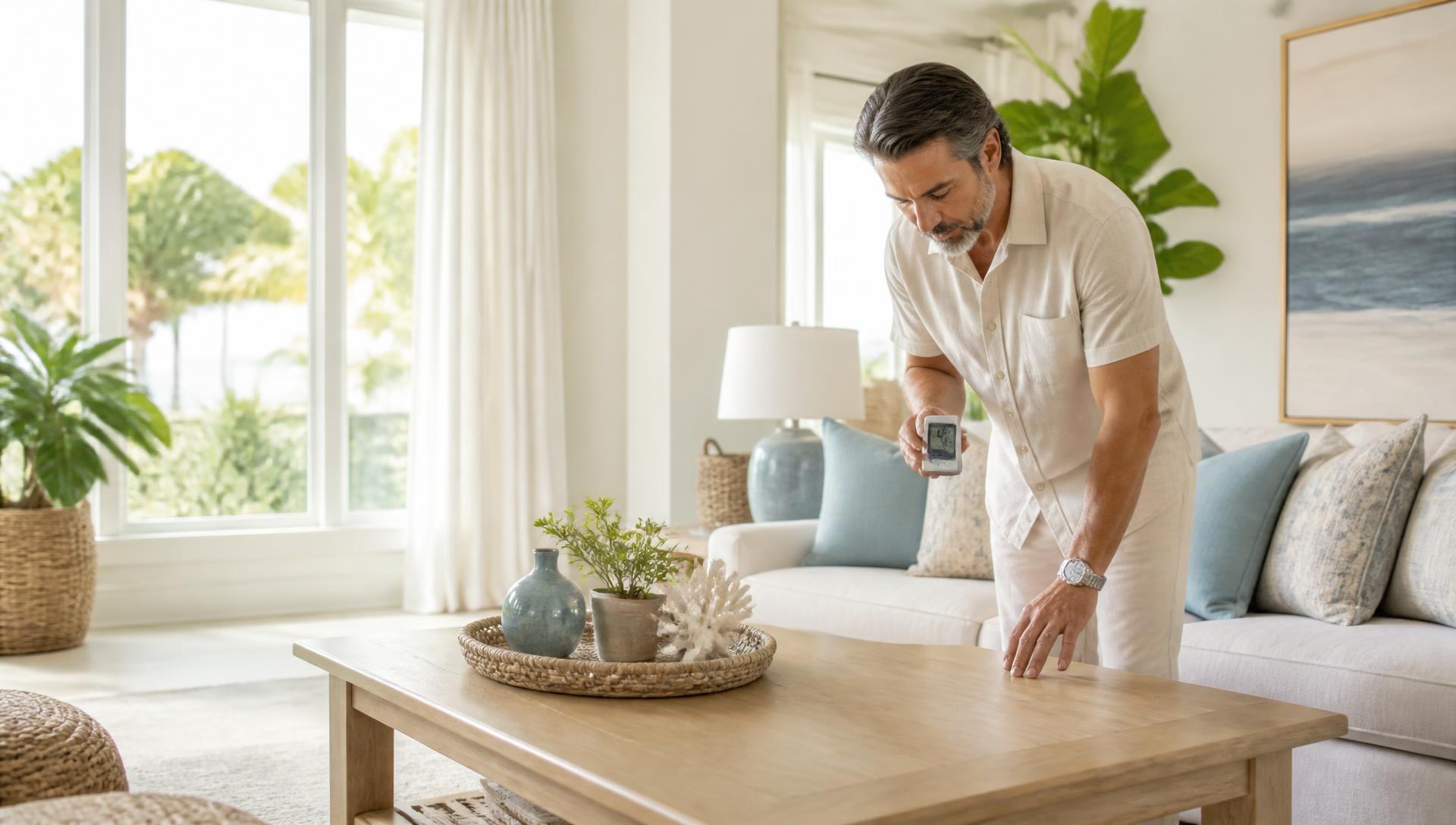
Humidity almost never ruins furniture in one dramatic moment. It changes it quietly, over seasons. Here is how moisture actually works on wood, leather, fabric, foam and metal — and the simple habits that keep good furniture performing for decades.
Yes — humidity can ruin furniture, but almost never the way homeowners expect. It rarely destroys a piece in a single dramatic event. Instead, sustained indoor humidity above roughly 55 percent slowly changes the moisture content inside wood, leather, foam, and fabric until joints loosen, drawers stick, finishes cloud, cushions feel heavy, and leather stiffens. Most humidity damage is cumulative, invisible for months, and completely preventable once you understand that furniture doesn't just sit in your home — it lives inside your home's climate.
That single idea is the reason this article exists.
I have spent years walking through Florida homes with people who are frustrated with furniture that "isn't holding up." Almost every time, the furniture is fine. The environment around it changed, and nobody told the homeowner that the environment was part of the purchase.
This guide is here to fix that. Not with fear, and not with a list of products. Just with a clear explanation of what is actually happening inside your home, and what small things genuinely make a difference.
Furniture Doesn't Sit in Your Home. It Lives in Your Home's Climate.
Here is the mental shift that changes everything.
We think of furniture as an object we place into a room. In reality, furniture is a material system that is constantly exchanging moisture with the air around it. Wood breathes. Leather breathes. Cotton, linen, wool, and foam all breathe. They absorb moisture when the air is humid and release it when the air is dry.
That exchange never stops. Not at night. Not while you're on vacation. Not while the air conditioning is running.
So the question is not really "can humidity ruin furniture." The better question is: what climate has my furniture been living in for the past three years?
Furniture in a home held at 48 percent humidity ages very differently from identical furniture in a home that swings between 45 percent in February and 68 percent in August. Same house. Same brand. Completely different outcome after five years.
The simple definition worth remembering
Humidity damage to furniture is the cumulative structural and cosmetic change caused by repeated moisture absorption and release in the materials a piece is made from. It is driven by the *range* and *duration* of indoor humidity, not by any single humid day.
Why Humidity Changes Furniture Slowly Instead of All at Once
Water damage is an event. Humidity is a process.
When a glass spills on a table, the wood absorbs a lot of moisture in one place, very quickly, and you see a ring within hours. When indoor air sits at 65 percent for a summer, every square inch of that same table absorbs a tiny amount of moisture, evenly, over weeks.
Even absorption doesn't look like damage. It looks like nothing.
The damage shows up in the *transition*. When the air dries out — a cool dry front in January, a new AC system that finally dehumidifies properly, a season away with the thermostat set differently — the wood releases that moisture and shrinks. Then it swells again in June.
Each cycle is harmless. Two hundred cycles are not.
That is why humidity problems in furniture almost always appear in year three, four, or five rather than year one. The material is not failing. It is fatiguing.
What that fatigue actually looks like
- Glue lines in joints that slowly lose their grip after repeated expansion and contraction
- Drawer boxes that fit perfectly in winter and bind in August
- Veneer that lifts at the edges where the substrate moved and the surface layer didn't
- Table tops that develop a barely visible cup or crown you notice only when you set down a straight object
- Chair rails and stretchers that creak because the joint moved a fraction of a millimeter
None of that is a defect. All of it is climate.
Can Humidity Damage Furniture Without Causing Mold?
Absolutely — and this is one of the most common misunderstandings I encounter.
Mold requires sustained surface moisture and typically shows up above 60 to 65 percent relative humidity in still air. But wood movement, joint fatigue, leather stiffening, and foam performance changes begin long before mold has any interest in your home.
You can have a spotless, odor-free, mold-free house and still be putting your furniture through mild seasonal stress every single year.
So if you have ever thought, "there's no mold, so humidity isn't an issue here" — that's the wrong test. Mold is a *late* indicator. Furniture movement is an *early* one.
Why Expensive Furniture Is Often More Sensitive Than Inexpensive Furniture
This surprises almost everyone, and it's worth understanding before you spend real money.
Better furniture is usually made from more natural materials: solid hardwood, real veneers over solid substrates, full-grain leather, natural-fiber upholstery, hand-fitted joinery. Natural materials are hygroscopic — they respond to the air.
Inexpensive furniture is often made from materials that are *less* responsive: particleboard with sealed laminate surfaces, bonded or heavily coated faux leather, synthetic fabrics, and mechanical fasteners instead of glued joinery.
So in a humid, poorly managed environment:
- A $400 laminate dresser may show almost no seasonal movement — until moisture eventually reaches an unsealed edge and the particleboard swells permanently and cannot recover.
- A $4,000 solid walnut dresser will move measurably every season, telegraphing changes through its drawers and panels — but it can be adjusted, refinished, and restored, and it will outlive the laminate piece by decades.
The premium piece is more sensitive *and* more repairable. The inexpensive piece is less sensitive *and* less recoverable.
That's not a reason to buy cheaper furniture. It's a reason to understand that when you invest in natural materials, you are also taking on responsibility for the climate they live in. Good furniture asks something of you. That's part of the deal.
How Different Materials React to Humidity
Every material in your home has its own relationship with moisture. Knowing which is which tells you where to look first.
Solid wood
The most responsive material in your home. Wood expands across the grain, not along it, which is why a 40-inch tabletop can gain and lose meaningful width across a year while its length barely changes. Well-built furniture is designed to allow this movement. Poorly built furniture fights it, and the joint loses.
Engineered wood and veneers
A quality veneer over a stable core is often *more* dimensionally stable than solid wood — that's the whole engineering point. The vulnerability is different: unsealed edges, undersides, and backs. Moisture enters where the finish stops. That's why the back panel against the exterior wall is where trouble starts, not the polished front.
Leather
Leather is a natural fiber structure that depends on its own internal oils to stay supple. High humidity swells the fibers and can leave leather feeling slightly tacky or cool to the touch. The real damage arrives on the other side of the cycle: as humidity drops, leather releases moisture and, if its oils have been depleted by sun and heat, the fibers stiffen. Stiff fibers crease. Creases eventually crack.
Performance fabric
Solution-dyed synthetics handle humidity extremely well at the fiber level — they simply don't absorb much. The catch is what's *underneath*. A performance-fabric cushion wrapped around foam and down in a humid room can still hold moisture in the fill, which is why a sofa can smell faintly closed-up while the fabric itself looks perfect.
Cotton and linen
Highly absorbent and highly honest. They tell you about your indoor air before anything else does. Linen slipcovers that feel slightly damp to the touch in the morning, cotton cushions that seem to lose their crispness — that's your humidity speaking.
Velvet
Velvet's beauty comes from its pile standing upright. Humidity relaxes the pile and makes crushing and pressure marks more likely and more persistent. If your velvet chair has developed a permanent "sitting shadow," humidity is usually part of the story.
Foam
Foam doesn't rot from humidity, but it does behave differently in it. Humid air is warmer-feeling and moves less freely through cushion cores, which is why the same sofa or mattress feels denser and warmer in August. Homeowners read that as "the cushions are breaking down." Often they're not — they're just working in different air.
Metal and glass
Metal is where humidity becomes visible fastest, especially near the coast. Salt-laden humid air corrodes fasteners, hinges, drawer slides, and bed frame hardware long before anything happens to the wood they hold together. Glass doesn't absorb anything, but it does condense — and condensation on a glass top runs off onto the wood frame underneath.
Why Furniture Squeaks and Doors Stop Closing in Humid Weather
These two complaints arrive together in Florida every summer, and they have the same explanation.
Wood swelling reduces clearance. A drawer that had 1/16 inch of space in March has less in August. A cabinet door that closed flush now catches on the frame. A dining chair joint that was snug now has an extra fraction of movement because the glue line was stressed in a previous cycle — and it announces itself as a squeak.
Notice the pattern: swelling causes sticking, and past swelling causes looseness. Same cause, opposite symptoms, different timelines.
The instinct is to sand the drawer or plane the door. Resist that for one season. If you remove material during the humid months, you will have a loose, rattling drawer in January. Fix the climate first, then adjust the furniture to its new normal.
Why Homeowners Blame the Furniture When the Home Is Responsible
I want to say this gently, because I have watched it cost people a lot of money and a lot of goodwill.
When furniture behaves strangely, the natural conclusion is that the furniture is defective. So the homeowner calls the retailer, requests a service visit, or replaces the piece entirely. Then the replacement does exactly the same thing eighteen months later, because it moved into the same climate.
A few honest signals that the environment — not the product — is the driver:
- Multiple unrelated pieces, from different brands, developing similar issues
- Problems that appear seasonally and improve on their own
- Issues concentrated in one room, one wall, or one closet rather than throughout the house
- A problem that started after a change in HVAC habits, an extended absence, or a new thermostat schedule
None of this means furniture is never defective. It sometimes is. But in a Florida home, the environment deserves to be investigated *first*, not last.
Can Humidity Damage Furniture Inside an Air-Conditioned Home?
Yes, and this is the single most important section in this article.
Air conditioning removes humidity as a side effect of cooling, not as its primary job. When the AC runs, the coil gets cold, moisture condenses on it, and drains away. When the AC is not running, no moisture is removed.
That leads to several situations where an air-conditioned Florida home still runs humid:
- An oversized system. It cools the air to the setpoint quickly, shuts off, and never runs long enough to pull real moisture out. The house feels cold and clammy at the same time.
- Mild weather. In October and March the house doesn't need much cooling, so the system barely runs — while the outdoor air is still holding plenty of moisture.
- Setting it high while away. A thermostat at 82 degrees means very little runtime. Very little runtime means very little dehumidification, for weeks.
- A dirty filter or a clogged drain line. Reduced airflow and standing water in the pan both undermine moisture removal.
- Closed-off rooms. Guest rooms with the door shut and the vent closed become their own small climate, regardless of what the rest of the house is doing.
The practical takeaway: a cool house is not automatically a dry house. Temperature and humidity are two different measurements, and your thermostat is generally only managing one of them.
Do Indoor Plants Affect Indoor Humidity?
A little, and less than the internet suggests.
A handful of houseplants will not meaningfully change the humidity of a whole home. What plants *can* do is create localized moisture: a cluster of plants on a wood console, a large pot sitting directly on a hardwood floor, a plant tray that gets watered generously every week.
The damage there isn't about humidity. It's about a slow, repeated water source touching a wood surface.
Keep plants. Just put something waterproof under them, keep large pots off unsealed wood, and don't crowd a dozen of them onto one antique sideboard.
How to Measure What's Actually Happening
Everything above becomes actionable the moment you stop guessing.
The target range for most Florida homes is 45 to 55 percent relative humidity. Below 40 percent and wood starts giving up more moisture than it should. Above 55 percent and you're accumulating stress. Above 60 percent for extended periods and you're in the zone where mold becomes a genuine consideration.
You cannot feel the difference between 52 percent and 61 percent. Your furniture can.
Place a monitor in the rooms that matter most — a primary bedroom, a main living space, and one closed-off room like a guest room or a closet. Watch it for two weeks. The pattern will teach you more about your home than any inspection.
A small monitor is one of the least expensive and most useful tools a Florida homeowner can own. It turns an invisible variable into a number you can act on. Two or three of them, placed in different rooms, will show you something a single reading never will: how differently the rooms in one house actually behave.
Invisible Warning Signs Most Homeowners Overlook
By the time furniture looks wrong, it has been telling you for a while. Here is what to notice.
- A drawer that pulls easily in winter and needs a tug in summer
- A faint musty note when you first open a closet or a guest room door
- Cushions that feel heavier or slower to rebound than they did a year ago
- A leather seat that feels slightly cool or tacky rather than warm and dry
- Cabinet doors that no longer line up evenly with each other
- A dining table that feels very slightly domed in the center
- Hardware — screws, hinges, bed bolts — needing tightening more than once a year
- A sofa that has started to squeak only in certain weather
- Books, paper, or artwork with a soft wave in them
- A room that feels warmer than the thermostat says it is
That last one is worth underlining. Humidity changes comfort long before it changes appearance. Air at 74 degrees and 60 percent humidity feels less comfortable than air at 76 degrees and 48 percent. Homeowners respond by lowering the thermostat, which raises the energy bill and still doesn't fix the actual problem.
Common Myths About Humidity and Furniture
"If it's not visibly damaged, humidity isn't affecting it." Movement precedes damage by years. The absence of visible damage means you're early, not safe.
"Running the AC colder solves humidity." Colder setpoints can actually *shorten* runtime cycles in mild weather. Runtime removes moisture, not low temperatures.
"Only antiques and solid wood are at risk." Leather, foam, upholstery fill, and metal hardware are all affected. Some of the fastest failures happen in drawer slides and fasteners near the coast.
"A dehumidifier in one room protects the house." It protects that room. Air moves, and so does moisture. Whole-home humidity is an HVAC conversation.
"Expensive furniture is built to handle anything." Better construction handles movement more gracefully. It doesn't eliminate movement — and the materials involved are often more responsive, not less.
"Turning the AC off while away saves money without consequence." It saves cooling cost and transfers the expense to your furniture, closets, and indoor air. Set it up, don't shut it off.
"Humidity damage is permanent." Often it isn't. Which brings us to the most encouraging part of this whole subject.
Correcting Humidity Can Actually Improve Furniture Performance
This is the part I wish more homeowners knew, because it replaces anxiety with agency.
Materials respond to *current* conditions, not just past ones. When you bring a home from 63 percent down to a steady 50 percent, real things happen over the following weeks and months:
- Drawers that were binding begin sliding freely again as the wood releases moisture
- Cushions feel more responsive because the fill is drying and breathing normally
- Leather that felt tacky returns to a dry, warm hand
- Musty notes in closets fade without any cleaning at all
- Doors that were catching start closing cleanly
- Rooms feel cooler at the same thermostat setting
Not everything reverses. Delaminated veneer, cracked leather, corroded hardware, and swollen particleboard are permanent. But a surprising amount of what homeowners assume is damage is actually just a material sitting in the wrong conditions — and it recovers.
I have watched people prepare to replace a sofa and then decide not to, eight weeks after fixing their humidity.
Why Florida Homeowners Face a Different Challenge Than Dry Climates
In Arizona or Colorado, the furniture conversation is about *dryness* — wood losing moisture, joints shrinking, leather drying out, gaps opening in tabletops. Homeowners there add moisture.
In Florida, the challenge is different in three specific ways.
1. The high side of the range is the default. Outdoor humidity is often 70 to 90 percent. Every door opening, every shower, every load of laundry, every uncovered pot adds to an indoor load that is already fighting an outdoor one.
2. The swings are wide and seasonal. A dry January and a saturated August put furniture through a much larger annual cycle than most of the country experiences.
3. Salt air adds a second variable. Within a few miles of the coast, humid air carries salt, and salt accelerates corrosion on every piece of metal in your furniture — slides, hinges, bolts, bed frames, and outdoor pieces most of all.
That combination is why the same sofa performs differently in Naples than in Nashville. It's not the furniture. It's the climate it moved into.
Common Mistakes Homeowners Make Without Realizing It
- Pushing large case goods flat against exterior walls. The unfinished back panel meets the coolest, dampest surface in the room. Leave an inch or two.
- Shutting off the AC during long absences. The single most expensive habit in Florida homeownership.
- Closing vents and doors in unused rooms. You are building a private humid microclimate in a room full of furniture.
- Storing furniture, mattresses, or upholstered pieces in the garage. Unconditioned, humid, and often the most damaging place in the property.
- Over-conditioning leather to "protect" it. Excess conditioner attracts dust and can leave a film. Sparing and occasional beats generous and frequent.
- Sanding or planing sticking drawers in August. You are fitting the piece to its most swollen state.
- Using a damp cloth on wood and walking away. Wipe with the grain and dry immediately.
- Placing furniture in direct sun through large windows. Sun and humidity together are far harsher than either alone, especially on leather.
- Assuming a new AC system fixed everything. Verify it with a monitor. Some new systems are oversized and dehumidify worse than the old one.
- Ignoring the smell. Your nose detects the change before any instrument you own.
Practical Habits That Actually Protect Furniture
None of these require money or a project. They require noticing.
Weekly
- Glance at your humidity monitor. Ten seconds. That's the habit.
- Run bath fans for 20 minutes *after* showers, not just during.
- Crack closet doors in rooms you don't use daily.
Monthly
- Check your AC filter. Airflow is dehumidification.
- Run your hand behind large furniture against exterior walls. It should feel dry and room-temperature.
- Open guest room doors and let the room join the rest of the house for a day.
Seasonally
- Walk the house with humidity in mind. Closets, guest rooms, pantry, garage-adjacent walls.
- Rotate and flip cushions so both sides get airflow.
- Check and tighten furniture hardware — especially anything metal within a few miles of the coast.
- Clean the AC drain line.
Twice a year
- Condition leather. Lightly.
- Inspect table tops with a straightedge for cupping.
- Look at veneer edges, drawer bottoms, and case backs — the unfinished places.
Caring for Leather in a Humid Climate
Leather deserves its own moment, because it is the material homeowners get wrong most often.
Humid air keeps leather's surface feeling supple, which creates a false sense of security. Meanwhile, heat and sunlight are steadily depleting the oils inside the hide. When the dry season arrives and the leather releases its absorbed moisture, there is less oil left to keep the fibers flexible. That is the moment stiffness and creasing appear — and homeowners blame the dry season, when the real damage happened during the humid one.
What genuinely helps:
- Keep leather out of direct sun through unshaded windows
- Give it airflow; don't press it against exterior walls or into a closed room
- Dust it more often than you think, since humid air makes dust cling
- Condition lightly, roughly twice a year, in thin even coats
- Wipe spills immediately and never let water sit on a seam
A quality conditioner used sparingly twice a year does more for leather in Florida than any amount of intensive treatment once it has already stiffened. The goal is maintenance, not rescue.
The Printable Homeowner Humidity Checklist
Print this. Put it inside a cabinet door.
Know your numbers
- [ ] Target indoor humidity: 45–55 percent
- [ ] Monitor in the main living area
- [ ] Monitor in the primary bedroom
- [ ] Monitor in one closed-off room or closet
Air conditioning
- [ ] Filter changed on schedule
- [ ] Drain line clear
- [ ] Annual service completed
- [ ] AC left running during absences — set high, never off
- [ ] Verified the system actually reduces humidity, not just temperature
Placement
- [ ] One to two inches of clearance behind large pieces on exterior walls
- [ ] No leather or fine wood in direct unshaded sunlight
- [ ] Nothing valuable stored in the garage
- [ ] Waterproof saucers under all indoor plants
Airflow
- [ ] Interior doors open in unused rooms
- [ ] Closet doors cracked
- [ ] Ceiling fans used in occupied rooms
- [ ] Bath fans run after showers
Seasonal inspection
- [ ] Drawers and doors operating smoothly
- [ ] Hardware tight
- [ ] Cushions rotated
- [ ] Leather conditioned (twice a year)
- [ ] Table tops checked for cupping
- [ ] No musty odor in any closed space
How Long Does Humidity Damage Actually Take?
A realistic timeline, based on what I see in homes:
- Weeks: comfort changes, cushion feel, faint odor in closed spaces, leather surface feel
- Months: drawers and doors sticking seasonally, minor hardware corrosion near the coast
- One to three years: joint loosening, creaks, veneer edges beginning to lift, persistent musty spaces
- Three to seven years: measurable tabletop cupping, cracked leather, failing glue joints, permanently swollen particleboard
The encouraging read on that timeline: you almost always have years of warning. The discouraging read: nearly all of that warning gets ignored, because none of it feels urgent in the moment.
You May Also Find These Homeowner Guides Helpful
If this topic is relevant to your home, a few related questions usually come next. I've written about them separately.
- Can Leather Furniture Crack in Florida? — a closer look at why leather behaves differently here, and what actually prevents cracking.
- What Humidity Should My Home Be? — the target ranges by room and season, and what to do when your home won't hold them.
- How Often Should You Change Your AC Filter? — because filter habits and humidity control are the same conversation.
- How Do You Protect Furniture During a Move? — moving trucks and storage units are the harshest humidity environments your furniture will ever face.
Final Thought
Somewhere along the way, we started treating furniture care as a product problem. Which polish. Which conditioner. Which brand holds up.
But furniture is not really an isolated object you maintain. It is a set of natural materials living in the environment you create. Take care of the environment and the furniture largely takes care of itself. Ignore the environment and no amount of product will compensate.
The homeowners whose furniture still looks beautiful after fifteen Florida years are almost never the ones with the most elaborate care routines. They're the ones who understand their home as a system — air, moisture, light, and airflow — and who keep that system in a reasonable range without thinking hard about it.
That understanding travels well. It applies to your floors, your cabinetry, your artwork, your instruments, your books, and your own comfort at night. Learning to read your home's climate is one of those skills that quietly improves everything else.
Your furniture was never the fragile part. It's just the part that tells you first.
Thought-Provoking Question
If your home could describe the climate it has been giving your furniture for the past five years, what do you think it would say?
Need a Second Opinion?
Whether you're relocating, downsizing, preparing for retirement, welcoming a new family member, furnishing a new home, planning a room, or simply trying to make smarter home decisions, I'm here to help.
Schedule a complimentary consultation with Maria Banou.
Recommended Next Resource
Your Resource Journey — the next step homeowners take after a resource like this one.
- Fusion Compare™Compare your options side by sideSee the real trade-offs between the choices in front of you.Estimated reading time: 7 min comparisonWhy this is recommendedComparing your options side by side is what turns background reading into a shortlist.Continue
- Decision GuideDecide with a complete guideEverything that matters for this decision, in the order it matters.Estimated reading time: 8 min readWhy this is recommendedYou've done the background — this guide brings the whole decision together in one place.Continue
- AssessmentCheck where you actually standA short evaluation that turns general guidance into your situation.Estimated reading time: 4 min assessmentWhy this is recommendedA short evaluation applies everything you've read to your own home rather than the general case.Continue
Furniture Collection
Choosing pieces that fit the room, the household and the years ahead.
Keep going
Helpful next steps
Complimentary, no-pressure resources that follow the decision you're working through.
Florida Homeowner Hub
Florida-specific homeowner considerations, season by season.
Learn moreMy Home — Care & Maintenance
Track what your home needs and when it was last done.
Learn moreHomeowner Planning Tools
Complimentary calculators and planners for real home decisions.
Learn moreAsk Maria
Talk through the decision you're actually making and get practical guidance.
Learn moreWas this guide helpful?
If you have an idea or suggestion that could help more homeowners, we'd love to hear it.
Talk it through
Planning your next home decision?
Whether you're evaluating a home, furnishing a room, improving sleep, relocating, downsizing, or simply trying to make smarter home decisions, Total Home Fusion provides practical guidance before you invest your time and money.
About the author
About Maria Banou
Maria Banou is the founder of Total Home Fusion, a homeowner decision platform focused on helping people think through the practical choices surrounding where they live, what they buy for their homes, and how their homes support everyday life. Her work includes furniture selection, sleep comfort, room planning, relocation, downsizing, Florida homeowner considerations, aging-in-place planning, and practical home decision guidance.
- Furniture Selection
- Sleep Comfort
- Room Planning
- Downsizing & Relocation
- Florida Homeowner Guidance
- Aging in Place Planning
- Home Decision Guidance
Connected guidance
More Homeowner Insights
Related resources from the Fusion Library™, chosen to continue the same decision.

Can Leather Furniture Crack in Florida? Here’s What Homeowners Should Know
Humidity gets the blame, but it’s usually not the culprit. A practical look at how Florida’s heat, air conditioning, sunlight, and daily habits shape leather furniture over time — and the simple care rhythm that helps it last.
Knowledge GuideRead Article
The Florida Homeowner's Comfort Guide: Creating a Home That Feels Better Every Day
Many homeowners assume comfort comes from bigger homes, newer furniture, or expensive upgrades. In reality, comfort is often influenced by smaller factors such as room layout, humidity, sleep quality, lighting, airflow, and how well a home supports your daily lifestyle. This Florida Homeowner's Comfort Guide explores practical ways to create a more comfortable home while helping you make smarter decisions that improve everyday living.
Knowledge GuideRead Article
The 7 Things Every Florida Homeowner Should Know Before They Become Expensive Problems
Most expensive home problems don’t happen overnight. Learn seven areas Florida homeowners should pay attention to before small issues become costly surprises.
Knowledge GuideRead ArticleQuick answers
Frequently asked questions
Can humidity ruin furniture permanently, or is the damage reversible?
It depends on the stage. Early effects — sticking drawers, heavy-feeling cushions, tacky leather, musty odors, doors that catch — are usually reversible once indoor humidity returns to a steady 45 to 55 percent, often within weeks. What does not reverse is structural or material failure: lifted veneer, cracked leather, corroded hardware, failed glue joints, and swollen particleboard. That is why noticing early matters so much. The same conditions that cause temporary changes will eventually cause permanent ones if they persist across several years of seasonal cycling.
What is the ideal indoor humidity level to protect furniture?
Aim for 45 to 55 percent relative humidity year-round. Below 40 percent, wood releases too much moisture and joints can shrink and loosen. Above 55 percent, materials begin absorbing more moisture than they should, and above 60 percent for extended periods you enter the range where mold becomes a genuine concern. The specific number matters less than the stability. A home that holds a steady 52 percent is far kinder to furniture than one that swings between 42 and 68 percent across the seasons.
Why does my furniture stick and squeak more in summer than in winter?
Wood expands when it absorbs moisture from humid summer air, reducing the clearance around drawers and doors so they bind. Squeaking comes from the opposite side of the same process: repeated expansion and contraction gradually stresses glue joints, and once a joint has a fraction of a millimeter of movement, it announces itself as a creak. Resist sanding or planing during humid months — you will remove material at the piece's most swollen point and end up with a loose, rattling fit once the dry season returns.
Can furniture be damaged by humidity even with the air conditioning running?
Yes. Air conditioning removes moisture only while it is actively running, because dehumidification is a side effect of cooling rather than its purpose. An oversized system satisfies the thermostat quickly and shuts off before removing much moisture. Mild spring and fall weather means little runtime while outdoor air is still damp. Setting the thermostat high during an absence has the same effect. A cool house is not automatically a dry house, which is why a humidity monitor tells you something your thermostat cannot.
How can I tell if humidity is already affecting my furniture?
Look for seasonal patterns rather than obvious damage. Drawers that pull easily in January and stick in August, cabinet doors that no longer align, cushions that feel heavier or slower to rebound, leather that feels cool or slightly tacky, hardware needing tightening more than once a year, and a faint musty note in closets or guest rooms are all early indicators. Comfort changes first, appearance changes last. If multiple unrelated pieces from different brands show similar behavior, the environment is almost certainly the cause.