
Can Sunlight Damage Furniture? What Every Homeowner Should Know
Reviewed & curated by Maria BanouHome Life AdvisorPublished July 29, 2026Updated September 4, 202624 minute read
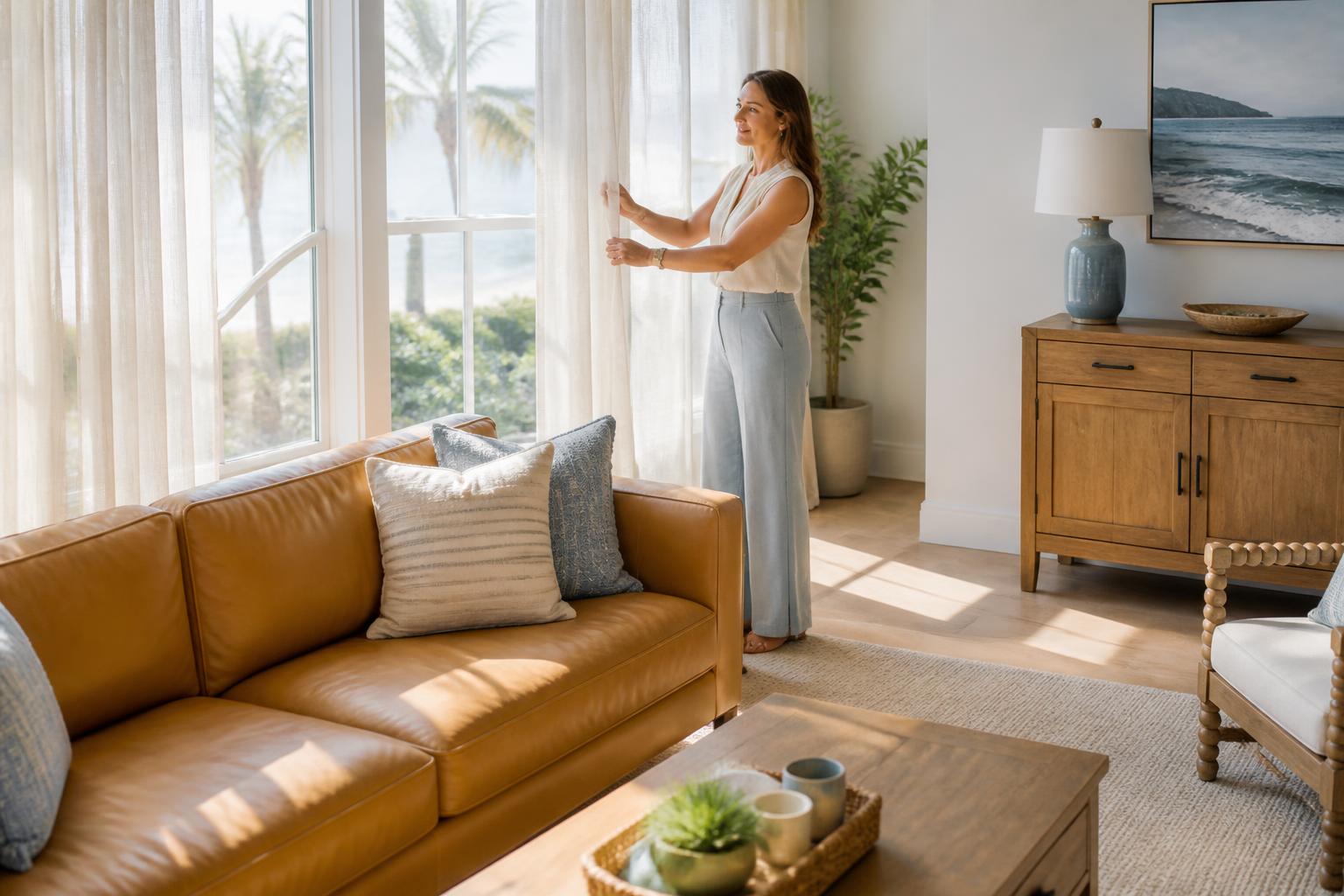
Sunlight is one of the things homeowners love most about a house and think about least when they arrange it. The light that makes a room feel open and alive is also, over years, quietly rearranging the color and condition of everything it touches. This guide explains how ultraviolet light and heat actually affect furniture, why two identical pieces in the same room can age differently, which materials are more sensitive than others, and what you can realistically do about it — without living behind closed blinds.
Most homeowners discover sun damage by accident.
Someone moves a lamp, slides a chair a few inches to vacuum behind it, or lifts a throw that has been draped over the same sofa arm for two years — and there it is. A patch of color that does not match the rest of the piece. Not damage exactly. Not a stain. Just a quiet reminder that light has been doing something all along.
I have spent years helping homeowners choose furniture, and sunlight is one of the least discussed factors in how a room ages. People ask thoughtful questions about frames, fabrics, cushions, and warranties. Almost nobody asks which direction the windows face.
So let us talk about it honestly. Sunlight is not the enemy of furniture. But it is a constant, patient force, and understanding how it works lets you make a handful of small decisions that add years of good appearance to the furniture you already own.
Can Sunlight Really Damage Furniture?
Yes — though "damage" is a stronger word than most situations deserve.
What sunlight does to furniture happens in slow motion. It rarely announces itself. A sofa does not fade over a weekend of open blinds. It fades across seasons, and because the change is gradual and happens to the whole visible surface at once, your eye adjusts along with it. That is exactly why the discovery moment usually involves moving something and seeing the original color underneath.
There are really three separate effects at work, and homeowners tend to blend them into one:
Color change. Dyes and pigments break down under ultraviolet light. Some shift, some lighten, and a few actually darken. This is the most common and most visible outcome.
Surface change. Finishes, coatings, and topcoats can dull, yellow, chalk, or become brittle with long exposure. This affects wood pieces and some leathers more than woven fabrics.
Material change. Fibers and hides can lose flexibility and strength over years of exposure combined with heat and dryness. This is the least common in normal homes but the most consequential when it happens.
The first is cosmetic. The third is structural. Most homeowners are dealing with the first and quietly worrying about the third.
Takeaway: Sunlight almost never ruins furniture suddenly. It changes it gradually, and the earlier you notice the pattern, the more choices you have.
Why UV Light Affects Furniture — and Why Heat Is a Separate Problem
This is the distinction that clears up most confusion, and it is worth slowing down for.
Ultraviolet light is the invisible portion of sunlight that carries enough energy to break chemical bonds. It is what fades dyes, degrades finishes, and, over long periods, weakens some fibers. UV does its work whether or not the room feels warm. A cool, bright north-facing room still delivers UV exposure.
Heat and infrared are what you feel. A sun patch on a leather seat can make that spot noticeably warmer than the cushion beside it. Heat does not fade color, but it accelerates drying, encourages materials to expand and contract, and can soften adhesives over time.
Visible light contributes to fading too. This surprises people. Even light that carries no measurable UV can shift certain dyes, which is why UV-blocking window film reduces fading rather than eliminating it.
Here is the practical consequence. Homeowners often assume that if a spot does not feel hot, nothing is happening there. A bright window that never feels warm can still be the fading window in the house. And a west window that turns the room into an oven in July is delivering both problems at once — the UV that changes color and the heat that dries materials out.
Understanding which one you are dealing with points you toward different solutions. UV calls for filtering the light. Heat calls for blocking or diffusing it, and for paying attention to how dry the air in that room gets.
Takeaway: Ask two questions about any sunny spot — how bright is it, and how hot does it get? The answers lead to different fixes.
How Wood Responds to Sunlight
Wood is the material homeowners most often assume is immune, and it is arguably the most visibly reactive of all.
Real wood contains natural compounds that change color under light exposure. Some species lighten. Others deepen or take on a warmer, richer tone. Cherry famously darkens. Many light woods, like maple and oak, warm up slightly. Walnut can lose depth and shift lighter. None of this is a defect — it is the wood doing what wood does — but it becomes a problem when it happens unevenly.
That is the real story with wood and sunlight: uneven exposure, not exposure itself.
A dining table with a runner down the middle for three years will develop a stripe. A console table with a lamp base, a bowl, and a stack of books in fixed positions will develop shadows of those objects. A cabinet door that catches afternoon light while the adjacent door sits in shade will drift out of match. The wood did not fail. It simply aged at two different speeds in two places.
The finish on top matters as much as the wood beneath it. Clear coats can yellow, lose gloss, or develop a chalky haze with sustained exposure. Some finishes crack or check when heat cycles the surface repeatedly — warm afternoon, cool evening, repeat for a few hundred days.
Veneers and laminates deserve their own note. A veneer is a thin layer of real wood over a substrate, so it fades like real wood but has less material to work with if refinishing is ever considered. Laminates are printed surfaces with a protective layer — they resist moisture well, but printed color can fade under long UV exposure and there is no way to refinish a laminate back to its original tone.
Takeaway: With wood, the goal is even exposure. Rotate what sits on top of a surface, and be especially deliberate about tables and cabinets that get direct sun on only part of their face.
What Happens to Leather Over Time
Leather is where sunlight, heat, and dryness meet, which is why it draws so much homeowner attention.
Sun exposure affects leather on two levels. The surface color and topcoat can fade, sometimes noticeably, particularly on richer dyed tones. And the hide itself, over long periods of heat and low humidity, can lose some of its natural suppleness — the quality that lets it flex thousands of times without complaint.
The pattern I have seen most often in Florida homes is simple: a leather sofa positioned so one end sits in afternoon light for years. The seat cushion and arm on that end lighten first. Then the surface starts to feel slightly different underhand — drier, a little less giving — while the shaded end still feels the way it did on delivery day.
This is a good example of why sunlight is rarely the whole story. Leather condition depends heavily on the humidity of the room around it, and Florida homes are air conditioned nearly year round, which means indoor air can actually be drier than people expect. Sun exposure plus a consistently dry room is a more meaningful combination than sun alone.
I have written a full guide on this specific question — Can Leather Furniture Crack in Florida? — which covers conditioning routines and what indoor climate really does to leather. Rather than repeat that here, I will keep this section to the sunlight-specific part: direct, prolonged sun is one of the few things that will visibly age leather faster than ordinary use.
Takeaway: For leather in a sunny room, manage both variables — reduce direct exposure, and know what the room's humidity actually is rather than guessing.
Fabric, Upholstery, and Color Fading
Fabric fading is the most familiar form of sun damage and the one with the widest range of outcomes, because upholstery covers an enormous variety of fibers and dye methods.
A few patterns hold up reliably:
Darker and more saturated colors show change more. A deep navy, a rich rust, a charcoal — these have more pigment to lose, and the loss reads clearly against unfaded areas. Light neutrals fade too, but the shift is harder to see.
Natural fibers generally react more than synthetics. Cotton, linen, and silk are more sensitive to UV than most performance synthetics. Silk is the most delicate of the common upholstery materials.
Performance fabrics resist, but do not ignore, UV. Solution-dyed fabrics — where color is built into the fiber rather than applied to the surface — hold color far better than surface-dyed alternatives. This is genuinely the biggest fabric-level difference you can choose at purchase time.
Rugs fade like upholstery, and show it more. A rug sits flat under a window's light path, holds still for years, and often has patterns that make partial fading obvious. Rugs are frequently the first thing in a room to reveal the sun's daily route.
There is also a fading effect people rarely anticipate: fading changes how colors relate to each other. A sofa and its accent chairs may have been chosen as a coordinated set. If the sofa fades and the chairs do not, the room reads as slightly off long before anyone identifies why.
Takeaway: If a room gets serious sun, fiber and dye method matter more than color choice — and rugs deserve the same attention as seating.
Florida Homes and Year-Round Sun Exposure
Florida changes the math, and it does so in a way that is easy to underestimate.
In much of the country, intense sun exposure is seasonal. Furniture gets a break. In Florida, the sun is strong across all twelve months, the days are long, and homes are designed to invite light in — large sliders, wide windows, screened lanais, open plans that let light travel deep into a room.
Add the way people actually live here. Blinds stay open because the view is part of why the house was chosen. Rooms sit unoccupied during long stretches of the day while sun moves across them. Seasonal residents leave homes closed up for months, and furniture holds the same position under the same light the entire time.
None of this means Florida furniture is doomed. I have seen ten-year-old pieces in bright Florida homes that still look excellent, because the homeowner understood the room and made a few simple adjustments early. I have also seen three-year-old pieces with obvious fade lines, in homes where nobody thought about it until the pattern was permanent.
The Florida-specific point worth remembering is about *consistency*. It is not one blazing August afternoon that changes a sofa. It is the same light, hitting the same place, most days, for years.
Humidity interacts with all of this, and I have covered that fully in Can Humidity Ruin Furniture?. The short version for this article: Florida furniture is managing sun exposure and moisture swings at the same time, and the two are worth thinking about together rather than separately.
Takeaway: In Florida, the risk factor is not intensity — it is repetition across a long, bright year.
Which Rooms and Windows Receive the Most UV Exposure?
This is the single most useful thing a homeowner can learn about their own house, and almost nobody is taught it.
South-facing windows deliver the most total light across the day. The sun arcs across the southern sky, so these windows receive steady exposure for many hours. This is the highest cumulative UV load in most homes.
West-facing windows deliver the most intense afternoon light and the most heat. The sun sits low in the sky, so light comes in at a shallow angle and travels deep into the room — reaching furniture that a midday sun never touches. West rooms are where the "hot spot on the sofa" problem lives.
East-facing windows get bright morning sun, also at a low angle, but for fewer hours and with less accumulated heat. Meaningful, but generally the gentlest of the direct exposures.
North-facing windows receive indirect light. Least fading risk by a wide margin — though "least" is not "none," particularly with large glass areas.
Then there is the part that catches everyone off guard: the sun's angle changes with the season. In winter, the sun sits lower in the sky, which means light reaches farther into your rooms. A sofa that sits comfortably in shade all summer may spend two hours a day in direct winter light. Homeowners who audit their sunlight in July genuinely miss half the picture.
The most reliable way to know your home is to watch it. Pick a bright day, and check the same rooms at mid-morning, early afternoon, and late afternoon. Note where the light actually lands. Then repeat it once in the opposite season. You will learn more in those six observations than any general rule can tell you.
Takeaway: Learn your home's orientation and watch the light in two different seasons. West and south deserve the most attention.
Practical Ways to Reduce Sun Damage
The good news is that the effective steps are ordinary ones. None of this requires living in a dim house.
Sheer window coverings. Sheers diffuse light rather than blocking it, cutting intensity meaningfully while keeping the room bright. For most homeowners this is the single best balance of protection and livability.
Lined or heavier drapery. Worth using selectively — closed during the few hours when a specific window is at its worst, open the rest of the day. Targeted beats constant.
Blinds and shades angled, not closed. Tilting slats upward bounces light onto the ceiling instead of onto the sofa. The room stays bright; the furniture stops getting hit directly.
UV-filtering window film. Films can block a large share of UV while remaining nearly invisible. They reduce fading substantially, but they do not eliminate it — visible light still contributes, and heat reduction depends on the specific film. Film also has practical considerations: some window warranties restrict aftermarket film, and quality of installation matters. Worth researching for your specific windows rather than assuming.
Solar screens and exterior shading. Anything that intercepts light before it reaches the glass — exterior shades, awnings, well-placed landscaping, a deep overhang — is more effective than anything installed inside.
Placement. Free, permanent, and the most underused option of all. Moving a piece three feet out of a light path can matter more than any product.
Takeaway: Combine one light-management change with one placement change. That pairing does more than either alone.
Rearranging Furniture to Minimize Uneven Fading
Uneven fading is the outcome homeowners actually mind. Overall softening of color is usually acceptable — a sofa with a bright stripe across one cushion is not.
The cause is always the same: something stayed in exactly one position for a long time. The fix is equally simple in principle.
Rotate loose cushions. Reversible seat and back cushions can be flipped and swapped end to end, which evens exposure across the whole piece. This is the highest-value five-minute habit in this entire article.
Move accessories periodically. Lamps, trays, books, and decorative objects on a wood surface act as stencils. Shift them a few times a year.
Reposition rugs. A quarter turn or a modest shift changes which portion sits under the daily light path.
Take one photo a year. Photograph the sunniest pieces from the same angle in the same light. A year-over-year comparison shows change your eye has been quietly adjusting to.
Rearrange thoughtfully, not reflexively. Here is the counterintuitive part: if a piece has already faded unevenly for years, moving it does not restore it — and sometimes it makes the mismatch more visible by putting the faded side into better view. Rotation works as prevention. Once significant uneven fading exists, the more useful question is whether the piece can be repositioned so the faded area faces away from the main sightline.
If you are planning a real layout change rather than a nudge, our Furniture & Space Planner walks through room measurements and placement, and See It in Your Home helps you visualize how a rearrangement will actually look before you move anything heavy.
Takeaway: Rotation prevents uneven fading. It does not reverse it. Start the habit before you need it.
Common Homeowner Mistakes
These are the patterns I see most often, and every one of them is easy to avoid once named.
Choosing furniture without considering where it will sit. Color is selected under showroom lighting, for a room the homeowner is picturing rather than measuring. Placement is decided on delivery day. Reversing that order — knowing the spot first — changes which fabric makes sense.
Assuming glass protects furniture. Standard window glass blocks a portion of UV but not all of it, and it does very little about visible light. "It is behind glass" is not protection.
Treating fading as a defect. Gradual color change from light exposure is normal material behavior and is typically excluded from warranties. Knowing this in advance prevents a frustrating conversation later.
Reacting only after the pattern is set. Almost every fade line I have seen could have been prevented by a habit that takes minutes per year.
Over-correcting into a dark house. Some homeowners, once alarmed, close everything permanently. That trades a real benefit — natural light, which affects how a home feels every single day — for a preventable problem that had gentler solutions available.
Forgetting the pieces that never move. Built-in seating, a bookcase against a bright wall, artwork, window treatments themselves. Fading is not limited to the sofa.
Takeaway: Most sun damage is not a maintenance failure. It is a planning gap, and planning gaps are fixable.
When Sun Damage Is Cosmetic Versus Permanent
This is the question underneath most homeowner worry, so let us answer it clearly.
Usually cosmetic:
- Overall, even lightening of a fabric or wood tone
- Mild dulling of a wood finish's sheen
- Slight warming or shifting of a wood's natural color
- Modest color softening on leather that still feels supple
Usually permanent, but often livable:
- Distinct fade lines where an object sat for years
- Two-tone appearance across a single piece
- Faded printed laminate surfaces, which cannot be refinished
Worth professional evaluation:
- Leather that has become noticeably stiff, brittle, or is cracking
- Fabric that tears or thins where light exposure was heaviest
- Finish that is flaking, checking, or chalking off the surface
- Veneer lifting or separating, particularly where heat cycling occurs
The honest distinction is this: faded color is almost always cosmetic. Changed texture is the signal worth taking seriously. Color change means the dye reacted. A hide that has gone stiff or a fabric that has gone fragile means the material itself has changed, and that is a different conversation.
Even then, cosmetic does not mean unimportant. If a faded sofa arm bothers you every time you walk past it, that matters. It just means you are making a decision about appearance, not repairing a failure. Our guide on How Long Should a Sofa Last? walks through the maintain-repair-replace decision in depth if you have reached that point.
For leather that has faded but is otherwise sound, a proper conditioning routine can help restore some suppleness and appearance — though it will not undo color loss.
Takeaway: Judge by texture, not by color. Texture change is the line between cosmetic and structural.
Choosing Furniture With Long-Term Placement in Mind
Everything above is easier if the thinking happens before delivery rather than after.
When a homeowner tells me a room is bright, here is what I want to know before we talk about specific pieces:
Which direction do the windows face, and how large is the glass? This sets the exposure level for everything in the room.
Where will the largest piece actually sit? Not roughly — specifically. Measure it. Our guide on How to Measure a Room for Furniture covers the process, and the measurement step is where sunlight planning naturally belongs, because you are already thinking about exact positions.
Is the piece intended for ten years or for this chapter of life? A sofa expected to serve a decade in a west-facing room justifies choosing a solution-dyed performance fabric. A piece intended for a few years in a guest room does not need the same standard.
Is the color forgiving? Mid-tone neutrals and textured, multi-tone weaves hide gradual change far better than flat, saturated solids. This is a genuinely useful trick and costs nothing.
Can components be replaced or reversed? Reversible cushions and replaceable covers give you options later that a fixed-construction piece will not.
If you are furnishing a home you have not moved into yet, the sunlight question is part of a larger sequencing decision, which I covered in Should You Buy Furniture Before You Move?.
Takeaway: Sunlight belongs in the buying conversation, not the maintenance conversation.
The Five-Step Sunlight Protection Check
Use this to evaluate any room quickly. It is a way of thinking, not a scoring system.
Step 1 — Window Exposure. Which direction does the room face, and how much glass does it have? South and west deserve the most attention. Note whether anything outside — an overhang, a tree, a neighboring structure — already provides shade.
Step 2 — Furniture Material. What is actually in the room? Solution-dyed performance fabric behaves very differently from silk, natural leather, or a printed laminate surface. Match your concern level to the materials you own.
Step 3 — Daily Sun Duration. Roughly how many hours does direct light land on the furniture, and at what time of day? Two hours of low-angle west sun is a heavier load than four hours of glancing morning light.
Step 4 — Room Layout. Is any piece parked permanently in the light path? Do accessories sit in fixed positions on a wood surface? This step identifies where uneven fading will appear first.
Step 5 — Protection Options. Given the four answers above, what is realistic here? Sheers, angled blinds, a repositioned piece, a rotation habit, window film, or exterior shading. Choose one or two you will actually keep up with rather than a plan you will abandon.
Most rooms need one or two adjustments, not all five. The value of the check is knowing which ones.
Printable Checklist: Protecting Furniture From Sunlight
□ Identify which rooms receive direct afternoon sun □ Note the direction each major window faces □ Check the furniture positioned nearest to windows □ Inspect visible surfaces for uneven fading or fade lines □ Look under cushions and behind objects to compare original color □ Rotate and flip reversible cushions □ Move accessories on wood surfaces to new positions □ Reposition or turn rugs in high-light areas □ Consider whether any piece can be shifted out of the light path □ Evaluate current window coverings — sheers, blinds, drapery □ Research UV-filtering window film options for the worst windows □ Check indoor humidity, especially in rooms with leather □ Condition leather according to its care instructions □ Follow manufacturer care guidance for each material □ Photograph high-exposure furniture once a year from the same angle □ Re-check sun patterns in the opposite season □ Review room layout when furniture or use changes
Run through this once a year. Most items take under a minute.
Common Myths About Sunlight and Furniture
Myth: Sunlight only affects leather. Leather draws attention because it changes texture as well as color, but fabric, wood, finishes, veneers, laminates, rugs, and artwork all respond to UV. Fabric and rugs frequently show fading before leather does.
Myth: Wood cannot fade. Wood is one of the most visibly reactive materials in a sunny room. Some species lighten, others darken, and the finish on top can dull or yellow independently of the wood beneath.
Myth: Closing the blinds completely is the only real solution. It is the most extreme solution and rarely the best one. Sheers, angled slats, exterior shading, repositioning, and rotation habits all reduce exposure meaningfully while keeping the natural light that made you like the room.
Myth: UV film blocks all damage forever. Quality film blocks a large share of UV and reduces fading substantially. It does not stop visible light, which also contributes, and film performance can decline over many years. It is a strong tool, not a permanent seal.
Myth: Furniture near a window will eventually need replacing. Plenty of furniture sits near windows for a decade and looks fine, because exposure was managed early. Position is a factor to plan around, not a countdown.
Myth: Fading means the furniture was low quality. Even excellent materials respond to UV. Solution-dyed fabrics resist better, but nothing available for indoor furniture is immune. Fade resistance and build quality are separate things.
Homeowners Also Ask
Does window glass block UV rays? Standard glass blocks much of one type of UV but lets a meaningful portion through, and it does very little about visible light, which also contributes to fading. Low-E and coated glass perform better. Being behind glass reduces exposure; it does not remove it.
Can sunlight crack leather? Sunlight alone rarely cracks leather. Prolonged direct sun combined with heat and a consistently dry room can accelerate the loss of suppleness that eventually leads to surface cracking. It is the combination that matters more than the sun by itself.
Why is only one arm of my sofa faded? Because only that arm sits in the light path. Low-angle morning or afternoon sun strikes a room at a shallow angle and lights one section far more than the rest. It is the most common uneven-fading pattern there is.
Can curtains actually protect furniture? Yes, meaningfully. Sheers diffuse light and cut intensity while keeping the room bright. Lined drapery closed during the worst few hours of a specific window is even more effective, and more practical than closing everything all day.
Does tinted or Low-E glass help? Both help. Low-E coatings and tinted glass reduce UV and heat transmission compared with plain glass. Neither eliminates fading, and the actual performance varies considerably by product.
Will furniture fade in a north-facing room? Much more slowly, but yes over long enough periods, particularly with large windows. North exposure is the lowest-risk orientation in most homes.
Do LED and indoor lighting fade furniture? Ordinary residential LED lighting emits very little UV and is not a practical fading concern. This is a sunlight question, not a lighting question.
Should I stop opening the blinds? No. Natural light affects how a home feels every day. The goal is managing exposure on the pieces that need it, not eliminating light from the house.
Continue Your Homeowner Journey
Concerned about moisture as well as light? → Can Humidity Ruin Furniture?
Evaluating leather in a bright Florida room? → Can Leather Furniture Crack in Florida?
Wondering whether a faded piece is worth keeping? → How Long Should a Sofa Last?
Planning a layout that works with your light? → Furniture & Space Planner
Want material-specific care guidance? → Furniture & Mattress Care Center
Not sure where to start? → Homeowner Toolkit
If you are moving into a brighter home than the one you have now, the Moving & Relocation Hub can help you plan placement before the truck arrives — which is the easiest time to get sunlight right.
Final Thought
Sunlight is one influence among many on how furniture ages. Use, humidity, construction quality, cleaning habits, pets, children, and simple time all matter too. Light is just the one that works invisibly and rewards a little foresight more than almost any other factor.
The homeowners whose furniture still looks good after a decade are rarely the ones who protected it obsessively. They are the ones who understood their rooms — which window brought in the strong afternoon light, which piece sat in it, which small habit kept the exposure even. Then they went on living in a bright, comfortable house without thinking about it much at all.
That is the right relationship to have with the sun in your home. Not fear. Just awareness, and a few decisions made early enough to matter.
If you walked through your home today following the path of the afternoon sun, what furniture might you see differently?
Need a Second Opinion?
Whether you're relocating, downsizing, preparing for retirement, welcoming a new family member, furnishing a new home, or simply trying to make smarter home decisions, I'm here to help.
Recommended Next Resource
Your Resource Journey — the next step homeowners take after a resource like this one.
- Fusion Compare™Compare your options side by sideSee the real trade-offs between the choices in front of you.Estimated reading time: 7 min comparisonWhy this is recommendedComparing your options side by side is what turns background reading into a shortlist.Continue
- Decision GuideDecide with a complete guideEverything that matters for this decision, in the order it matters.Estimated reading time: 8 min readWhy this is recommendedYou've done the background — this guide brings the whole decision together in one place.Continue
- AssessmentCheck where you actually standA short evaluation that turns general guidance into your situation.Estimated reading time: 4 min assessmentWhy this is recommendedA short evaluation applies everything you've read to your own home rather than the general case.Continue
Furniture Collection
Choosing pieces that fit the room, the household and the years ahead.
Keep going
Helpful next steps
Complimentary, no-pressure resources that follow the decision you're working through.
Care Center
Care and maintenance guidance for what's already in your home.
Learn moreCan Humidity Ruin Furniture?
What Florida humidity does to wood, upholstery and finishes, and how to prevent it.
Learn moreFlorida Homeowner Annual Calendar
What to check, and when, through the year.
Learn moreMy Home — Care & Maintenance
Track what your home needs and when it was last done.
Learn moreWas this guide helpful?
If you have an idea or suggestion that could help more homeowners, we'd love to hear it.
Stay ahead of it
Keeping ahead of what your home needs?
Most expensive homeowner repairs start as small, ordinary maintenance that quietly went unnoticed.
About the author
About Maria Banou
Maria Banou is the founder of Total Home Fusion, a homeowner decision platform focused on helping people think through the practical choices surrounding where they live, what they buy for their homes, and how their homes support everyday life. Her work includes furniture selection, sleep comfort, room planning, relocation, downsizing, Florida homeowner considerations, aging-in-place planning, and practical home decision guidance.
- Furniture Selection
- Sleep Comfort
- Room Planning
- Downsizing & Relocation
- Florida Homeowner Guidance
- Aging in Place Planning
- Home Decision Guidance
Connected guidance
More Homeowner Insights
Related resources from the Fusion Library™, chosen to continue the same decision.
UV Protection for Artwork and Family Photos: How to Preserve the Memories That Matter
Furniture gets replaced. Photographs usually do not. Most homeowners already know sunlight affects furniture, but far fewer think about it when they hang the things they love most — the wedding portrait, the heirloom watercolor, the child's first painting. This guide explains how ultraviolet light gradually changes artwork, photographs, certificates, and keepsakes, why some colors fade faster than others, what inexpensive framing does and does not protect against, and how to display treasured pieces thoughtfully in a bright Florida home — without living behind closed blinds.
Knowledge GuideRead Article
How Long Should a Sofa Last? What Really Determines Its Lifespan
Most homeowners ask the question the same way: how many years should a sofa last? It is a fair question, and it almost never has a clean answer. Two sofas purchased the same month, in the same neighborhood, can end up in very different condition. One still feels supportive and welcoming. The other sags in the middle and nobody wants to sit there. Age was identical. Everything else was not. This guide walks through what actually determines a sofa's useful life — frame, suspension, cushions, upholstery, household use, Florida conditions, and changing comfort needs — and gives you a calm way to decide whether to maintain, repair, reupholster, or replace the sofa you already own.
Knowledge GuideRead Article
Can Leather Furniture Crack in Florida? Here’s What Homeowners Should Know
Humidity gets the blame, but it’s usually not the culprit. A practical look at how Florida’s heat, air conditioning, sunlight, and daily habits shape leather furniture over time — and the simple care rhythm that helps it last.
Knowledge GuideRead ArticleQuick answers
Frequently asked questions
Can sunlight really damage furniture, or does it just fade the color?
Both are possible, but they are different outcomes. Color fading from ultraviolet light is by far the most common and is usually cosmetic. Actual material change — leather losing suppleness, fabric weakening, or a finish becoming brittle — takes prolonged direct exposure, typically combined with heat and dry air. A useful rule is to judge by texture rather than color: faded color is cosmetic, while a surface that now feels stiff, dry, or fragile deserves professional evaluation.
How can I protect furniture near a large window without keeping the room dark?
Sheer window coverings are usually the best balance, because they diffuse light and cut intensity while keeping the room bright. Angling blind slats upward bounces light onto the ceiling instead of onto the sofa. UV-filtering window film reduces fading substantially while staying nearly invisible, and exterior shading such as awnings or solar screens works even better because it stops light before it reaches the glass. Pair one of these with a small placement change for the best result.
Why does one part of my sofa look different from the rest?
Almost always because that section sits in the daily light path while the rest does not. Low-angle morning and afternoon sun strikes a room at a shallow angle and lights one area far more than the others. Anything that stayed in a fixed position — a throw, a cushion, a side table — creates the same effect in miniature. Rotating and flipping reversible cushions a few times a year is the simplest way to prevent this pattern from forming.
Does Florida sunlight affect furniture more than sunlight elsewhere?
The difference is consistency rather than intensity. Florida receives strong sun across all twelve months with long daylight hours, and homes here are usually designed to bring that light indoors through large windows and sliders. Furniture therefore accumulates exposure year-round instead of seasonally. Florida furniture is also managing indoor humidity swings and air conditioning dryness at the same time, so light and climate are worth considering together.
Can faded furniture be restored?
It depends on the material. Wood pieces can often be refinished by a qualified professional, which can even out color, though veneers offer less material to work with and printed laminates cannot be refinished at all. Faded upholstery generally cannot be returned to its original color, though reupholstery is an option on a well-built frame. Leather that has faded but remains sound can regain some suppleness and appearance with proper conditioning, but conditioning will not restore lost color.