
Can Leather Furniture Crack in Florida? Here’s What Homeowners Should Know
Reviewed & curated by Maria BanouHome Life AdvisorPublished July 29, 202624 minute read
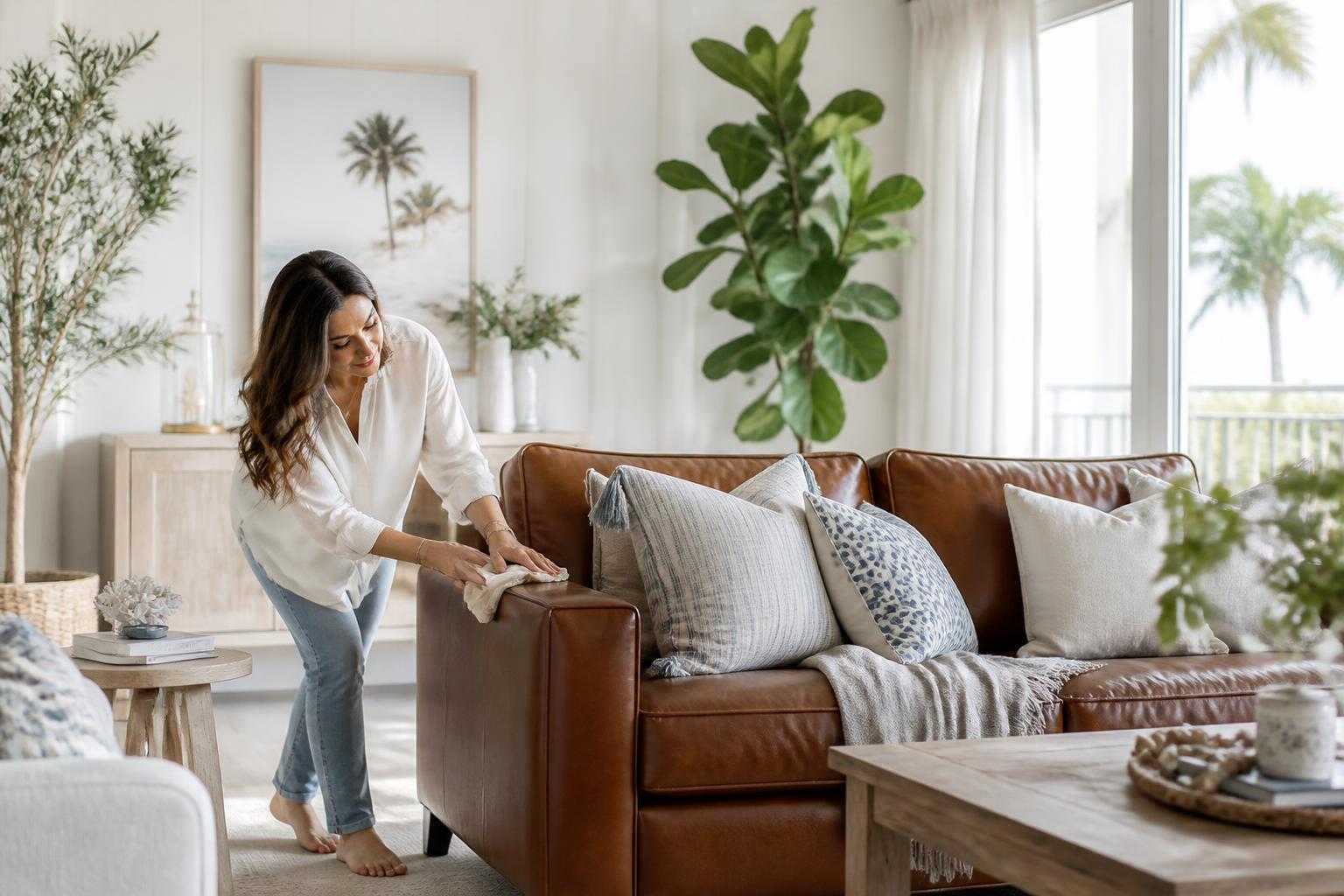
Humidity gets the blame, but it’s usually not the culprit. A practical look at how Florida’s heat, air conditioning, sunlight, and daily habits shape leather furniture over time — and the simple care rhythm that helps it last.
Most Florida homeowners believe the same thing about leather furniture: that the humidity down here is slowly destroying it.
It's a reasonable assumption. We watch humidity warp cabinet doors, swell drawers, and grow mildew on things we forgot in the garage. So it follows that leather — a natural material — must be suffering too.
The truth is more interesting, and honestly more useful.
Leather is skin. It was alive once, and even after tanning it behaves a little like skin still does. It holds moisture, it loses moisture, it stretches where you sit, it softens where you touch it, and it changes color slowly in the light. What it responds to isn't one thing. It's the whole environment around it — the heat, the air conditioning, the sun through the slider, the dog who has claimed the left cushion, and how often anyone thinks about it at all.
And here's the part most people get backwards: in Florida, the bigger risk to leather usually isn't the humidity outside. It's what happens *inside* your home, where the air conditioning runs nearly year-round and quietly pulls moisture out of everything in the room.
I've sat on a lot of leather sofas in Naples, Fort Myers, and Bonita Springs homes. Some are twelve years old and look better than the day they arrived. Some are three years old and already dry and tight across the seat cushions. The difference is almost never the brand. It's placement, habits, and whether anyone ever wiped the thing down.
This guide is about understanding those influences well before any visible damage shows up — and about knowing the difference between leather that's aging and leather that's actually in trouble.
Why Leather Behaves Differently From Fabric
If you've owned upholstered furniture, you already have instincts about how fabric behaves. Those instincts don't transfer cleanly to leather.
Fabric is woven. It's made of threads that hold their shape until they're stretched, stained, or worn through. When fabric fails, it usually fails visibly and locally: a pull, a stain, a thin spot on the arm.
Leather is a single continuous surface, and it's porous. It contains natural oils and a certain amount of moisture, and it exchanges both with the air around it. Warm, humid air, cold dry air, direct sun, body heat, hand oils, sunscreen, hair products — leather registers all of it.
That gives leather two qualities fabric doesn't have.
It's forgiving in the short term. Spills sit on the surface longer before they soak in. Dust doesn't embed. A quick wipe handles most of what daily life throws at it. This is a real advantage in a Florida house with sandy floors, wet swimsuits, and a lanai door that's always open.
It's cumulative in the long term. Fabric wears where you sit. Leather changes everywhere, slowly, based on years of environment. A sofa can look fine for six years and then seem to change quickly in year seven — not because something suddenly happened, but because a slow process finally crossed a threshold you can see.
That's the mental shift worth making. Leather care isn't reactive. It's a habit that runs quietly in the background, and the payoff arrives years later.
Florida's Climate and Leather: The Real Story
Let's take the humidity question head-on, because it's the one everyone asks.
Florida's outdoor humidity, on its own, does not crack leather. If anything, moderate ambient moisture is closer to what leather likes than the dry indoor air of a northern winter.
What Florida's climate actually does is create swings, and swings are what stress natural materials.
Consider a typical August day in a Southwest Florida home. It's 92 degrees and soaking outside. Inside, the AC is holding 74. A homeowner walks in from the lanai, the slider opens, humid air rushes in and hits a cool leather sofa. That happens twenty times a day, every day, for five months.
Now consider a snowbird's condo. The owners leave in April. The thermostat gets set to 82 or the AC gets shut off entirely. For six months the unit sits hot and humid and closed, with no air movement. Then in November the owners return, drop the temperature to 72, and the house dries out fast.
Neither scenario is catastrophic. But both are the kind of repeated expansion and contraction that, over years, contributes to leather losing suppleness — especially at the flex points where you sit and lean.
Alongside the swings, Florida adds three more pressures:
Real heat. Sustained warmth accelerates the natural evaporation of the oils and moisture inside the leather. A sofa on a west wall in a sunroom lives a harder life than one in a shaded family room.
Intense sunlight. Our UV index is high most of the year, and Florida homes are designed around glass. More on this below, because sun does more visible damage to leather than humidity ever will.
Salt air, if you're near the coast. Salt is mildly abrasive and hygroscopic — it attracts and holds moisture. On coastal homes with open windows, a fine salt film can settle on surfaces. It's not dramatic, but it's one more reason regular dusting matters more here than it does inland.
The realistic summary: Florida is a demanding environment for leather, but not a hostile one. Plenty of leather furniture ages beautifully in this state. It just requires a bit more attention than the same sofa would need in Ohio.
The Role of Indoor Humidity
Here's where the story flips on most homeowners.
Leather is generally happiest in the same range people are — roughly 40 to 55 percent relative humidity indoors. That's a broad target, not a precise rule, and no one should be micromanaging a hygrometer over a sofa.
The problem is that Florida homes tend to spend time on *both* sides of that range:
Too dry happens more often than people expect. An aggressively cooled home — especially one kept in the high 60s, or a room sitting directly under a supply vent — can hold indoor humidity well below comfortable levels for months. Air conditioning is a dehumidifier. That's most of what it does. Run it hard enough for long enough and the air in that room becomes genuinely dry, and leather in that room will slowly stiffen.
Too damp happens in closed-up seasonal homes, in condos with poor circulation, in rooms that sit unused with the door shut, and after any water event. That direction doesn't dry leather out — it invites mildew, musty odor, and a slightly tacky surface feel instead.
Between the two, the drying side is what quietly causes the changes people later describe as cracking.
If you want a simple homeowner check, buy an inexpensive humidity gauge and set it in the room where your leather lives. Look at it a couple times a week for a month. You'll learn more about your house in that month than in five years of guessing. If you'd like the broader version of this conversation, my guide on how humidity affects furniture in Florida homes covers what those readings mean for wood, upholstery, and mattresses too.
Air Conditioning and Moisture Balance
Air conditioning is the single most underappreciated influence on leather furniture in Florida, and almost nobody thinks about it.
Three specific things worth knowing:
Vents matter more than thermostats. A supply vent blowing directly onto a leather sofa creates a small zone of constantly moving, cooled, dried air on one part of one piece of furniture. That's why you'll sometimes see a sofa that's noticeably tighter and drier on one end. If a vent aims at your leather, redirect the louvers or move the sofa a couple of feet. It's a five-minute fix that pays off for years.
Empty houses are harder on furniture than occupied ones. A home left closed for the summer at 82 degrees with no dehumidification is a different environment than a lived-in home. Snowbirds who set the thermostat around 77 to 80 with the fan cycling, or who run a dehumidifier, generally come back to furniture in better shape.
Consistency beats perfection. Leather cares much less about hitting exactly 72 degrees than about not swinging from 68 to 84 and back every few days. Steady is what you're after.
None of this means you should be uncomfortable in your own house to protect a sofa. It means that if you already know your family runs the AC cold, the leather in that room may simply need attention a little sooner than the leather in a neighbor's warmer house.
Sunlight and UV Exposure
If humidity is the risk everyone worries about, sunlight is the risk that actually shows up in photographs.
Direct sun does three things to leather:
It fades color — unevenly, so you get a lighter patch or stripe where the sun lands and a truer color in the shade. On dark browns and reds this can be dramatic within two or three years.
It heats the surface, and heat accelerates moisture loss. Leather that's warm to the touch every afternoon is drying faster than leather that isn't.
It stiffens the top layer over time, which is where you start seeing tight, dry, crazed texture in one specific area while the rest of the piece is still soft.
In Florida this matters more than in most states. Our homes are built for light: sliders across the back, tall windows, transoms, western exposures over the water that are gorgeous at 5 p.m. and brutal on a leather chair.
A few practical responses, none of which require living in the dark:
- Keep leather seating out of the path of direct afternoon sun where you reasonably can. Two or three feet of shift is often enough.
- Sheer curtains, solar shades, or UV-filtering window film cut a meaningful amount of exposure while keeping the view. Homeowners are usually surprised how much difference a sheer makes.
- Rotate loose cushions occasionally so one face doesn't take all the light. It's the same logic as rotating a mattress — even wear beats concentrated wear, which I get into in my guide on rotating your mattress the right way.
- If you're placing new furniture, watch where the sun actually falls at 3 and 5 p.m. before you commit. It's rarely where people assume.
I've seen homeowners spend real money on conditioning products while a west-facing slider bleached one arm of the sofa every afternoon. The window was the problem.
Daily Habits That Affect Leather
The environment sets the conditions. Daily life determines how fast things move.
Body oils and hair products. Head and hand contact points — headrests, arm tops, the outside edge where people push off to stand — absorb oils continuously. Over years those spots darken and get slightly sticky. This is the most common "what happened to my sofa" issue I see, and it's entirely a cleaning matter, not a conditioning one.
Sunscreen and lotion. Very Florida, very underestimated. Sunscreen can stain and, on some finishes, react with the topcoat. Coming in from the pool and settling onto the leather sofa is a daily-ritual problem in a lot of homes. A throw over the favorite seat solves it.
Pets. Claws scratch. Dogs and cats also carry body oils and heat. Leather stands up to pets better than most fabrics, but a dedicated pet blanket in their spot is worth more than any product you can buy.
Sharp objects. Keys, phone cases, rivets on jeans, remote controls with hard edges, kids' toys. Most scratches in leather are hardware, not wear.
Where the drink sits. Water rings and condensation on a leather arm are real. So is a wet swimsuit. Wipe it now, not tonight.
Nothing at all. The most damaging habit is the absence of one. Leather that goes years without a wipe accumulates a film of dust, salt, oil, and sunscreen that traps grit and abrades the finish every time someone shifts their weight.
Everyday use isn't the enemy. Furniture exists to be used. The point is that a couple of small habits — a throw here, a wipe there, keys off the cushion — do more over ten years than any product applied twice.
Natural Aging vs. Actual Cracking
This is the section I most want homeowners to read, because a lot of people panic over furniture that is completely fine.
There's a spectrum, and knowing where your piece sits changes what you should do.
Natural aging. Leather softens, relaxes, and deepens in color. Seat cushions develop gentle waves. Panels that were taut become slightly slack. This is normal, expected, and on good leather it's the reason people buy leather in the first place.
Patina. The sheen and color shift that comes from years of light contact and handling — darker on the arms, a little glossier where hands rest, richer overall. On full-grain and aniline leathers, patina is a feature. It cannot be prevented and shouldn't be.
Creasing and wrinkling. Lines that appear where the leather flexes: seat fronts, back cushions, the inside of arms. Furniture makers expect this. It's the leather doing exactly what skin does at your elbow.
Surface wear. Loss of finish at high-contact points — the top of the arm, the front edge of the seat. Color looks thinner and slightly uneven. This is wear, not failure, and it's usually gradual.
Drying. Now we're leaving normal. Dry leather feels stiff rather than supple, sounds slightly papery when you press it, and doesn't spring back the way it used to. Color may look flat or chalky. This is the stage where attention actually helps.
Genuine cracking. Fine fissures in the surface layer, most often along seat and arm flex points, sometimes in a fine web pattern. Real cracking is a structural change in the finish or the leather itself. It doesn't reverse. Conditioning at that point may improve appearance and slow further change, but nothing puts the surface back.
Here's the practical test I use with homeowners. Press your palm on the questionable area and hold for a few seconds, then lift. If the leather flexes and relaxes back with a supple feel, you have aging. If it feels rigid, papery, or you see fine lines opening in the surface as it bends — that's dryness heading toward cracking, and it's worth paying attention.
Most of what people call cracking is creasing. Some of it is dryness. A minority is real cracking. Learning which one you have is the whole game.
Common Myths About Leather Cracking
"Humidity ruins leather." Excess humidity causes mildew and musty odor. Cracking is a drying phenomenon. In Florida, the drying usually comes from indoor air conditioning and sun, not from the weather outside.
"Leather needs to be conditioned every month." Over-conditioning is a genuine problem. Too much product can leave a tacky surface, attract dust, darken leather unevenly, and on protected leathers largely sit on top of a finish that doesn't absorb it anyway. More is not better.
"All leather is the same." It isn't, and this is the mistake with the biggest consequences. Protected or pigmented leather has a durable topcoat and mostly needs cleaning. Semi-aniline has light protection. Full-grain aniline is unfinished, gorgeous, absorbent, and far more sensitive to sun, spills, and oils. Bonded leather is a different product entirely — a backing coated with a polyurethane layer — and it can peel in a way real leather doesn't, which no amount of conditioner fixes. Know which one you own before you put anything on it.
"Baby wipes / olive oil / household cleaner work fine." Wipes often contain alcohol or detergents that strip finish. Kitchen oils go rancid inside leather and darken it permanently. All-purpose cleaners can dull or lift a topcoat. If you take one prohibition from this article, take this one.
"If it's cracked, it's ruined." Not necessarily. Cracking that's cosmetic and confined to one area is often something you live with comfortably for years, especially on a piece that's still structurally sound.
"Leather is a bad choice for Florida." It's actually one of the better choices here — it doesn't hold sand, pet hair, or humidity the way upholstery does, and it wipes clean after a wet swimsuit. It just wants a little thought about placement.
A Simple Leather Care Routine
You don't need a regimen. You need a rhythm — and the rhythm is mostly cleaning, with conditioning as the occasional step.
Weekly (two minutes). Dust with a dry, soft microfiber cloth. Get into the seams and the crease where the seat meets the back, where grit collects. Vacuum crevices with a soft brush attachment if you have pets or sandy floors.
Monthly (ten minutes). Wipe the whole piece with a barely damp cloth — distilled water is fine — and dry immediately with a second cloth. Pay extra attention to headrests, arm tops, and the spot where hands push off. This is where oils build.
Every three to six months. Give it a real look. Run your hand across the seats and arms. Note anything that feels different from last time: stiffness, tackiness, thinning color, a spot that's lighter than the rest. Catching a change early is the entire advantage.
Once or twice a year (Florida-specific). Consider a proper clean followed by conditioning, if your leather type calls for it. Late spring, before the hardest heat and the summer sun, and again in late fall are sensible checkpoints.
Always, before conditioning: clean first. Conditioning over dust and body oil seals the grime into the surface. This is the most common mistake homeowners make, and it's completely avoidable.
Always: test in a hidden spot. Back of the skirt, underside of a cushion, the inside of an arm. Wait a few hours. Then proceed.
Spills, immediately. Blot, never rub. Work from the outside in. Let it air dry — no hair dryers, no sunlight, no heat.
Seasonal Rhythm for Florida Homes
Spring (March–May). Deep clean. Check where the sun now falls as the angle changes. Consider conditioning before the hot months.
Summer (June–September). Watch AC vents and sun exposure. If you're leaving for the season, set the thermostat sensibly rather than shutting the system off, and pull leather away from windows and exterior walls. Cover pieces with a breathable sheet if the house will be closed — never plastic.
Fall (October–November). Returning snowbirds: air the house out, let humidity stabilize for a few days before dropping the temperature hard, then clean and assess.
Winter (December–February). Peak entertaining season, peak sunscreen, peak guests. Throws on the high-traffic seats, wipe more often.
When Conditioning Is Worth Considering
Conditioning is helpful. It's also over-recommended, and it's not the answer to every leather question.
Think about conditioning when:
- The leather feels dry, stiff, or papery rather than supple.
- The piece lives in a room that runs cold and dry most of the year.
- The piece gets significant indirect light or sits near a sunny window.
- It's been more than six to twelve months and you're doing a seasonal reset.
- The home sits empty part of the year with the AC in vacation mode.
- Your manufacturer's care card specifically recommends it — and this outranks anything I or anyone else says, because they know how their leather was finished.
Think twice about conditioning when:
- The leather is protected/pigmented and still feels supple. Cleaning is what it needs.
- You conditioned recently. Twice a year is plenty for most homes; some need less.
- The surface already feels slightly tacky. That's usually too much product, not too little.
- You haven't cleaned first.
- You haven't confirmed what type of leather you own.
And a boundary worth stating plainly: conditioning maintains suppleness and appearance. It does not prevent cracking, reverse damage, restore color, or make a sofa new. Anyone promising that is selling something. What it realistically does is help leather stay comfortable and looking like itself for longer — which is a worthwhile, honest goal.
When Repair or Replacement Becomes Reasonable
I'm not in the business of telling people to buy furniture they don't need. Most leather sofas that homeowners are ready to give up on have years left.
Live with it when the change is cosmetic — patina, creasing, a slightly worn arm, color that's deepened. The frame is solid, the cushions still support you, and the piece is comfortable. This is a well-loved sofa, not a failing one.
Consider professional attention when there's a tear at a seam, cracking that's spreading beyond one area, a stain you can't resolve, or hardware and frame issues. A qualified leather repair specialist or the manufacturer's service network can often address these for a fraction of replacement cost. This is genuinely outside homeowner DIY territory — I'd rather you call someone good than experiment on your own sofa.
Consider replacing when the structure has gone: broken frame, cushions that no longer support, foam collapsed past the point of a rebuild, or bonded leather that's peeling across large areas (peeling bonded material can't be meaningfully repaired). Or, honestly, when the piece no longer fits your life — you've downsized, the room changed, or your household's needs are different now.
Four Questions Worth Asking
1. Is this cosmetic or structural? Appearance issues are usually livable. Structural issues rarely improve on their own.
2. Is it still comfortable? If everyone in the house still chooses that seat, that tells you something the leather's appearance doesn't.
3. What does repair actually cost against replacement? Get one real number before you assume. Repair is frequently a fraction of the price.
4. Does this piece still fit how we live now? Not how we lived when we bought it. Now — and over the next five years.
If a piece passes questions 2 and 4, keep it. Almost always.
Two Real Homeowner Examples
The Fort Myers couple who blamed the humidity. Their four-year-old leather sectional had gone stiff and dry on the right side only, and they were convinced Florida had ruined it. We looked at the room for about ninety seconds. A ceiling supply vent aimed straight down at that end of the sofa, and the western slider put sun on the same arm from about four o'clock on. Not humidity — a vent and a window. They angled the louvers, added a solar shade, and had the piece cleaned and conditioned properly. The dry side never came all the way back, but three years later it hasn't gotten worse, and they still own the sofa they were about to replace.
The Naples snowbirds who over-conditioned. Wonderful, meticulous owners. They conditioned their leather chairs every six weeks because they wanted to do everything right. The chairs became tacky, collected dust, and darkened unevenly across the seats. Nothing was wrong with the leather — there was simply too much product on it. They stopped for a full year, cleaned properly, and the surface evened out considerably. Their care routine now is a wipe-down monthly and conditioning each spring. The chairs look better with less effort.
Both stories have the same moral: understanding your specific room beats following generic advice.
Mistakes Homeowners Make Most Often
- Conditioning without cleaning first, sealing dirt into the surface.
- Conditioning far too frequently, creating tackiness and uneven color.
- Using baby wipes, all-purpose cleaner, or kitchen oils.
- Placing leather in direct afternoon sun and never reconsidering it.
- Letting an AC vent blow directly onto one section of a piece.
- Ignoring seams and crevices where grit and salt collect.
- Not knowing what type of leather they own before treating it.
- Skipping the hidden-spot test.
- Letting spills, sunscreen, and wet swimsuits sit until later.
- Closing up a seasonal home with the AC off entirely.
- Rubbing a stain instead of blotting it.
- Assuming every crease is damage — and replacing perfectly good furniture over it.
Your Printable Leather Care Checklist
Know your piece
- [ ] Identify leather type (protected / semi-aniline / aniline / bonded)
- [ ] Locate and save the manufacturer's care instructions
- [ ] Note warranty terms and any service contact
Check the room
- [ ] No AC vent blowing directly on the furniture
- [ ] Not in the path of direct afternoon sun
- [ ] Sheers, shades, or UV film on the strongest windows
- [ ] Humidity gauge in the room; readings roughly 40–55%
- [ ] Not pushed tight against an exterior wall
Weekly
- [ ] Dry dust with a soft microfiber cloth
- [ ] Clear seams and crevices
- [ ] Vacuum with a soft brush if pets or sandy floors
Monthly
- [ ] Damp-wipe the whole piece, dry immediately
- [ ] Extra attention to headrests, arms, and push-off points
- [ ] Rotate and flip loose cushions
Every 3–6 months
- [ ] Hand-check for stiffness, tackiness, or color change
- [ ] Inspect seams and stitching
- [ ] Photograph the piece so you can compare over time
Once or twice a year
- [ ] Clean thoroughly with a leather-appropriate cleaner
- [ ] Test any new product in a hidden spot first
- [ ] Condition only if the leather type and its condition call for it
Household habits
- [ ] Throws on the highest-use seats
- [ ] Pet blanket in the pet's spot
- [ ] Rinse off before sitting down after the pool
- [ ] Keys, phones, and hard objects off the cushions
- [ ] Blot spills right away — never rub
Seasonal home
- [ ] Thermostat or dehumidifier set for the closed season
- [ ] Furniture moved away from windows and exterior walls
- [ ] Breathable covers only, never plastic
- [ ] Clean and assess on return, before dropping the temperature hard
The Bigger Picture
Somewhere along the way, we picked up the idea that taking care of something means keeping it looking brand new.
I don't think that's quite right, and leather is the clearest example of why. A leather sofa that's been in a family for a decade *should* look like it. The arms are darker where hands rest. The favorite cushion has relaxed. The color has deepened in the places the light touches. That's not deterioration. That's a record of the life that happened on it.
What good care actually does is different, and better. It keeps the material supple enough to stay comfortable. It keeps small things from becoming structural ones. It buys you years — and it means the changes you see are the ones you'd want, not the ones that come from a vent nobody redirected or a window nobody shaded.
That's true of everything in a home, really. The way your rooms are arranged, where the sun lands, how the air moves, what your family does day after day — those things shape your furniture far more than the price you paid for it. If you want to see the same principle from a different angle, my guides on choosing the right dining table size and how much space to leave between furniture come at it through layout rather than materials, and they land in the same place.
Well-maintained furniture isn't about freezing things in time. It's about understanding how your home, your environment, and your daily habits influence the things you live with — and making thoughtful decisions that help them serve you well for years to come.
So here's the question worth sitting with:
When you look at your leather furniture today, do you see signs of damage — or simply the story of a well-loved home?
Let's Talk It Through
If you're wondering whether what you're seeing on your leather is normal wear or something worth addressing — or you're deciding whether leather is the right choice for your Florida home in the first place — I'm glad to help you think it through.
No sales pitch, no pressure. Just a practical conversation about your room, your climate, how your family actually lives, and what makes sense for you.
Schedule a complimentary consultation with me and let's make the decision an easy one.
Recommended Next Resource
Your Resource Journey — the next step homeowners take after a resource like this one.
- Fusion Compare™Compare your options side by sideSee the real trade-offs between the choices in front of you.Estimated reading time: 7 min comparisonWhy this is recommendedComparing your options side by side is what turns background reading into a shortlist.Continue
- Decision GuideDecide with a complete guideEverything that matters for this decision, in the order it matters.Estimated reading time: 8 min readWhy this is recommendedYou've done the background — this guide brings the whole decision together in one place.Continue
- AssessmentCheck where you actually standA short evaluation that turns general guidance into your situation.Estimated reading time: 4 min assessmentWhy this is recommendedA short evaluation applies everything you've read to your own home rather than the general case.Continue
Furniture Collection
Choosing pieces that fit the room, the household and the years ahead.
Keep going
Helpful next steps
Complimentary, no-pressure resources that follow the decision you're working through.
Florida Homeowner Hub
Florida-specific homeowner considerations, season by season.
Learn moreMy Home — Care & Maintenance
Track what your home needs and when it was last done.
Learn moreHomeowner Planning Tools
Complimentary calculators and planners for real home decisions.
Learn moreAsk Maria
Talk through the decision you're actually making and get practical guidance.
Learn moreWas this guide helpful?
If you have an idea or suggestion that could help more homeowners, we'd love to hear it.
Talk it through
Planning your next home decision?
Whether you're evaluating a home, furnishing a room, improving sleep, relocating, downsizing, or simply trying to make smarter home decisions, Total Home Fusion provides practical guidance before you invest your time and money.
About the author
About Maria Banou
Maria Banou is the founder of Total Home Fusion, a homeowner decision platform focused on helping people think through the practical choices surrounding where they live, what they buy for their homes, and how their homes support everyday life. Her work includes furniture selection, sleep comfort, room planning, relocation, downsizing, Florida homeowner considerations, aging-in-place planning, and practical home decision guidance.
- Furniture Selection
- Sleep Comfort
- Room Planning
- Downsizing & Relocation
- Florida Homeowner Guidance
- Aging in Place Planning
- Home Decision Guidance
Connected guidance
More Homeowner Insights
Related resources from the Fusion Library™, chosen to continue the same decision.

The Florida Homeowner's Comfort Guide: Creating a Home That Feels Better Every Day
Many homeowners assume comfort comes from bigger homes, newer furniture, or expensive upgrades. In reality, comfort is often influenced by smaller factors such as room layout, humidity, sleep quality, lighting, airflow, and how well a home supports your daily lifestyle. This Florida Homeowner's Comfort Guide explores practical ways to create a more comfortable home while helping you make smarter decisions that improve everyday living.
Knowledge GuideRead Article
Can Humidity Ruin Furniture? Here's What Every Homeowner Should Know
Humidity almost never ruins furniture in one dramatic moment. It changes it quietly, over seasons. Here is how moisture actually works on wood, leather, fabric, foam and metal — and the simple habits that keep good furniture performing for decades.
Knowledge GuideRead Article
How Often Should You Change Your AC Filter? A Homeowner's Practical Guide
Most homeowners know they should change the AC filter. Far fewer know when. The honest answer depends less on the calendar and more on how your home is lived in — pets, people, Florida's year-round cooling, and the routine you will actually keep.
Knowledge GuideRead ArticleQuick answers
Frequently asked questions
Does humidity damage leather furniture?
Not the way most people assume. High humidity can cause mildew, musty odor, and a slightly tacky surface feel, but it does not cause cracking. Cracking comes from leather drying out and losing suppleness. In Florida, that drying usually happens indoors — from air conditioning pulling moisture out of the room and from direct sun heating the surface. Aim for roughly 40 to 55 percent indoor humidity and steady conditions rather than big swings.
Can cracked leather be repaired?
Genuine cracking cannot be reversed, but it can often be improved and slowed. Light surface cracking in one area is frequently something homeowners live with comfortably for years, especially if the frame and cushions are sound. For spreading cracks, seam tears, or peeling, a qualified leather repair specialist or the manufacturer’s service network is the right call — it usually costs a fraction of replacement. Bonded leather that is peeling generally cannot be meaningfully repaired.
How often should leather furniture be conditioned?
For most Florida homes, once or twice a year is plenty — typically late spring and late fall. Over-conditioning is a real problem: too much product can leave a tacky surface, attract dust, and darken leather unevenly. Always clean first, always test in a hidden spot, and always follow your manufacturer’s care instructions, since protected leather needs far less conditioning than unfinished aniline leather.
Is sunlight bad for leather furniture?
Direct sun is the most visible risk to leather in Florida. It fades color unevenly, heats the surface, and speeds up moisture loss, which is why you often see one dry, stiff, lighter area on an otherwise healthy piece. You do not need to live in the dark. Shifting seating two or three feet out of the afternoon sun, adding sheers or solar shades, and rotating loose cushions all help considerably.
Is leather a good choice for Florida homes?
Generally yes. Leather does not trap sand, pet hair, or moisture the way upholstery does, and it wipes clean after wet swimsuits and sunscreen — real advantages in a coastal household. It simply asks for a little more thought about placement: away from direct afternoon sun and out of the path of an air conditioning vent. With that and a monthly wipe-down, leather ages very well down here.