
UV Protection for Artwork and Family Photos: How to Preserve the Memories That Matter
Reviewed & curated by Maria BanouHome Life AdvisorPublished July 30, 2026Updated September 4, 202625 minute read
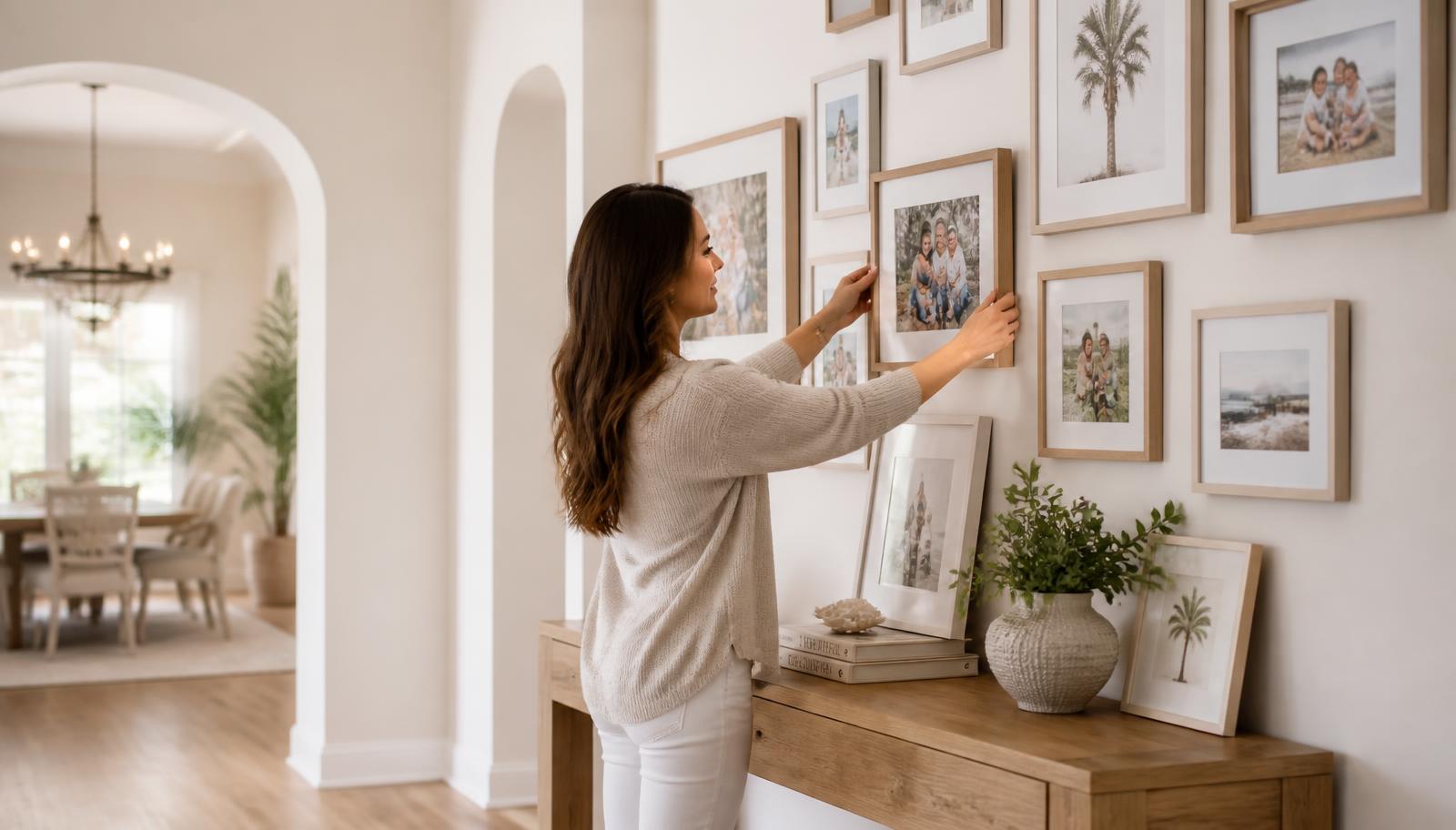
Furniture gets replaced. Photographs usually do not. Most homeowners already know sunlight affects furniture, but far fewer think about it when they hang the things they love most — the wedding portrait, the heirloom watercolor, the child's first painting. This guide explains how ultraviolet light gradually changes artwork, photographs, certificates, and keepsakes, why some colors fade faster than others, what inexpensive framing does and does not protect against, and how to display treasured pieces thoughtfully in a bright Florida home — without living behind closed blinds.
Furniture gets replaced. Photographs usually do not.
That is the sentence I come back to whenever a homeowner asks me where a piece of artwork should hang. A sofa can be reupholstered, a rug can be swapped, a dining table can be handed down or sold. But the wedding portrait, the hand-printed watercolor from a trip that mattered, the diploma, the child's first painting with the crooked signature in the corner — those exist in one copy, and once the color has drifted out of them, no amount of care brings it back.
Most homeowners already know sunlight affects furniture. Fewer think about it when they hang the things they love most. The frames go where the wall looks empty, which is often the brightest wall in the house, directly across from the window that makes the room feel wonderful.
This guide is about that gap. Not about hiding your memories in a closet — that defeats the point of having them. About displaying them thoughtfully, so the story on your walls still reads clearly in thirty years.
If you want the broader picture of how light affects upholstery, wood, and leather, that is covered in detail in Can Sunlight Damage Furniture?. This article stays with the paper, pigment, ink, and glass side of your home.
Why Sunlight Slowly Changes Artwork and Photographs
Fading is not an event. It is an accumulation.
A framed photograph does not look different after a sunny weekend, or a summer, or usually even a year. What happens instead is a slow chemical change in the dyes and pigments that make up the image. Light energy breaks apart the molecules responsible for color. Each broken bond is invisible. A few million of them, spread over several years, is what you finally notice one day when you take the frame down to dust behind it and see a ring of original color at the edge where the mat covered the print.
That moment is the most common way homeowners discover fading, and it is always a surprise. The eye adjusts to gradual change. You have looked at that photograph every day for eight years and never registered the shift, because you had nothing to compare it to until the frame came off the wall.
Three things drive the process: ultraviolet radiation, visible light, and time. Heat and humidity accelerate the chemistry and add their own damage — warped mats, buckled paper, adhesive failure. Sunlight through a window brings all of them at once.
Homeowner takeaway: Fading is cumulative and invisible while it happens, which is exactly why placement decisions matter more than reaction.
Understanding UV Light in a Home
Ultraviolet light is the part of sunlight just past the violet end of what your eye can see. It carries more energy per unit than visible light, and that extra energy is what breaks the chemical bonds in dyes, inks, paper fibers, and textile threads.
Two points surprise most homeowners.
The first is that ordinary window glass is only a partial filter. Standard glazing blocks most UVB but lets a substantial share of UVA through. UVA is the longer-wavelength band, and it is perfectly capable of fading a photograph. This is why a print can fade badly on a wall that never receives a single ray of unfiltered outdoor sun.
The second is that UV is not the whole story. Visible light — especially the blue end of it — also degrades colorants. Museums measure exposure in lux-hours for exactly this reason. Blocking 99% of UV removes the most aggressive part of the problem while leaving a real, slower one in place. That is still an enormous improvement. It is just not immunity.
The practical framing is simple: UV is the fastest cause of fading, visible light is the patient one, and heat is the accomplice that makes both worse.
Homeowner takeaway: Behind glass is safer than direct exposure, and never equal to protected. Reduce exposure rather than assuming it away.
Which Items in Your Home Are Most Vulnerable?
Not everything on your walls ages at the same rate. In rough order of sensitivity, from most fragile to most durable:
- Color photographs and inkjet prints. Chromogenic photo prints and consumer dye-based inkjet output are among the most light-sensitive things in a house. A dye-based print in a bright room can show visible change in a handful of years.
- Newspaper clippings, certificates, diplomas, and printed keepsakes. Inexpensive paper carries acid and lignin that yellow and embrittle on their own; light speeds it up considerably.
- Watercolors, pastels, gouache, and colored pencil. Water-based media sit on the surface of the paper with minimal binder protecting the pigment.
- Textiles and needlework. Cross-stitch, christening gowns, sports jerseys, and quilts in shadow boxes fade unevenly along the exposed folds.
- Children's artwork. Marker, tempera, and construction paper are the fastest-fading materials most families own — and often the most irreplaceable.
- Oil and acrylic paintings. More stable than works on paper, but varnish yellows and some pigments still shift.
- Black-and-white silver gelatin photographs. Comparatively stable, though mounts and mats still degrade.
- Metal, ceramic, and stone objects. Generally light-stable; the display materials around them are usually the weak point.
This ordering matters because it lets you allocate your attention. If one wall in your home is genuinely bright, put the oil painting there and move the watercolor and the color photographs somewhere calmer.
Homeowner takeaway: Match the item to the wall. The most light-sensitive pieces belong on the least-lit walls.
Why Certain Colors Fade Faster Than Others
Fading is almost never uniform, and the pattern is predictable enough to be useful.
Yellows, reds, and magentas typically go first. They are commonly produced with organic dye molecules that are less stable under light energy. Cyan and blue tones tend to hold longer. Blacks made from carbon are the most stable of all.
That imbalance is why faded prints do not simply look pale — they look wrong. A family portrait loses its reds and magentas first, so skin tones drift toward yellow-green or cyan and the whole image takes on an unfamiliar cast. Sunsets flatten out. Warm wood tones in the background of a photograph go grey. People often describe it as the picture looking cold or off without being able to say why.
Older color photographs from the 1970s and 1980s are especially prone to this. The dye sets of that era were less stable than modern ones, which is why so many family albums from that period have a uniform orange-red shift even in photos that were stored in a drawer.
Pigment-based printing — true archival inks and traditional artists' pigments — is dramatically more stable than dye-based printing. If you are reprinting a treasured photograph for display, asking for pigment ink on acid-free paper is one of the highest-value decisions available, and it usually costs a few dollars more.
Homeowner takeaway: Color shift, not just dimming, is the signature of light damage. If a photo looks cold or oddly tinted, that is fading, not memory.
Window Placement Matters More Than Homeowners Realize
Here is the part most people never map out: which of your walls actually receive light, and for how long.
In the Northern Hemisphere:
- South-facing windows deliver the longest daily exposure across the year. The wall opposite a south window is the highest-risk wall in most houses.
- West-facing windows deliver the most intense late-afternoon light, arriving at a low angle that reaches deep into a room and carries the most heat.
- East-facing windows bring strong morning light, also at a low, penetrating angle, but with less accumulated heat.
- North-facing windows are the gentlest, offering steady indirect light — the reason artists have preferred north light for centuries.
Low-angle light is the one homeowners underestimate. Midday sun through a south window mostly lands on the floor. Late-afternoon western sun comes in nearly horizontal and travels fifteen or twenty feet across a room to strike a wall that nobody thinks of as sunny. I have looked at more than one faded gallery wall on the far side of a room from any window.
There is a five-minute exercise worth doing before you hang anything permanent. On a sunny day, walk each room three times — mid-morning, mid-afternoon, and around an hour before sunset — and note where the light actually lands. Then check again in the opposite season, because the sun's arc changes and a wall that is shaded in July may be lit in January.
If you are measuring wall runs while you do this, the same measurements feed directly into layout planning — How to Measure a Room for Furniture walks through capturing them properly once instead of three times.
Homeowner takeaway: Track the light path before you commit to a wall. The brightest wall is rarely the one you assumed.
Florida Homes and Year-Round UV Exposure
Florida changes the math in three specific ways.
The exposure never really pauses. In northern climates, low winter sun angles and months of overcast weather give artwork an annual rest. Here, UV levels stay meaningfully high through winter. A wall in Naples or Sarasota may accumulate more light exposure in a year than a comparable wall further north accumulates in two.
Homes are designed to gather light. Sliders, transoms, high clerestory windows, glass front doors, lanai openings, and open floor plans are exactly the features people move to Florida for. They are also efficient light-delivery systems. A great room with a wall of glass on one side and a two-story wall on the other is a beautiful space and a challenging place to hang paper.
Reflected light adds up. Pale exterior walls, light stone or paver decking, pool surfaces, and white-sand landscaping all bounce light back into the house. Rooms with no direct sun can still carry high ambient light levels — enough to matter over a decade.
Humidity is the other half of the Florida story and deserves its own attention, because moisture is what buckles mats, blooms mold behind glass, and lifts old mounting tape. Can Humidity Ruin Furniture? covers the household side of moisture management in depth; for framed works, aim for a stable indoor environment rather than a specific perfect number, and avoid hanging paper on exterior walls in unconditioned rooms. Leather sits at the intersection of both forces, which is covered separately in Can Leather Furniture Crack in Florida?.
Homeowner takeaway: Florida's exposure is year-round and partly reflected, so treat indirect light here as more significant than it would be further north.
Choosing Better Framing Materials
Framing is where most of the real protection lives, and it is also where the least attention gets paid. A frame assembled to hit a price point typically contains materials that actively damage what is inside it.
The elements that matter:
Glazing. The glass or acrylic sheet. This is the single biggest protective decision and it gets its own section below.
Mat board. The window mat that surrounds the image. Standard mat board is wood-pulp based and acidic. Over years it burns a brown line into the edge of the artwork wherever it makes contact — you have almost certainly seen this on an older framed piece. Acid-free, buffered, or cotton rag matting eliminates it. The upcharge at a frame shop is usually modest.
Spacing. The mat also does something structural: it holds the artwork off the glazing. Photographs and prints pressed against glass can stick permanently, especially in humid conditions. If you frame without a mat, ask for spacers.
Backing board. Same acid issue as the mat. Corrugated cardboard and standard hardboard backing should be replaced with acid-free foam board or archival backing.
Mounting method. Never dry-mount, glue, or tape anything irreplaceable. Archival photo corners and hinges hold a piece securely and reversibly. Pressure-sensitive tape yellows, hardens, and tears paper when it eventually fails.
Sealing. A properly sealed frame package slows dust and moisture exchange, which matters more in a humid climate than a dry one.
You do not need museum-grade framing for a poster. You very likely want it for the wedding portrait, the heirloom watercolor, and the certificate that only exists once.
Homeowner takeaway: Inexpensive framing is not neutral — acidic mats and backing cause damage on their own. Upgrade the framing on irreplaceable pieces first.
UV Glass vs. UV Acrylic
Once you decide to upgrade glazing, you face a fork: glass or acrylic. Both are available in UV-filtering versions, and both are legitimate choices.
UV-filtering glass is clear, scratch-resistant, rigid, and generally less expensive. It is heavy, which matters for large frames and for wall anchoring, and it can break — a real consideration in a house with children, or in a coastal home where storm prep means things get moved.
UV-filtering acrylic is roughly half the weight, does not shatter, and is the standard choice for large pieces and for anything that needs to travel. It scratches easily, carries a static charge that makes it a poor choice over loose pastels or charcoal, and costs more.
Within each type there are tiers. Standard versions block a modest portion of UV. Conservation-grade glazing typically blocks around 97–99% of UV. Museum-grade adds an anti-reflective coating on top of the UV filtering, which dramatically improves how the piece actually looks on a lit wall — worth seeing in person before dismissing on price.
Two clarifications that save disappointment:
Conservation glazing is not a license to hang anything anywhere. It removes the fastest cause of fading; visible light still works on the piece.
And you cannot tell what you have by looking. Conservation glazing looks like ordinary glass. If you inherited framed pieces or bought them pre-framed, assume standard glazing until a framer tells you otherwise.
For a genuinely irreplaceable original, there is a third option worth knowing: have it professionally digitized, display a high-quality pigment reprint in the bright room, and store the original properly. The wall still tells the story. The original stops absorbing light.
Homeowner takeaway: Conservation glazing is the highest-value framing upgrade available. Choose glass for smaller framed pieces, acrylic for large or moving ones.
Gallery Walls Without Excessive Sun Exposure
Gallery walls have been the most popular way to display family photographs for a decade, and they concentrate risk in a specific way: they put a large number of light-sensitive items on one continuous plane, which means they either all age well or all age together.
A few principles make them last.
Choose the wall by light, then by look. Perpendicular walls — the ones the window sits in, or the ones running alongside it — receive far less direct light than the wall opposite. Hallways, stair walls, and interior walls are the natural homes for the most sensitive pieces.
Mix durability into the arrangement. If part of the wall unavoidably catches light, put oil paintings, canvas prints, metal pieces, and mirrors in the bright zone and reserve the shaded portion for photographs and works on paper.
Reprint rather than hang originals. For a wall of family photographs, hanging quality reprints and keeping originals stored flat and dark is not a compromise. It is the whole solution — and it means you can refresh the wall whenever you want.
Plan the arrangement before you drill. Paper templates on the wall, or a photo of the wall marked up before you commit, save both the drywall and the second-guessing. If you would rather see the arrangement rendered in your actual room first, See It in Your Home lets you visualize a wall before anything gets hung.
Rotate seasonally. Swapping a few frames between a bright wall and a shaded one twice a year distributes exposure and keeps the display feeling current. Families with a lot of children's artwork often do this naturally.
Homeowner takeaway: Pick the gallery wall by tracking light first. Reprints on the bright wall, originals in the shade or in storage.
Lighting Artwork Safely Indoors
Artificial lighting is where the conversation gets more nuanced than most homeowners expect.
Modern residential LED lighting emits essentially no UV, which makes it a genuinely good choice for lighting artwork — a substantial improvement over the halogen and incandescent picture lights it replaced, both for UV and for heat. On this point the common upgrade advice is correct.
But LEDs still emit visible light, and visible light still fades things. A picture light left burning ten hours a day, six inches from a watercolor, delivers real cumulative exposure over a decade. The relevant number is intensity multiplied by hours, and a dedicated fixture aimed directly at one small object can concentrate more light on it than the room's ambient daylight does.
What actually helps:
- Mount picture lights far enough away to spread the light rather than concentrate it.
- Use dimmers, and light artwork to a comfortable level rather than a dramatic one.
- Put display lighting on a timer or a smart switch so it is on when someone is in the room, not all day.
- Prefer warmer color temperatures for the display itself — lower blue content, and generally more flattering to warm-toned prints and wood frames.
- Avoid halogen picture lights on anything valuable. They run hot and emit measurable UV.
- Keep fluorescent tubes away from artwork; they emit more UV than most people assume.
Homeowner takeaway: LEDs solved the UV problem, not the exposure problem. Aim, dim, and time your display lighting.
Common Homeowner Mistakes
The patterns I see repeat are rarely careless. They are usually reasonable decisions with an unconsidered consequence.
Hanging the most treasured piece on the most prominent wall. The prominent wall is prominent because it is well lit. Give the important piece a good wall, not the brightest one.
Assuming a room without direct sun is safe. Reflected and ambient light fades things too, just more slowly. In Florida, no direct sun is not the same as low exposure.
Framing at the lowest possible price for something irreplaceable. Acidic mats and backing damage artwork independent of light. This one causes harm even in a dark hallway.
Storing overflow frames in the garage or attic. Heat and humidity swings in an unconditioned Florida space will do more damage in two summers than a decade on a shaded wall. Store inside the conditioned envelope — a closet shelf is far better than a garage rack.
Hanging paper works on bathroom or unconditioned exterior-facing walls. Moisture, temperature swings, and condensation behind glass cause mat buckling and mold.
Never taking the frame off the wall. An annual look behind the mat tells you whether fading has begun, whether the backing is bowing, and whether mounting tape has failed. It takes two minutes.
Waiting until fading is visible. By the time you can see it across the room, a great deal of change has already occurred, and none of it reverses.
Homeowner takeaway: Most damage comes from placement and framing decisions made once, not from neglect over time.
Creating Displays That Last for Generations
The homes where treasured pieces still look right after twenty years are not the careful ones. They are the deliberate ones. A handful of decisions made at hanging time, then largely forgotten.
Practically, that means:
Digitize first. High-resolution scans of every irreplaceable photograph and document, stored in two places. This is the single most valuable preservation step available, it protects against fire and storm as well as fading, and it costs nothing but an afternoon.
Display reprints of the most fragile things. Originals stored flat, dark, and dry; excellent pigment reprints on the wall.
Upgrade glazing on the pieces that deserve it. Not everything. The five or ten that matter.
Photograph your walls annually. Same angle, same time of day, same lighting. Two years of photos tell you nothing. Ten years of photos tell you exactly which wall is costing you color.
Rotate the display. A home whose walls change a little each year is both more interesting to live in and easier on the artwork.
Label the backs. Names, dates, places, in pencil on the backing board or on an archival label. The preservation nobody thinks about is the loss of context — a beautifully preserved photograph of people nobody can identify is only half saved.
Plan for the move. Artwork and framed photographs are among the most commonly damaged items in a relocation, usually from being packed flat, stacked, or left in a hot truck. The Moving & Relocation Hub covers protecting fragile and irreplaceable items during a move, and Should You Buy Furniture Before You Move? is useful if you are still deciding what goes to the new house at all.
Homeowner takeaway: Digitize, reprint, upgrade selectively, and document. Four steps cover the majority of long-term risk.
The Five-Step Memory Preservation Check
Use this on any piece you care about. It takes about two minutes per item and it produces a decision, not a worry.
1. Light Exposure Where does light actually fall on this piece, and for how many hours a day? Check morning, afternoon, and pre-sunset. Note whether the light is direct, filtered, reflected, or artificial. Direct light for more than an hour a day on a work on paper is a flag.
2. Display Location Which direction does the nearest window face, and how far away is it? Is this wall opposite the glass or alongside it? Is the room conditioned year-round? Is it an exterior wall, a bathroom, or an unconditioned space?
3. Framing Protection What is actually in the frame? Standard glass or conservation glazing? Acid-free mat and backing, or unknown? Is the piece held off the glazing? Is it hinged with archival materials or taped down? If you do not know, assume the least protective answer.
4. Material Sensitivity What is this made of? Dye-based photo print, pigment print, watercolor, oil, textile, newsprint, marker on construction paper? Rank it against the vulnerability list earlier in this guide. Sensitive material plus bright wall is the combination that needs action.
5. Long-Term Preservation Is this replaceable? Has it been digitized? Is a reprint an acceptable substitute for display? Who in the family would want this in thirty years, and is it labeled well enough for that to mean something to them?
Any piece that scores poorly on steps 1 and 4 together should move, get better glazing, or be swapped for a reprint. That is the whole decision.
Printable Checklist: Protecting Artwork & Family Photos
□ Check which pieces receive direct sunlight at any point in the day □ Review the orientation of every window near a display wall □ Inspect existing pieces for fading — compare edges under the mat □ Consider UV-filtering glass or acrylic for irreplaceable items □ Rotate seasonal displays between bright and shaded walls □ Avoid excessive or unstable humidity around framed works □ Use interior and perpendicular walls for the most sensitive pieces □ Review artificial and picture lighting — distance, dimming, hours □ Photograph valuable artwork annually from the same angle □ Inspect frames for bowed backing, failed tape, and mat contact □ Protect family heirlooms with archival mats, backing, and hinges □ Preserve children's artwork by scanning it before it fades □ Digitize every irreplaceable photograph and store copies in two places □ Label the back of each piece with names, dates, and places □ Move overflow frames out of the garage and attic into conditioned storage □ Re-check light patterns in the opposite season
Run this once a year. Most items take under a minute.
Common Myths About UV and Artwork
Glass completely blocks UV rays. Standard window and frame glass blocks most UVB but passes a significant share of UVA, which fades dyes and pigments perfectly well. Conservation glazing blocks roughly 97–99%. Ordinary glass is a partial filter, not a shield.
Only expensive artwork needs protection. Value and irreplaceability are different things. A child's drawing and a wedding portrait have no market price and cannot be reordered. Those are usually the pieces worth protecting first.
Family photos never fade. Color photographic prints are among the most light-sensitive objects in a typical home. Dye-based prints in a bright room can shift visibly within a decade — that familiar orange cast on 1970s photos is exactly this.
LED lights cannot affect artwork. LEDs emit essentially no UV, which is a genuine improvement. They still emit visible light, and visible light still fades things. A bright picture light running ten hours a day for years delivers real exposure.
Once fading starts, it can be reversed. It cannot. Light-caused fading is a permanent chemical change. A conservator may improve appearance and a good scan can be digitally color-corrected, but the original colorant is gone. Prevention is the only real remedy.
Behind glass in an air-conditioned room, nothing can happen. Conditioning helps considerably with humidity, and glass helps somewhat with UV. Neither addresses visible light, and neither addresses acidic mats and backing quietly working from the inside.
Homeowners Also Ask
Does UV-filtering glass stop fading completely? No. Conservation glazing typically blocks 97–99% of UV, which removes the fastest driver of fading. Visible light continues to cause slower change. It is a large reduction in rate, not a stop.
How long does it take for a photograph to fade? It depends entirely on the printing method and the exposure. A dye-based print in direct sun can change noticeably within a year or two. The same print on a shaded interior wall may look unchanged after fifteen. Pigment prints under conservation glazing last dramatically longer than either.
Can faded artwork be restored? The original color cannot be brought back — the chemistry is permanent. A professional conservator can address discoloration, staining, and support damage, and a digitized copy can be color-corrected for a fresh reprint. Restoring the physical original's color is not possible.
Is window film worth installing? Often yes, particularly for a room with a large glass wall or a west-facing slider. Quality UV-filtering film blocks the large majority of UV across the whole window, protecting artwork, upholstery, flooring, and rugs at once. It does not eliminate visible-light fading, and professional installation is worth it on large panes.
Should I hang family photos in a sunroom or lanai? Not originals, and not works on paper. Those spaces combine the highest light levels in the house with the least stable temperature and humidity. Use canvas prints, metal prints, or reprints you would not mind replacing.
What about artwork above a fireplace? Heat and soot are the concerns there rather than UV. Rising warm air and temperature cycling stress paper, mats, and adhesives. If the fireplace sees regular use, put something durable above it and hang the fragile piece elsewhere.
How should I store artwork I am not displaying? Flat where possible, interleaved with acid-free tissue, inside the conditioned part of the home. Not the garage, not the attic, not against an exterior wall in a humid room. Stable temperature and humidity matter more than a specific target number.
Do mirrors and canvas prints need the same protection? Mirrors are essentially light-stable. Canvas prints hold up far better than works on paper but are not immune — pigment-ink canvas with a UV-inhibiting coating is a good choice for the bright wall where a photograph should not go.
Continue Your Homeowner Journey
Wondering how the same light affects your furniture? → Can Sunlight Damage Furniture?
Concerned about moisture behind glass and around paper? → Can Humidity Ruin Furniture?
Planning a room layout that works with your light? → Furniture & Space Planner
Want to see a gallery wall in your actual room first? → See It in Your Home
Not sure where to start? → Homeowner Toolkit
Final Thought
Walk through any home you have loved and you can read the family in it. The travel photograph in the hallway. The painting somebody's grandmother made. The certificate that took four years and a lot of quiet effort. The finger-painted sun that has been on the refrigerator, then the hallway, then a real frame, for eleven years now.
Furniture arranges a home. These things explain it.
Protecting them is not about treating your house like a museum, and it is certainly not about closing the blinds on the light that made you want to live there. It is the same thinking you already apply to furniture placement — knowing where the light falls, knowing what each material can take, and making a few decisions early enough that they never have to be regretted.
The homes that still tell their story clearly in fifty years belong to the families who thought about it once, then went on living.
If someone walked through your home fifty years from now, which photographs, artwork, or keepsakes would you hope still looked as beautiful as they do today?
Need a Second Opinion?
Whether you're relocating, downsizing, preparing for retirement, welcoming a new family member, furnishing a new home, or simply trying to make smarter home decisions, I'm here to help.
Recommended Next Resource
Your Resource Journey — the next step homeowners take after a resource like this one.
- Fusion Compare™Compare your options side by sideSee the real trade-offs between the choices in front of you.Estimated reading time: 7 min comparisonWhy this is recommendedComparing your options side by side is what turns background reading into a shortlist.Continue
- Decision GuideDecide with a complete guideEverything that matters for this decision, in the order it matters.Estimated reading time: 8 min readWhy this is recommendedYou've done the background — this guide brings the whole decision together in one place.Continue
- AssessmentCheck where you actually standA short evaluation that turns general guidance into your situation.Estimated reading time: 4 min assessmentWhy this is recommendedA short evaluation applies everything you've read to your own home rather than the general case.Continue
Furniture Collection
Choosing pieces that fit the room, the household and the years ahead.
Keep going
Helpful next steps
Complimentary, no-pressure resources that follow the decision you're working through.
Care Center
Care and maintenance guidance for what's already in your home.
Learn moreCan Humidity Ruin Furniture?
What Florida humidity does to wood, upholstery and finishes, and how to prevent it.
Learn moreFlorida Homeowner Annual Calendar
What to check, and when, through the year.
Learn moreMy Home — Care & Maintenance
Track what your home needs and when it was last done.
Learn moreWas this guide helpful?
If you have an idea or suggestion that could help more homeowners, we'd love to hear it.
Stay ahead of it
Keeping ahead of what your home needs?
Most expensive homeowner repairs start as small, ordinary maintenance that quietly went unnoticed.
About the author
About Maria Banou
Maria Banou is the founder of Total Home Fusion, a homeowner decision platform focused on helping people think through the practical choices surrounding where they live, what they buy for their homes, and how their homes support everyday life. Her work includes furniture selection, sleep comfort, room planning, relocation, downsizing, Florida homeowner considerations, aging-in-place planning, and practical home decision guidance.
- Furniture Selection
- Sleep Comfort
- Room Planning
- Downsizing & Relocation
- Florida Homeowner Guidance
- Aging in Place Planning
- Home Decision Guidance
Connected guidance
More Homeowner Insights
Related resources from the Fusion Library™, chosen to continue the same decision.
Can Sunlight Damage Furniture? What Every Homeowner Should Know
Sunlight is one of the things homeowners love most about a house and think about least when they arrange it. The light that makes a room feel open and alive is also, over years, quietly rearranging the color and condition of everything it touches. This guide explains how ultraviolet light and heat actually affect furniture, why two identical pieces in the same room can age differently, which materials are more sensitive than others, and what you can realistically do about it — without living behind closed blinds.
Knowledge GuideRead Article
How Long Should a Sofa Last? What Really Determines Its Lifespan
Most homeowners ask the question the same way: how many years should a sofa last? It is a fair question, and it almost never has a clean answer. Two sofas purchased the same month, in the same neighborhood, can end up in very different condition. One still feels supportive and welcoming. The other sags in the middle and nobody wants to sit there. Age was identical. Everything else was not. This guide walks through what actually determines a sofa's useful life — frame, suspension, cushions, upholstery, household use, Florida conditions, and changing comfort needs — and gives you a calm way to decide whether to maintain, repair, reupholster, or replace the sofa you already own.
Knowledge GuideRead Article
Can Leather Furniture Crack in Florida? Here’s What Homeowners Should Know
Humidity gets the blame, but it’s usually not the culprit. A practical look at how Florida’s heat, air conditioning, sunlight, and daily habits shape leather furniture over time — and the simple care rhythm that helps it last.
Knowledge GuideRead ArticleQuick answers
Frequently asked questions
Does UV-filtering glass completely prevent fading?
No. Conservation-grade glazing typically blocks about 97 to 99 percent of ultraviolet light, which removes the fastest driver of fading. Visible light continues to cause slower change over time. UV glazing dramatically reduces the rate of fading rather than stopping it entirely, so placement still matters.
Why do family photographs fade faster than paintings?
Color photographic prints and consumer inkjet prints rely on dye-based colorants that are among the most light-sensitive materials in a home. Oil and acrylic paintings use pigments bound in a protective medium, which makes them considerably more stable. This is why a photograph can shift noticeably within a decade on a wall where a painting looks unchanged.
Can faded artwork or photographs be restored?
The original color cannot be brought back, because light-caused fading is a permanent chemical change in the colorant. A professional conservator can address discoloration, staining, and physical damage, and a high-resolution scan can be digitally color-corrected for a fresh reprint. Prevention is the only real remedy.
Where should family photographs be hung in a Florida home?
Interior walls, hallways, stair walls, and walls perpendicular to windows receive far less light than the wall opposite the glass. Avoid sunrooms, lanais, bathrooms, and unconditioned spaces for anything on paper. In Florida, reflected light from pale decking, pool surfaces, and light landscaping also raises exposure in rooms with no direct sun.
Do LED picture lights damage artwork?
Modern residential LEDs emit essentially no ultraviolet light, which makes them a much better choice than halogen or incandescent picture lights for both UV and heat. They still emit visible light, and visible light still fades colorants. Mount fixtures far enough away to spread the light, use a dimmer, and put display lighting on a timer.