
How Often Should You Change Your AC Filter? A Homeowner's Practical Guide
Reviewed & curated by Maria BanouHome Life AdvisorPublished July 29, 202622 minute read
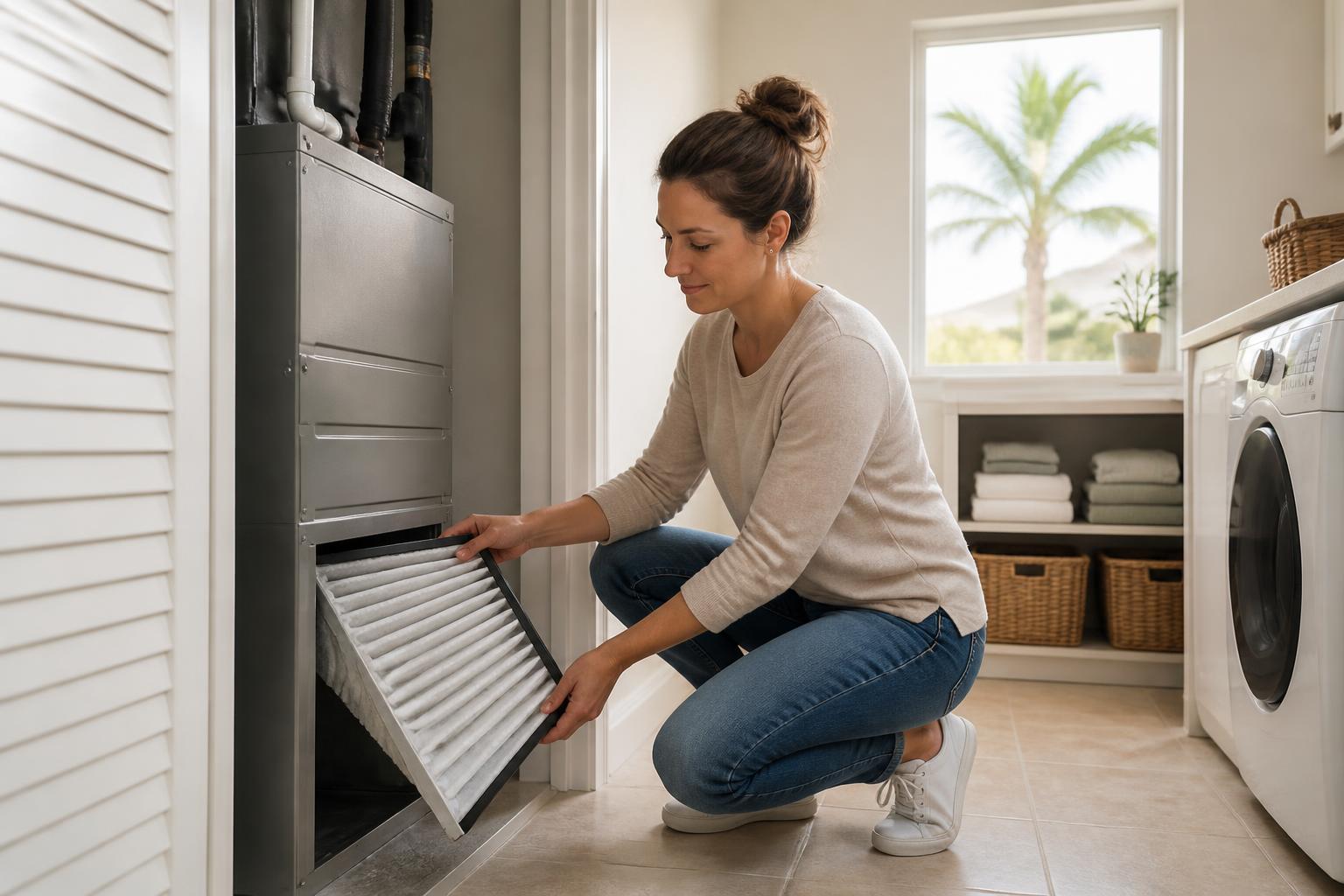
Most homeowners know they should change the AC filter. Far fewer know when. The honest answer depends less on the calendar and more on how your home is lived in — pets, people, Florida's year-round cooling, and the routine you will actually keep.
One of the smallest and least expensive maintenance tasks in a home is also one of the easiest to forget.
Most homeowners know they're supposed to change the AC filter. Far fewer could tell you when they last did it. And almost nobody can tell you why the number they have in their head — three months, six months, whenever it looks dirty — is the right number for their house.
After years of walking through homes in Southwest Florida, here's what I've learned: the answer has less to do with the calendar and more to do with the house itself.
A retired couple in a tidy two-bedroom condo, no pets, doors closed, who travel half the year, do not need the same filter schedule as a family of five with two golden retrievers, a lanai door that never stops opening, and a garage workshop.
Same filter. Same store. Completely different timeline.
So this guide won't hand you one number and send you on your way. It will teach you how to read your own home, build a schedule that fits how your family actually lives, and then stop thinking about it.
I should be clear about my role. I'm not an HVAC technician and won't pretend to be one. I don't repair or diagnose systems, and I won't tell you which brand to buy. What I do is help homeowners make smarter decisions about their homes — and a filter habit is one of the highest-return, lowest-effort decisions there is.
Why AC Filters Matter More Than Their Price Suggests
There's a strange psychology around cheap maintenance items: we assume a thing's importance matches its price. A filter is a few dollars of pleated paper in a cardboard frame, so how important can it be?
But your air conditioning system is likely one of the most expensive pieces of equipment in your home, and it moves an enormous amount of air through your house every single day. In Florida, that's practically nonstop for a good chunk of the year.
Every bit of that air passes through the filter first.
That gives one small, inexpensive item three jobs that quietly punch above their weight.
It protects the equipment. The original reason filters exist is to keep dust and debris out of the working parts of the system — protective gear for expensive machinery, positioned right where the air enters.
It affects how the system breathes. When a filter is loaded up, the system works harder to pull air through it. Anything that makes a machine work harder than designed is worth attention.
It captures particles that would otherwise circulate. Dust, dander, lint, and pollen get caught rather than recirculated through every room.
Notice what I'm not saying. I'm not promising you a specific dollar amount in energy savings, and I'm not promising that a filter change will fix anyone's allergies. Those claims get thrown around constantly online, and they're not honest. What I'll say is this: a system running the way it was designed to run is a system with fewer things going wrong. That's the whole argument, and it's enough.
What an Air Filter Actually Does — and What It Doesn't
Let's clear up a misunderstanding I hear all the time, because it changes how people think about replacement.
Most homeowners picture a filter like a screen door: big stuff gets stopped, and it keeps working until it's physically blocked.
Not quite. Filter media is a dense layer of fibers, and particles get trapped throughout its depth, not just on the face. Two things follow from that.
First, a filter can be doing its job even when it looks used. A little gray discoloration is normal and expected. That's the filter working.
Second, a filter that's genuinely loaded is a problem, not an achievement. A packed filter restricts airflow, which makes the system strain and can leave your home feeling less comfortable than it should.
So the goal isn't "use every last day of life out of it." The goal is to swap it out while it's still breathing freely.
And here's what a filter is not:
- It's not an air purifier. It's not going to solve a serious indoor air concern on its own.
- It's not a humidity control device. Florida moisture is a separate conversation — one I get into in my guide on whether humidity can ruin furniture.
- It's not a substitute for professional maintenance. Changing a filter is homeowner-level upkeep. It doesn't replace having a qualified technician service your system.
- It's not one-size-fits-all. Your system was designed for a specific size and type. Your manufacturer's documentation is the authority on that, not a blog post and not a store display.
That last point matters more than any other in this article. Whatever you read here, your system's manufacturer recommendations come first. Always.
Why There Isn't One Replacement Schedule
If you search this question, you'll get a confident answer: every 90 days.
That's roughly the mid-point of the wide range filter manufacturers print on packaging — often something like 30 to 90 days for standard pleated filters. Somebody rounded it into a rule, the internet repeated it, and now it lives in everyone's head as gospel.
The range is real. The single number isn't.
What determines how quickly a filter loads up is a simple equation with two variables:
How much air moves through it × how much stuff is in that air
That's genuinely all it is. Everything else in this article is just a way of estimating those two numbers for your particular house.
A Vermont homeowner running AC eight weeks a year with no pets is on one end. A Naples family running AC ten months a year with two shedding dogs and a construction site down the street is on the other. Handing both "90 days" is like handing them the same size shoe.
Here's the practical framing I give homeowners:
Check monthly. Replace based on what you see, not what the calendar says. Use your manufacturer's guidance as the outer boundary.
Checking is not the same as replacing. Checking takes fifteen seconds. It's what builds the instinct for your own home. After two or three months of looking, you'll know your rhythm — and then you can mostly stop looking.
The Household Factors That Set Your Real Timeline
Let's get specific. These are the things that actually move your number.
Pets
This is the single biggest variable in most homes. Dander and hair are continuously produced, they're light enough to stay airborne, and they head straight for the return vent.
One short-haired cat barely registers. Two large shedding dogs is a completely different situation — many pet-heavy households find themselves on a considerably shorter cycle than the packaging suggests.
If you have pets, assume a shorter interval than a pet-free neighbor with an identical house, and let what you see in the filter confirm it.
Number of people
More people means more activity, more doors opening, more laundry, more cooking, more textiles shedding fibers. A household of six loads a filter faster than a household of two in the same square footage. It's not dramatic, but it's real.
Children
Kids come with additional traffic in and out of the house, more floor-level activity that stirs settled dust back into the air, and more of everything generally. Households with young children tend to sit on the shorter end of the range.
Allergies and sensitivities
If someone in the house is sensitive to airborne particles, you may want both a filter that captures finer particles and a shorter replacement interval. But — important caveat — higher-capture filters can restrict airflow more, and not every system is designed for every filter type. This is exactly the kind of question to bring to a qualified HVAC professional rather than guessing.
Construction and renovation
Nothing loads a filter faster than construction dust. Drywall dust in particular is fine, abundant, and travels everywhere.
If you're renovating — or if there's active construction near you, which in Southwest Florida is often — check your filter weekly during the work and expect to replace it far more often than usual. A filter that would normally last three months can load up in a matter of weeks.
Where your home sits, and how you live in it
A house on a dirt road, near an empty lot, or downwind of ongoing development takes on more airborne debris than one in an established neighborhood. Coastal homes deal with salt air and fine sand. A lanai door that's open half the day makes a home effectively part-outdoors.
Then there's habit: windows open in February, fans running constantly, the thermostat at 71 versus 78. All of it feeds the same equation — how much air, carrying how much stuff.
Florida's Year-Round Cooling Season Changes the Math
This deserves its own section, because most filter advice online is written for climates with four distinct seasons — and it simply doesn't transfer.
In much of the country, an HVAC system gets meaningful downtime. Spring and fall are mild, windows open, the system idles. A filter installed in June might see genuinely light duty by September.
Florida doesn't work that way. Here, the air conditioning is doing real work for most of the year. In Naples, Fort Myers, Bonita Springs, and Estero, it's not unusual for a system to run in some capacity ten or eleven months out of twelve.
Three practical consequences:
Your filter accumulates more, faster. More runtime means more air through it. A Florida homeowner following advice written for Ohio is likely stretching the interval too far.
There's no natural reminder. In cold climates, the switch from cooling to heating prompts you to think about the system. Down here there's no seasonal boundary — which is exactly why a deliberate routine matters more.
Your system also handles moisture. Part of what your AC does in Florida is pull humidity out of the air. Keeping the system breathing freely supports that work, and indoor moisture affects far more than comfort — it touches wood furniture, upholstery, and leather, which is why I wrote separately about how Florida's climate affects leather furniture.
If you take one regional adjustment from this article: most Florida homes should assume the shorter end of any published range, then verify with their own eyes.
Vacation Homes, Snowbirds, and Seasonal Occupancy
Roughly a third of the homeowners I talk to in this area don't live here full-time, and seasonal homes have their own logic.
The instinct is that an empty house doesn't dirty a filter. Partly true — no people, no pets, no cooking. But the system usually still runs to manage temperature and moisture while the house sits closed, so air moves through that filter for months.
A practical rhythm for seasonal homes:
Before you leave for the season. Put in a fresh filter. Never leave a used one sitting in a closed house for six months.
During the closed season. If you have a caretaker, property manager, or neighbor checking the house, ask them to look at the filter as part of the walkthrough. Many seasonal owners have a mid-season swap done, and it's cheap insurance.
When you return. Check the filter before you settle in and start running the system hard. This is also a good moment to look at the house generally — humidity readings, any musty smell, how furniture came through the closed months.
If you have the house professionally maintained, ask your HVAC service company how they want the filter handled while you're away. They know your system. Follow their guidance over anything you read online.
If you're managing a home from a thousand miles away, filter changes belong on the same short list as pest control and landscaping — a standing task somebody handles, not something anyone tries to remember.
Understanding Filter Types Without the Jargon
You don't need to become an expert. You need enough to make an informed choice at the store and a sensible one for your system.
Fiberglass / spun filters. The inexpensive flat blue or white ones. They catch larger debris and do the basic job of protecting equipment, but they capture much less of the fine stuff. They tend to need replacing on the shorter end of any range.
Pleated filters. The accordion-folded kind, and the most common choice for everyday homes. The pleats create more surface area, which means more capacity and better capture of fine particles without necessarily choking airflow. For most homes, this is the practical middle ground.
High-efficiency and HEPA-style filters. These capture the finest particles and are marketed hard to allergy sufferers. The honest caution: denser media can restrict airflow, and not every residential system is designed for every filter. Check what your manufacturer specifies before upgrading, and ask a qualified technician if you're unsure. More is not automatically better here.
Washable / reusable filters. Appealing on paper — buy once, rinse, reuse. In practice they need diligent cleaning and must be completely dry before going back in. A damp filter in a Florida air handler is not something you want. They work well for a disciplined homeowner; many people find them harder to keep up with than swapping a disposable.
A word on MERV numbers. You'll see a MERV rating on packaging — a scale describing how fine a particle the filter captures. Higher isn't universally better; it's a trade-off between capture and airflow. Your system's documentation typically indicates an appropriate range. Stay inside it.
And the most important sizing note: the filter must fit. Size is printed on the frame of your current filter. A filter that's loose in the slot lets air slip around the edges, which defeats the purpose.
Signs Your Filter Should Be Replaced Sooner
Between calendar checks, your home will tell you things. None of these are diagnoses — they're prompts to go look.
The visual test. Pull the filter out and hold it up to a light source. Light coming through means it's still breathing. If the media looks thick, matted, or gray-brown across the whole surface, it's done.
Dust returning quickly after cleaning. If you dust on Saturday and surfaces are hazy again by Tuesday, more particles are circulating than usual.
Visible dust around vents. Buildup on supply registers or a fuzzy fringe around the return grille is worth a look.
Rooms feeling less evenly comfortable. The filter is the first, easiest, cheapest thing to rule out. If a fresh one doesn't change anything, that's a conversation for a professional — not a DIY project.
Something changed in the house. New pet. Houseguests for a month. Renovation. Grandkids for the summer. Any change in how the home is used should trigger a filter check, regardless of the date.
Windows and doors have been open a lot. Those beautiful stretches when nobody wants the AC on still bring pollen and outdoor dust inside.
You genuinely can't remember the last change. That's your answer. Replace it and start the clock.
Three Real Homeowner Situations
Abstract advice is easy to nod at and hard to use. Here's how this plays out in actual homes.
The full-time family with pets
A family of four in Fort Myers, two dogs, kids in and out to the pool all day, AC running March through November.
They started on the standard "every three months" plan. By month two the filter was consistently heavy and gray. No formula required — they simply checked monthly, saw the pattern, and settled into a much shorter cycle during the heavy months, stretching it slightly in the cooler ones. They buy a multi-pack so the next one is always in the closet, and they mark the date on the frame.
Total change to their lives: about four minutes a month.
The seasonal condo owners
A retired couple in Bonita Springs, in residence November through April, no pets, home closed the rest of the year.
Their rhythm: fresh filter when they arrive, another partway through the season, a fresh one going in the day they leave, and their property manager checks it mid-summer as part of the regular walkthrough. Four touchpoints a year, all attached to things already happening.
The key insight for them wasn't frequency. It was attaching the task to events they'd never forget — arrival and departure — rather than to dates they would.
The new-construction homeowner
A couple who moved into a newly built home near an active development.
For the first several months, construction dust was relentless — theirs and the neighborhood's. They checked weekly and replaced far more often than any packaging suggested. Once the dust settled, literally, they eased into a normal interval.
The lesson: your schedule isn't permanent. It should shift when your circumstances shift.
Common Myths Worth Retiring
"Every three months, always." A reasonable midpoint, not a rule. Your home decides.
"A more expensive filter automatically lasts longer." Not necessarily. Higher-capture filters may catch more, which can mean they load up sooner, not later. Price and lifespan aren't the same conversation.
"If it's not visibly black, it's fine." Filters restrict airflow before they look dramatic.
"Changing the filter will lower my power bill by X." Nobody can honestly promise you a number. A system operating as designed is a reasonable goal; a guaranteed savings figure is marketing.
"A better filter will fix my allergies." Filtration is one small piece of indoor air quality. Anyone with real health concerns should be talking to a medical professional and, separately, to a qualified indoor air specialist.
"Washable filters are always the smarter choice." Only if you'll genuinely clean and fully dry them on schedule. Be honest with yourself.
"An empty house doesn't need filter changes." The system usually still runs. Air still moves.
"Bigger MERV number equals better." It's a trade-off. Stay within what your system specifies.
Mistakes Homeowners Make Most Often
- Buying the wrong size and forcing it into the slot.
- Installing it backward — filters have an airflow arrow on the frame that should point toward the air handler.
- Never writing down the date, then guessing for months.
- Buying one filter at a time, so a change requires a trip to the store.
- Choosing a high-efficiency filter without checking whether the system is designed for it.
- Forgetting a second filter — some homes have more than one return.
- Leaving a used filter in a closed seasonal home.
- Ignoring the manufacturer's documentation entirely.
- Reusing a disposable filter after vacuuming it.
- Putting a washable filter back while it's still damp.
- Assuming a filter change fixes a comfort problem that actually needs a professional.
- Treating "I'll do it soon" as a plan.
A Simple Decision Framework
Four questions. Answer them once and you'll have your number.
1. How much is my system running? Nearly year-round → shorter interval. Seasonal or light use → longer.
2. What's the particle load in my house? Pets, kids, lots of occupants, open doors, construction nearby, dirt road, coastal exposure → shorter interval. Quiet, closed, pet-free home → longer.
3. What type of filter am I using, and what does my system's manufacturer specify? Start with the documented range for your system and filter type. That's the outer boundary; your household conditions determine where you land inside it.
4. What routine will I realistically keep? Be honest. A schedule you actually follow beats an ideal one you abandon in March.
Land on a starting interval, then check monthly for the first three months and adjust. After that, you'll know your home.
A Seasonal Rhythm for Florida Homes
Not a rulebook — a rhythm most homeowners here find natural.
January – February (cooler, windows open, snowbird season) Check monthly. Open windows mean outdoor pollen and dust find their way in even when the AC is quiet. Seasonal residents: fresh filter on arrival.
March – May (heat building, pollen heavy) Check monthly, expect to replace on the shorter end. Pollen season plus rising runtime is a demanding combination. Seasonal owners leaving in April: fresh filter in, before you close up.
June – September (peak cooling and humidity) Your heaviest stretch. Systems run hardest, filters load fastest. Check monthly without fail, and pet households may want to check more often. This is also the season when indoor moisture matters most throughout the house.
October – December (easing off, holidays) Runtime drops slightly. Holidays bring guests, more cooking, more foot traffic. Fresh filter before company arrives is a small, satisfying bit of hosting prep.
Any month, whenever these happen: Renovation or nearby construction. A new pet. An extended houseguest. Returning to a home that's been closed. Any of these resets the clock.
Your Printable Filter Maintenance Checklist
Know your setup
- [ ] Filter size (written on the frame of the current one)
- [ ] Filter type your system's manufacturer specifies
- [ ] Number of filters in your home — check for more than one return
- [ ] Location of each filter and how the access panel opens
- [ ] Manufacturer documentation saved somewhere you can find it
- [ ] Your HVAC service company's contact information
Every month (about 60 seconds)
- [ ] Pull the filter and hold it to a light
- [ ] Replace if the media is dense, matted, or uniformly dark
- [ ] Confirm the airflow arrow points toward the air handler
- [ ] Write the date on the new filter's frame
- [ ] Glance at the vents and return grille while you're there
Every quarter
- [ ] Confirm you still have spares on hand
- [ ] Reassess: has anything changed in the household?
- [ ] Check the return grille for dust buildup
Twice a year
- [ ] Review whether your interval still matches your life
- [ ] Confirm professional maintenance is scheduled
- [ ] Verify you're still using the type your system specifies
Seasonal or vacation homes
- [ ] Fresh filter installed before closing the house
- [ ] Mid-season check arranged with a caretaker or manager
- [ ] Filter checked on arrival, before running the system hard
- [ ] Filter changes written into your property management instructions
Situational triggers
- [ ] Renovation or nearby construction → check weekly
- [ ] New pet → shorten your interval
- [ ] Extended guests → check at the halfway point
- [ ] Windows open for a stretch → check afterward
Building a Routine You'll Actually Keep
Everything above is worthless if the habit doesn't stick. So let's talk about the part almost no article covers: making it automatic.
Attach it to something you already do. The first of the month. The day you pay a recurring bill. The Sunday you take the trash out. New habits survive when they lean on old ones.
Buy in multiples. The single biggest reason filters don't get changed is that there isn't one in the house. Keep two or three on a shelf near the air handler. A task that requires a store trip becomes a task for later, and later becomes never.
Write the date on the frame. In marker, right on the cardboard, the moment it goes in. This one tiny act eliminates the entire "when did I last do this?" problem forever.
Set a recurring phone reminder. Monthly, same day. Not "change the filter" — make it "check the filter." Checking is easy to say yes to. Replacing follows naturally when it's needed.
Keep a photo of the size in your phone. Snap the frame. No more standing in an aisle trying to remember whether it's 16x25x1.
Give it to one person. In households where "somebody" is responsible, nobody is. Name the person.
The Bigger Picture
I've spent years helping homeowners make decisions about their homes — furniture, layouts, comfort, timing, all of it. And the pattern I keep seeing has almost nothing to do with money.
The homes that hold up best over time don't belong to the people who spent the most. They belong to the people who built small, unglamorous routines and quietly kept them.
The couple who rotate their mattress twice a year and still love it at year eight. (If that's a habit you've been skipping, I wrote about it here.) The family who wipe down their leather sofa monthly and have a piece that's aged beautifully instead of just aged. The homeowner who measured properly before buying, so nothing ever had to be squeezed into a room where it didn't belong — the principle behind both choosing a dining table that fits and leaving the right space between furniture.
None of those are big moves. Not one of them is expensive. They're just small things done consistently, by someone who decided the home was worth the attention.
A filter fits that pattern exactly. It costs a few dollars. It takes a few minutes. Nobody will ever compliment you on it. And it quietly supports the comfort of every room in your house, every day, for years.
The most valuable home maintenance habits aren't always the biggest or the most expensive. Often, they're the small routines that quietly protect the comfort, the efficiency, and the systems your family relies on without ever thinking about them.
So here's the question worth sitting with:
What small maintenance habit could you start this month that your future self — and your home — would thank you for?
Let's Talk It Through
If you're working through the bigger picture of your home — how it functions, how it feels, what's worth your attention and what isn't — I'm glad to help you think it through.
I'm not an HVAC technician, and I'll always point you to a qualified professional for anything involving your system itself. What I do is help homeowners make smarter, calmer decisions about their homes: what to prioritize, what to plan for, which local professionals to trust, and how to stop guessing.
No sales pitch, no pressure. Just a practical conversation about your home and what makes sense for you.
Schedule a complimentary consultation with me and let's make your next decision an easy one.
Recommended Next Resource
Your Resource Journey — the next step homeowners take after a resource like this one.
- Fusion Compare™Compare your options side by sideSee the real trade-offs between the choices in front of you.Estimated reading time: 7 min comparisonWhy this is recommendedComparing your options side by side is what turns background reading into a shortlist.Continue
- Decision GuideDecide with a complete guideEverything that matters for this decision, in the order it matters.Estimated reading time: 8 min readWhy this is recommendedYou've done the background — this guide brings the whole decision together in one place.Continue
- AssessmentCheck where you actually standA short evaluation that turns general guidance into your situation.Estimated reading time: 4 min assessmentWhy this is recommendedA short evaluation applies everything you've read to your own home rather than the general case.Continue
Keep going
Helpful next steps
Complimentary, no-pressure resources that follow the decision you're working through.
Florida Homeowner Hub
Florida-specific homeowner considerations, season by season.
Learn moreMy Home — Care & Maintenance
Track what your home needs and when it was last done.
Learn moreHomeowner Planning Tools
Complimentary calculators and planners for real home decisions.
Learn moreAsk Maria
Talk through the decision you're actually making and get practical guidance.
Learn moreWas this guide helpful?
If you have an idea or suggestion that could help more homeowners, we'd love to hear it.
Talk it through
Planning your next home decision?
Whether you're evaluating a home, furnishing a room, improving sleep, relocating, downsizing, or simply trying to make smarter home decisions, Total Home Fusion provides practical guidance before you invest your time and money.
About the author
About Maria Banou
Maria Banou is the founder of Total Home Fusion, a homeowner decision platform focused on helping people think through the practical choices surrounding where they live, what they buy for their homes, and how their homes support everyday life. Her work includes furniture selection, sleep comfort, room planning, relocation, downsizing, Florida homeowner considerations, aging-in-place planning, and practical home decision guidance.
- Furniture Selection
- Sleep Comfort
- Room Planning
- Downsizing & Relocation
- Florida Homeowner Guidance
- Aging in Place Planning
- Home Decision Guidance
Connected guidance
More Homeowner Insights
Related resources from the Fusion Library™, chosen to continue the same decision.
What Should Never Be Stored Against a Garage Wall?
Almost every homeowner pushes boxes, bins, shelving and cabinets tight against the garage walls, because every inch you move outward gives an inch back to the middle. It looks efficient, and in floor-space terms it is. But garage walls, corners and floor transitions are one of the few places a home is still plainly visible to you. Storage does not only occupy space — it can quietly remove your ability to notice a change. This guide introduces the Garage Perimeter Visibility Test, the Storage Visibility Tax, and the idea of an inspection gap instead of an arbitrary clearance number, so you can keep the storage you need without going blind to the building behind it.
Knowledge GuideRead Article
The 7 Things Every Florida Homeowner Should Know Before They Become Expensive Problems
Most expensive home problems don’t happen overnight. Learn seven areas Florida homeowners should pay attention to before small issues become costly surprises.
Knowledge GuideRead Article
The Florida Homeowner's Comfort Guide: Creating a Home That Feels Better Every Day
Many homeowners assume comfort comes from bigger homes, newer furniture, or expensive upgrades. In reality, comfort is often influenced by smaller factors such as room layout, humidity, sleep quality, lighting, airflow, and how well a home supports your daily lifestyle. This Florida Homeowner's Comfort Guide explores practical ways to create a more comfortable home while helping you make smarter decisions that improve everyday living.
Knowledge GuideRead ArticleQuick answers
Frequently asked questions
How do I know my AC filter needs changing?
Pull it out and hold it up to a light. If light still passes through the pleats, it is breathing. If the media looks thick, matted, or uniformly gray-brown across the whole surface, replace it. Other prompts worth acting on: dust returning quickly after you clean, buildup around vents or the return grille, or a recent change in the house such as a new pet, houseguests, or nearby construction. And if you genuinely cannot remember the last change, that is your answer.
Can I leave my filter in longer than recommended?
Stretching an interval past what your system and filter manufacturer specify is not a good trade. A loaded filter restricts airflow, which makes the system work harder than it was designed to and can leave rooms feeling less comfortable. There is very little money saved by waiting an extra month, and the equipment being protected is one of the more expensive things in your home. Follow your manufacturer guidance as the outer limit, and let your own monthly check decide within it.
Do more expensive filters last longer?
Not automatically. Price usually reflects how fine a particle the filter captures, not how many months it lasts. A higher-capture filter may actually load up sooner in a dusty or pet-heavy home, because it is catching more. Denser media can also restrict airflow more, and not every residential system is designed for every filter type. Check what your system manufacturer specifies before upgrading, and ask a qualified HVAC professional if you are unsure.
Are washable filters better than disposable ones?
They can be, for a disciplined homeowner. Washable filters cost more upfront and less over time, but they only work if you clean them on schedule and let them dry completely before reinstalling. A damp filter going back into a Florida air handler is a situation nobody wants. Many homeowners find that swapping an inexpensive disposable filter is simply easier to keep up with, and the easier habit is usually the one that actually gets done.
Does Florida weather affect how often I should replace my filter?
Yes, meaningfully. Most filter advice online is written for climates with four distinct seasons and real HVAC downtime. In Southwest Florida, systems often run in some capacity ten or eleven months a year, so more air passes through the filter and it loads up faster. Add heavy spring pollen, coastal dust, and lanai doors that stay open, and most Florida homes should assume the shorter end of any published range, then verify by checking monthly.