
What Should Never Be Stored Against a Garage Wall?
Reviewed & curated by Maria BanouHome Life AdvisorPublished August 25, 2026Updated September 4, 202629 minute read
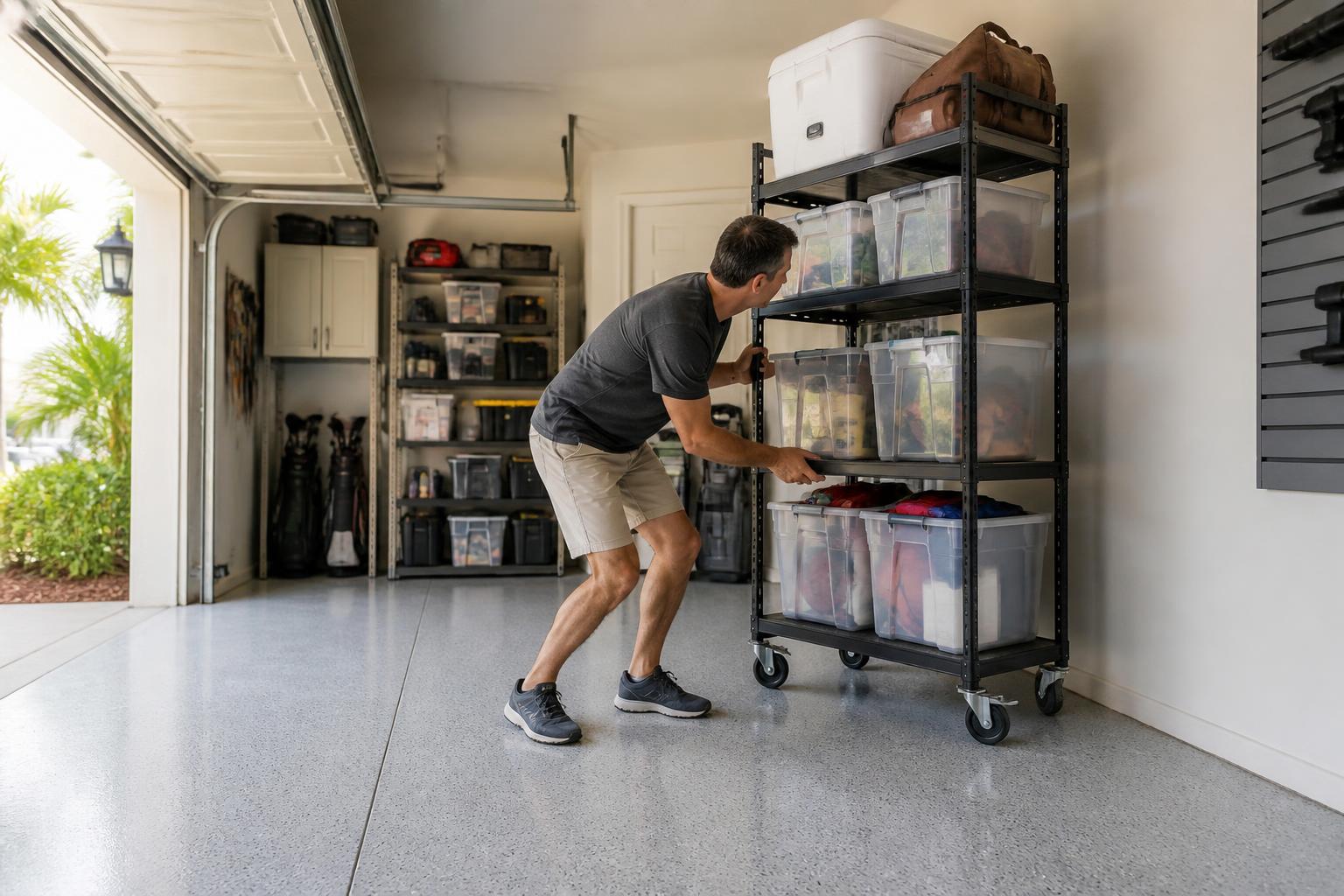
Almost every homeowner pushes boxes, bins, shelving and cabinets tight against the garage walls, because every inch you move outward gives an inch back to the middle. It looks efficient, and in floor-space terms it is. But garage walls, corners and floor transitions are one of the few places a home is still plainly visible to you. Storage does not only occupy space — it can quietly remove your ability to notice a change. This guide introduces the Garage Perimeter Visibility Test, the Storage Visibility Tax, and the idea of an inspection gap instead of an arbitrary clearance number, so you can keep the storage you need without going blind to the building behind it.
Walk into almost any garage that gets used for storage and you will probably find the same strategy at work. Boxes against the wall. Cabinets against the wall. Totes against the wall. Shelving against the wall. Bikes leaned into the corner. A stack of folded moving boxes wedged behind the water heater closet because that was the only place left.
It makes perfect sense. Every inch you push something toward the perimeter gives you back an inch in the middle, and the middle is where the cars go, where the kids' bikes turn around, where you actually walk. Perimeter packing feels like good math.
But there is a second question worth asking, and almost nobody asks it: what are those belongings preventing you from seeing?
That is a different question from "what should I not store in a garage." That article has been written a thousand times, and you already know most of the answers. This one is about something quieter and, I think, more useful. Your garage is not a storage closet that happens to be attached to your house. It is part of the house. The walls, the corners, the slab, the place where the wall meets the floor — those surfaces are one of the few places in a typical home where the building is still visible to you. No drywall texture, no paint you are afraid to scuff, no furniture you would never move. Just the structure, in plain view, quietly telling you how things are going.
And then we cover it with holiday bins.
I am not going to tell you to keep your garage walls bare. That would be unrealistic advice for most families and, frankly, a waste of good storage space. What I want to give you instead is a way of thinking about the tradeoff — because there is one, and most homeowners make it without ever noticing they made it.
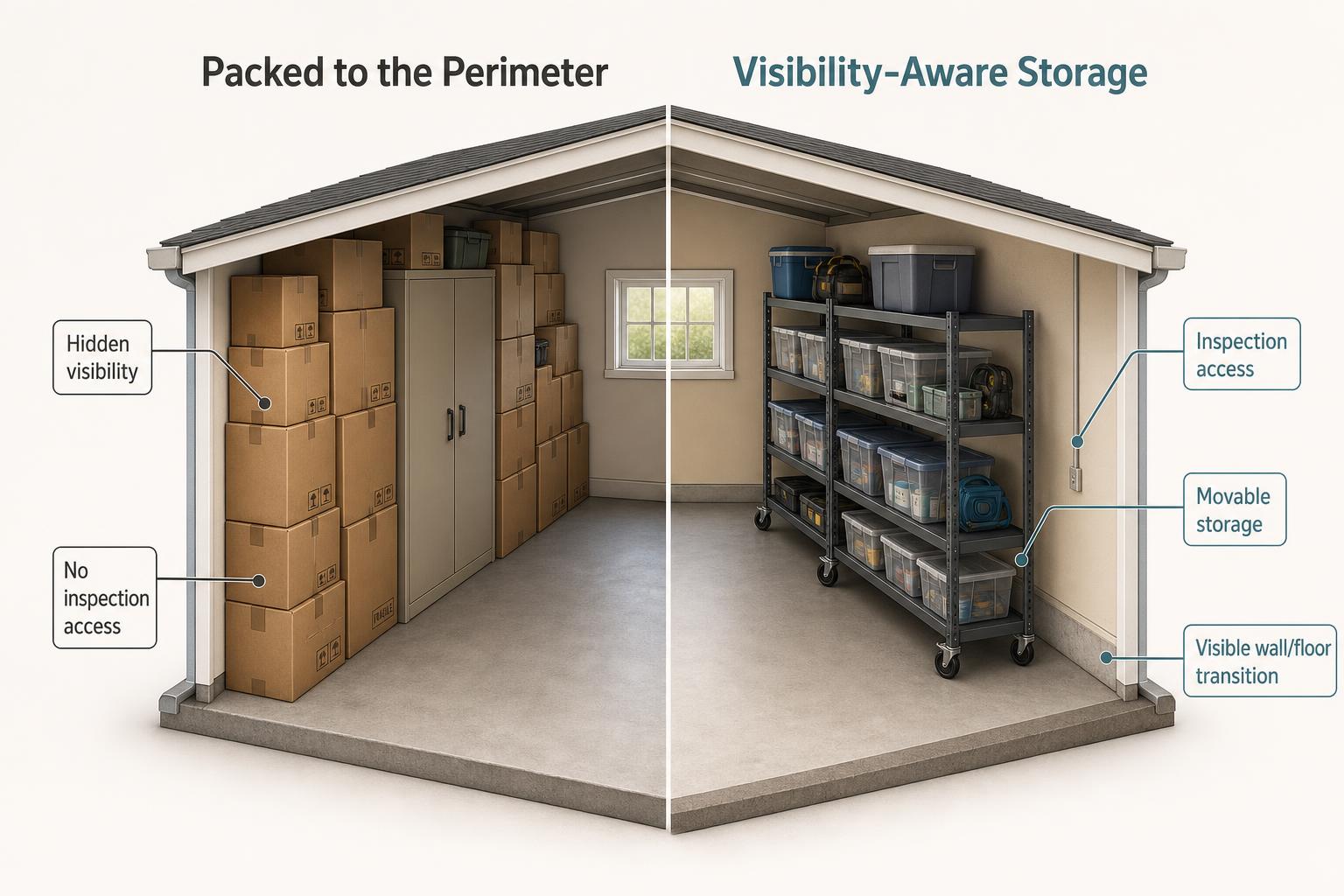
Is It Actually Okay to Store Things Against a Garage Wall?
Yes. Usually. For most items, in most garages, in most conditions, storage touching a wall is not the problem people imagine it to be.
But "can this touch the wall?" is the wrong question, and it is the reason so much garage advice online feels either paranoid or useless. Contact is not really the issue. A plastic bin resting against painted drywall is not damaging anything. A steel shelving unit backed up to the block is not causing harm by being there.
The better question is this: will this storage arrangement prevent me from seeing or reaching something I may eventually need to look at?
That reframes everything. Now the answer depends on which wall, which corner, what the object is made of, how heavy it is, whether it can be moved by one person, how often you would have a natural reason to move it, and what your climate does to a garage in August. A bin you slide out in ten seconds is a very different decision from a fifteen-foot run of anchored cabinetry, even though both are "storage against the wall."
One is a placement. The other is a commitment.
Why Homeowners Naturally Push Everything to the Perimeter
The instinct is geometric, and it is a good instinct. A garage has a fixed footprint and a non-negotiable tenant: the vehicles. Once the cars are parked and the doors can open, what is left is a ring of leftover space around the edges. Pushing belongings outward into that ring is how you keep the middle usable.
There is also a psychological piece. Perimeter storage looks tidy. A garage with everything flat against the walls reads as organized, even when the bins are unlabeled and nobody knows what is in half of them. Center-floor storage reads as chaos. So we push outward, and we feel better, and the garage looks better in photographs.
What is easy to overlook is that we are optimizing for one thing — floor area — using a metric that never accounts for anything else. Nobody stands in their garage and thinks, "I just traded eleven feet of observable wall for four cubic feet of holiday storage." But that is exactly the trade, and it is worth understanding before you make it at scale.
This is where I would rather teach a principle than a rule. Not "leave six inches." Not "nothing touches the wall." Something more like: visibility, access, and observation are features of a garage, and they compete with capacity.
Your Garage Wall Is Giving You Information
Here is the part I genuinely wish more homeowners thought about.
A garage wall is one of the most honest surfaces in your house. It is usually unfinished or lightly finished. It is not decorated. Nobody is going to repaint it because a spot appeared. Which means when something changes on that surface, the change stays visible.
Changes worth being able to notice include new discoloration, an area that looks damp or darker than the surrounding surface, staining that was not there last season, deteriorating material at the base of a wall, chalky or flaking texture, unusual debris collecting in a corner, evidence of pest activity, rust appearing on the bottom of a shelving leg, or a smell that is different from the normal garage smell.
Notice what I am not asking you to do: diagnose any of it. You do not need to know whether a stain is a plumbing issue, a wind-driven rain issue, condensation, an old spill from the prior owner, or nothing at all. Interpretation belongs to a qualified professional, and honestly, half the time the answer turns out to be boring.
The advantage is simply earlier awareness. Noticing that something changed, and roughly when, is enormously valuable information — to a plumber, to a pest control professional, to a roofer, to an insurance claim, to your own decision-making about whether this is a "watch it" or a "call someone" situation.
You cannot notice what your storage system permanently hides.
That is the whole idea in one line. Everything else in this article is just the practical version of it.
Why Hot and Humid Climates Change the Equation
I work with homeowners in Southwest Florida, so let me be specific without being alarmist. Most Florida garages are perfectly fine. This is not a warning that your garage is secretly failing.
But the environment does change the math in a few concrete ways.
An attached garage in a hot, humid climate is typically unconditioned space sharing at least one wall with conditioned space. That means you have significant temperature differences across surfaces, seasonally high outdoor humidity, cars that come home wet for six months of the year, garage doors that are not weather-tight the way a front door is, and driving rain that can arrive sideways. Add the everyday reality that a garage door opening is essentially a giant hole you open several times a day, and you have a space with real humidity swings.
None of that means damage. It means conditions vary more here, and materials that are marginal elsewhere become genuinely poor choices here. Cardboard is the obvious example. Upholstered furniture and mattresses are another — I would not store either in an unconditioned Florida garage for any meaningful period, and that is a furniture opinion, which is squarely my lane.
It also means that having a rough sense of what your garage's environment is actually doing is more useful here than it is in Denver. A simple humidity reading over time tells you whether your garage runs close to the outdoor air or noticeably drier, and whether it swings hard after a storm. That is context, not diagnosis — it will not tell you whether you have a problem, but it will tell you what kind of space you are storing things in.
If you want the deeper Florida-specific version of this — what the climate actually does to a garage and what to do about it — the Florida garage realities guide covers it properly, and the broader Florida Homeowner Hub puts the garage in context with the rest of the house.
The Wall Isn't the Only Thing You Should Be Watching
Here is a detail that surprises people: the middle of a wall is often the least informative part of it.
Think about where things tend to show up first. Water travels down and collects low. Debris gathers in corners. Pests move along edges rather than across open floor. Air and moisture come in around openings. So if you only had a limited amount of visibility to spend, you would not spend it on the middle of the wall at chest height. You would spend it on the transitions.
The places worth being able to see reasonably well:
- The wall-to-floor transition, especially along exterior walls
- Corners, which collect everything and hide it well
- Around the base of doors, including the door into the house
- Around windows, if the garage has them
- Where anything penetrates a wall — hose bibs, conduit, dryer vents, utility lines
- Anywhere plumbing or a water heater is located
- Any spot that has given you trouble before, which is exactly the spot people bury first
That last one deserves a sentence of its own. There is a very human tendency to store things over the area you would rather not think about. If a corner had a stain three years ago and it was addressed, that corner is now the most informative square foot in the garage — and it is usually the one behind the Christmas tree box.
What Types of Storage Deserve More Thought?
This is not a list of things you should never keep in a garage. It is a list organized by how a given object interacts with the perimeter — how much it hides, how permanent it is, and how easy it is to move when you want to look behind it.
Cardboard boxes. High hiding, low durability, poor humidity tolerance. They also fail quietly, which is the real issue.
Plastic bins. Much better as containers, identical as visual barriers. A wall of stacked totes hides just as much wall as a wall of stacked boxes.
Freestanding cabinets. Excellent capacity, excellent appearance, very high visibility cost. More on this below, because it deserves its own section.
Open shelving. Often the best compromise in the whole category. You still see the wall through and under it, and many units can be walked away from the wall by one person.
Upholstered furniture and mattresses. These are my professional lane, and my honest advice is that an unconditioned garage in a humid climate is a poor long-term home for either one. If they must be there, they should be off the slab, wrapped appropriately, and not pressed flat against an exterior wall where air cannot move.
Rugs. Rolled rugs standing on end against a wall are a classic. They are tall, they touch the floor, and they hide a vertical strip of the wall-floor transition completely.
Wood furniture. Tolerates the garage better than upholstery, still not ideal, and heavy enough that "I'll move it and check behind it" rarely happens.
Paper records. Better in the house. Almost always.
Seasonal decorations. The single most common perimeter occupant, and the one least likely to be moved between November and November.
Luggage. Light, bulky, and a great candidate for high storage rather than floor-level perimeter storage.
The pattern is not really about materials. It is about the combination of how much wall an item covers and how likely you are to ever move it.
Cardboard Changes the Risk Equation
Cardboard deserves its own section, and not for the reason you expect.
Yes, cardboard absorbs moisture from humid air. Yes, it softens, warps, and loses structural strength over time. Yes, in most climates it is a less durable container than sealed plastic, and pest professionals will tell you it is not their favorite material to find stacked against a wall.
But the thing I find most interesting about cardboard is that it fails *invisibly and slowly*. A box does not announce that it has been sitting in a damp corner. It just gradually gets softer, and then one day it collapses when you lift it, and the contents were compromised long before that moment. And because the stack looks the same from the front for years, nobody has any reason to move it.
So cardboard creates a double blind spot. It hides the wall behind it, and it hides its own deterioration.
Sealed hard-sided bins genuinely help with the second problem. They protect contents, they stack predictably, they do not absorb humidity, and clear or semi-clear versions let you identify contents without opening anything. If you are replacing cardboard in a garage, that is a good and worthwhile upgrade — the Garage Buying Guide covers what to look for, and the sealed bins versus boxes comparison walks through the tradeoff in detail.
What sealed bins do not solve is the first problem. A perfectly organized wall of latching totes stacked five high against an exterior wall hides exactly as much building as cardboard did. Better containers, same visibility tax.
Cabinets Can Hide More Than Boxes
Now the section I most want you to read.
Cabinets are the aspirational garage upgrade. They look wonderful. They hide clutter behind doors. They make a garage feel like a finished room instead of a leftover space. When homeowners show me a garage they are proud of, there are usually cabinets in the photo.
And a full run of cabinets can conceal more wall, more thoroughly, for more years, than any pile of boxes ever will.
A stack of bins gets rearranged every season. Somebody pulls the holiday tote in December and puts it back in January, and in that moment they look at the wall whether they meant to or not. A cabinet installed against a wall may not move for a decade. Nobody has a reason to move it. Moving it is a project. It might be anchored. It might have a countertop. It might be part of a matched run where removing one piece means dismantling three.
Which produces a genuinely counterintuitive result: a beautifully organized garage can be less observable than a messy one.
I want to be careful here, because I am not telling you to skip cabinets. They are often the right choice, and for many households they are the difference between a garage that works and one that does not. What I am suggesting is that cabinet placement deserves more thought than "against the longest wall."
A few practical approaches homeowners have found useful:
- Put the long cabinet run on an interior wall — often a shared wall with the house — and use lighter, more movable storage along exterior walls
- Choose base cabinets with legs or a recessed toe kick rather than a fully closed base to the slab, so the wall-floor line is at least partly visible
- Leave the corners out of the cabinet plan; corners are where the useful information collects and where cabinetry is least efficient anyway
- Do not cover a hose bib, cleanout, shutoff, panel, or water heater access, ever, no matter how well it fits
- Where a wall must be covered, know that you covered it — write it down, photograph it before installation, and treat that section as a scheduled look rather than an assumed one
If you are weighing cabinets against other systems, the garage storage guide compares wall track, shelving and casework by what each is genuinely good at.
How Much Space Should You Leave?
I am deliberately not going to give you a number.
Every article that says "leave four inches" or "leave six inches" is inventing a specification that has no authority behind it for your garage, your climate, your wall assembly, or the object in question. Four inches behind a shelving unit is meaningless if you cannot get your head or a flashlight into the space. Zero inches behind a bin you slide out with one hand is completely fine.
The useful concept is not clearance. It is what I would call an inspection gap.
An inspection gap is enough practical space, access, or movability that you can periodically observe an area without a project. That is the definition, and notice that it does not require empty space at all. It can come from any of these:
- Physical clearance behind or beside a unit
- Shelving with legs, so you can see the floor line underneath
- Casters, so a heavy unit rolls instead of being carried
- Bins that slide out individually rather than stacking into a solid mass
- Shelves that lift out, so a section can be opened up quickly
- Intentional inspection points — deliberately leaving one or two access spots along a wall you otherwise covered
The goal is not empty space. The goal is access. A garage where every unit can be moved by one person in under a minute has excellent visibility even if nothing is more than an inch off the wall. A garage with a tidy six-inch gap behind an anchored, loaded, immovable cabinet run has a gap you will never actually use.
Ask yourself the honest version of the question: *if I wanted to look at that wall next Saturday, what would it take?* If the answer is "a helper, an hour, and emptying two shelves," you do not have an inspection gap. You have a wall you have decided not to look at.
The Storage Mobility Principle
This leads to a way of shopping that I think is underrated.
Storage that can move may be worth more than storage that holds more.
Picture two cabinets. One is larger, holds maybe twenty percent more, and sits flush to the floor, fully loaded, effectively permanent. The other is slightly smaller, sits on good locking casters, and one person can unlock it and roll it two feet out from the wall.
On a spec sheet, the first one wins. In the life of a house, I would take the second one almost every time. Not because I expect a problem, but because the smaller cabinet lets you check, clean, run a cord, chase a smell, retrieve something that fell behind, or show a professional exactly what they need to see — all without a project.
Mobility also ages well. Households change. The garage that stores strollers becomes the garage that stores golf clubs becomes the garage that stores mobility equipment or a workshop or a second refrigerator. Storage that moves adapts. Storage that is bolted to a wall for maximum capacity locks in the layout you needed the year you installed it.
When you are comparing garage storage products, mobility deserves to sit next to capacity and price as a real criterion — not an afterthought. The garage worksheets include a quote comparison sheet where that is a fair thing to ask a vendor about.
The Garage Perimeter Visibility Test
Before you place anything permanent or semi-permanent against a garage wall, run it through five questions. It takes about thirty seconds and it will change some decisions.
- Can I see it? Can I reasonably observe the wall, the corner, and the wall-to-floor transition in this area, or does this storage close it off entirely?
- Can I reach it? If I wanted to touch that surface — or point a flashlight at it, or let a professional look at it — could I, without a project?
- Can I move it? Could this be moved by the people who actually live here, without dismantling half the garage?
- Would I notice a change? If staining, moisture, debris, deterioration or pest evidence appeared in this area, would anything about my normal routine bring it to my attention?
- Am I sacrificing visibility for a few inches? Is the extra capacity I gain by pushing this tight to the wall actually worth what it hides?
You will fail some of these on purpose, and that is fine. A garage where every answer is perfect is a garage with no storage in it. The point is to fail them knowingly, in the places where it matters least, rather than accidentally along the exterior wall where the water heater lives.
The Storage Visibility Tax
Here is the idea I would most like you to take with you.
Every storage decision has two prices. The first is the one you pay at checkout. The second is what I call the storage visibility tax — the amount of your home you can no longer observe as a result of that decision.
A cabinet might give you twenty cubic feet of genuinely useful, well-organized storage. Wonderful. Its true cost is the purchase price, the installation, *and* the eight linear feet of wall and floor transition that just went dark for the next ten years.
Sometimes that tax is trivial. Covering an interior wall shared with a bedroom, in a dry climate, with a unit on casters, costs you almost nothing. Sometimes the tax is steep — covering an exterior corner near plumbing in a humid climate with anchored casework you will never move is an expensive decision in visibility terms, even if the cabinet was on sale.
The tax is not a reason to avoid storage. Homes are for living in, and garages are for storing things. It is a reason to *spend* the tax deliberately: pay it on the walls where information is least likely to appear, and keep your visibility where changes tend to show up first.
Most homeowners have never priced this. Once you do, you start placing storage differently without owning any less.
Three Homeowners, Three Lessons
The holiday boxes. A family stacks eight boxes of decorations against the back wall of the garage every January. In November, when they pull them out, there is staining on the wall behind them. Understandably, the first reaction is that the boxes caused it.
Almost certainly they did not. The important lesson is different and more useful: the boxes delayed visibility. Whatever the cause turned out to be — and that is a question for the right professional — it existed for some portion of ten months before anyone had a reason to look. The cost of the storage arrangement was not damage. It was time.
The movable shelving. Another homeowner buys freestanding shelving on casters instead of packing the perimeter solid. During a seasonal reorganize, she rolls a unit out and notices that the wall-floor transition looks different from the rest of the run. She does not know what it means, and she does not try to. She photographs it, notes the date, and calls someone qualified to look.
Nothing about that story is dramatic. That is the point. Earlier awareness turned a potential surprise into a scheduled conversation.
The beautiful garage. A homeowner invests in a full cabinet package. Matched doors, a work surface, overhead units, the whole wall. The garage looks better than the kitchen. Two years later he realizes something odd: he no longer has any idea what the perimeter of his garage looks like. Organization went up dramatically. Observability went down just as dramatically.
He was not wrong to buy the cabinets. He simply had not been told there was a second price. Organization and home intelligence are not the same thing, and no one selling storage has any reason to mention it.
The Five-Minute Garage Perimeter Check
You do not need a schedule, a checklist app, or an annual professional inspection to benefit from this. You need a habit that takes five minutes.
Once or twice a year — and after anything unusual, like a significant storm, a plumbing repair, or a period where the garage was closed up for weeks — walk the perimeter of your garage with your phone in your hand and just look.
What you are looking for:
- New staining or discoloration on walls, especially low
- Areas that look or feel damp when the rest does not
- Damaged, sagging, softened or stained containers
- Unusual debris, particularly in corners and along edges
- Any evidence of pest activity
- Cardboard that has deteriorated since you last looked
- A smell that is different from the normal garage smell
- Changes at the wall-to-floor line
- Rust or corrosion at the base of shelving and metal legs
Take photos of anything you want to compare later, and take them from roughly the same spot each time. A photo from last spring is one of the most useful things you can hand a professional, because it answers the question they always ask: how long has it been like this?
Then stop. Do not diagnose. Observation is the whole job. If something looks like it warrants a real opinion, get a real opinion — a licensed plumber, a roofer, a pest control professional, a general contractor, or a home inspector, depending on what you are looking at. If you would like help figuring out which kind of professional that is, that is exactly the sort of question I am here for, and the Trusted Network exists for the moment you decide you want someone local to look.
Design Your Garage So the House Can Still Talk to You
Put all of this together and you get a slightly different definition of a well-designed garage.
A good garage balances six things, not one: capacity, accessibility, visibility, movement, maintenance, and future flexibility. Capacity is the only one that shows up on the box. It is also the only one most people optimize for.
The garage that holds the most is not automatically the best garage. The best garage is the one that holds what your household actually needs, in a way you can still see around, reach into, and change your mind about in five years.
If you are planning a garage project from scratch, the sequence matters more than the products — the garage planning guide walks through the order that keeps people from paying twice, and the Garage Hub is where the whole ecosystem lives.
Common Mistakes Homeowners Make
Treating every inch of perimeter as storage capacity. The perimeter is not free space. It is the part of the building you can still see, and it has value in that role too.
Stacking cardboard against walls that are rarely inspected. The material least able to tolerate a garage, placed where nobody will notice it failing.
Assuming plastic bins solve everything. They solve the container problem completely and the visibility problem not at all.
Installing large cabinet runs without considering future access. The most permanent storage decision in the garage is usually made with the least thought about what happens in year seven.
Blocking utility, shutoff, panel or water heater access. This is the one I would ask you to fix today if it describes your garage. Anything you might need in a hurry — or that a professional will need — should never be behind a loaded shelf.
Ignoring wall-to-floor transitions. The most informative line in the garage, and the one most consistently covered.
Leaving stored furniture untouched for years. Furniture against a garage wall for five years is not storage. It is a decision to never look at that wall, plus furniture that is probably no longer worth keeping.
Assuming "organized" means "well planned." Tidiness is visual. Planning accounts for time, access, change and observation.
Packing storage around a previously problematic area. The spot with history is the spot you most want to be able to see.
Designing storage only for today's belongings. Households change faster than casework does. Build in the ability to change your mind.
Four Myths Worth Retiring
Myth: Nothing should ever touch a garage wall. Contact is not the issue. Material, location, mobility, climate, and access are. A bin touching an interior wall is fine. A cabinet permanently sealing an exterior corner near plumbing deserves more thought — and the difference has nothing to do with whether something is technically touching.
Myth: Plastic storage bins solve the problem. Bins are a genuine upgrade over cardboard for protecting contents, resisting humidity and stacking predictably. They block your view of the wall exactly as effectively. Better containers, same visibility tax.
Myth: If the garage looks dry, moisture is not a concern. A single glance tells you about one moment. What matters is change over time, which is why photographs and a twice-yearly walk are more useful than any one-time impression — and why a wall you cannot see cannot participate in that comparison at all.
Myth: Built-in cabinets are automatically the best garage storage. They are often excellent. They are also the least reversible and the least movable option available, which means they should be placed with more care than anything else in the garage, not less.
Garage Wall Visibility Checklist
Print this, or copy it into your notes app, and walk your garage with it. It pairs well with the printable garage worksheets, which include measurement, zoning and declutter sheets.
- Walk the full garage perimeter, slowly
- Identify every area completely hidden by storage
- Look at the wall-to-floor transitions along exterior walls
- Check all four corners
- Review any cardboard storage for softness, staining or sagging
- Inspect bins for cracks, warping or damaged lids
- Identify large cabinets or units that one person could not move
- Note the areas around doors and windows
- Confirm utility, shutoff, panel and water heater access is clear
- Look for new staining or discoloration
- Note unusual debris or any evidence of pest activity
- Notice any odor that differs from the normal garage smell
- Check a humidity reading if you have one, and note the date
- Identify at least one storage unit you could make more movable
- Photograph any area you want to compare next time, from a repeatable spot
- Re-walk the perimeter after any major storage change or unusual weather event
Homeowners Also Ask
Should garage shelving touch the wall? It can. Freestanding shelving against a wall is normal and fine. What matters more is whether the unit has legs so you can see the floor line, and whether one person can walk it away from the wall when they want to look behind it.
Can plastic bins sit against a garage wall? Yes. Sealed hard-sided bins are a good garage container. Just remember that stacking them into a solid five-foot wall of storage hides the building behind them as completely as anything else would.
Should cardboard boxes be stored in a garage? For short periods and non-precious items, it is workable. For anything you intend to keep, in a humid climate, sealed bins are a meaningfully better choice — cardboard softens over time and fails without warning.
How much space should I leave behind garage shelving? There is no universal number, and be skeptical of anyone who gives you one. Aim for enough access to look and reach — which may mean clearance, or may simply mean the unit rolls.
Should garage cabinets be installed flush against the wall? Often, yes, for stability and appearance. The more useful decision is *which* wall you cover. Prefer interior walls for long permanent runs, and keep corners and utility areas out of the plan.
Is it better to keep garage storage off the floor? Generally yes, in humid climates especially. Off-floor storage protects contents, makes cleaning easier, and leaves the wall-to-floor transition visible — the line where changes tend to appear first.
Can humidity damage items stored in a garage? It can affect paper, photographs, textiles, upholstery, mattresses, electronics and some adhesives and paints. Sealed containers help considerably. Items you truly care about generally belong inside the conditioned house.
How often should I look behind garage storage? Once or twice a year is a reasonable rhythm for most homes, plus after any significant storm, plumbing event or long period where the garage was closed up. This is observation, not an inspection schedule.
Continue Your Homeowner Journey
Planning a full garage reset? Start with the garage planning guide — it sets the order of operations that keeps homeowners from buying storage before the space is measured.
Wondering which storage products actually make sense? The Garage Buying Guide covers what to buy, in what order, and what to ask before you pay.
Want to evaluate your garage before buying anything? Take the Garage Readiness Assessment — about fourteen questions, and it turns how you actually use the space into a prioritized plan.
Living with Florida humidity? The Florida garage realities guide and the Florida Homeowner Hub cover what this climate does to a garage and to the rest of the house.
Found something behind your storage that may need attention? Do not try to diagnose it. Photograph it, note the date, and talk to someone qualified — the Trusted Network is there when you want a local professional, and you are always welcome to ask me which kind of professional you actually need.
One Last Thought
A well-organized garage is not simply the one that holds the most. It is the one that still lets you understand the space around what it holds.
Storage is not free, even when the shelf was. Some of what you pay is capacity you gained. Some of it is awareness you gave up. Most homeowners only ever price the first half of that trade, and the second half only shows up years later, usually at an inconvenient moment.
So spend it on purpose. Cover the walls where nothing is likely to happen. Keep your eyes on the corners, the transitions, the utility areas, and the wall the weather actually touches. Buy the shelving that rolls. And every so often, walk the perimeter and just look.
Sometimes the smartest use of the last few inches is not storage at all. It is visibility.
If you moved everything six inches away from your garage walls tomorrow, what might you find that you have not seen in years?
Need a second opinion?
Whether you're relocating, downsizing, preparing for retirement, welcoming a new family member, furnishing a new home, or simply trying to make smarter home decisions, I'm here to help.
Schedule a complimentary consultation with Maria Banou.
Recommended Next Resource
Your Resource Journey — the next step homeowners take after a resource like this one.
- Fusion Compare™Compare your options side by sideSee the real trade-offs between the choices in front of you.Estimated reading time: 7 min comparisonWhy this is recommendedComparing your options side by side is what turns background reading into a shortlist.Continue
- Decision GuideDecide with a complete guideEverything that matters for this decision, in the order it matters.Estimated reading time: 8 min readWhy this is recommendedYou've done the background — this guide brings the whole decision together in one place.Continue
- AssessmentCheck where you actually standA short evaluation that turns general guidance into your situation.Estimated reading time: 4 min assessmentWhy this is recommendedA short evaluation applies everything you've read to your own home rather than the general case.Continue
Keep going
Helpful next steps
Complimentary, no-pressure resources that follow the decision you're working through.
Florida Homeowner Hub
Florida-specific homeowner considerations, season by season.
Learn moreMy Home — Care & Maintenance
Track what your home needs and when it was last done.
Learn moreHomeowner Planning Tools
Complimentary calculators and planners for real home decisions.
Learn moreAsk Maria
Talk through the decision you're actually making and get practical guidance.
Learn moreWas this guide helpful?
If you have an idea or suggestion that could help more homeowners, we'd love to hear it.
Talk it through
Planning your next home decision?
Whether you're evaluating a home, furnishing a room, improving sleep, relocating, downsizing, or simply trying to make smarter home decisions, Total Home Fusion provides practical guidance before you invest your time and money.
About the author
About Maria Banou
Maria Banou is the founder of Total Home Fusion, a homeowner decision platform focused on helping people think through the practical choices surrounding where they live, what they buy for their homes, and how their homes support everyday life. Her work includes furniture selection, sleep comfort, room planning, relocation, downsizing, Florida homeowner considerations, aging-in-place planning, and practical home decision guidance.
- Furniture Selection
- Sleep Comfort
- Room Planning
- Downsizing & Relocation
- Florida Homeowner Guidance
- Aging in Place Planning
- Home Decision Guidance
Connected guidance
More Homeowner Insights
Related resources from the Fusion Library™, chosen to continue the same decision.
How Often Should You Change Your AC Filter? A Homeowner's Practical Guide
Most homeowners know they should change the AC filter. Far fewer know when. The honest answer depends less on the calendar and more on how your home is lived in — pets, people, Florida's year-round cooling, and the routine you will actually keep.
Knowledge GuideRead Article
The 7 Things Every Florida Homeowner Should Know Before They Become Expensive Problems
Most expensive home problems don’t happen overnight. Learn seven areas Florida homeowners should pay attention to before small issues become costly surprises.
Knowledge GuideRead Article
Can Humidity Ruin Furniture? Here's What Every Homeowner Should Know
Humidity almost never ruins furniture in one dramatic moment. It changes it quietly, over seasons. Here is how moisture actually works on wood, leather, fabric, foam and metal — and the simple habits that keep good furniture performing for decades.
Knowledge GuideRead ArticleQuick answers
Frequently asked questions
Is it bad to store things against a garage wall?
Not usually. Contact itself is rarely the issue. What matters is whether the arrangement permanently hides a part of the building you may need to look at. Storage you can move, shelving with visible legs, and bins that slide out individually all let you keep the capacity while keeping the wall observable. A large, immovable run against an exterior wall is the decision worth thinking about twice.
What is an inspection gap in a garage?
An inspection gap is enough practical space, access, or movability to let you periodically observe a wall, corner, or floor transition without turning it into a project. It does not require empty space. Casters, shelf legs, lift-out shelves, and bins that slide out one at a time all create an inspection gap just as effectively as physical clearance behind a unit.
How much clearance should I leave behind garage shelving?
There is no universal number that applies to every garage, wall, climate, and object, and it is worth being skeptical of any article that gives you one. Aim for the outcome instead of the measurement: could you look at and reach that surface next Saturday without help? If the answer is yes, you have enough, whether that came from clearance or from mobility.
Are garage cabinets a bad idea?
No. Cabinets are often the right choice for capacity, dust protection, and appearance. They are simply the least reversible storage in the garage, so placement deserves extra care. Prefer interior walls for long permanent runs, keep corners and utility areas out of the plan, choose bases with legs or a toe kick where possible, and never cover a shutoff, panel, cleanout, or water heater access.
How often should I look behind my garage storage?
Once or twice a year suits most homes, plus after any significant storm, plumbing event, or long stretch where the garage stayed closed up. Walk the perimeter, look for changes rather than problems, and photograph anything you want to compare later from the same spot. The goal is observation, not diagnosis — interpretation belongs to a qualified professional.