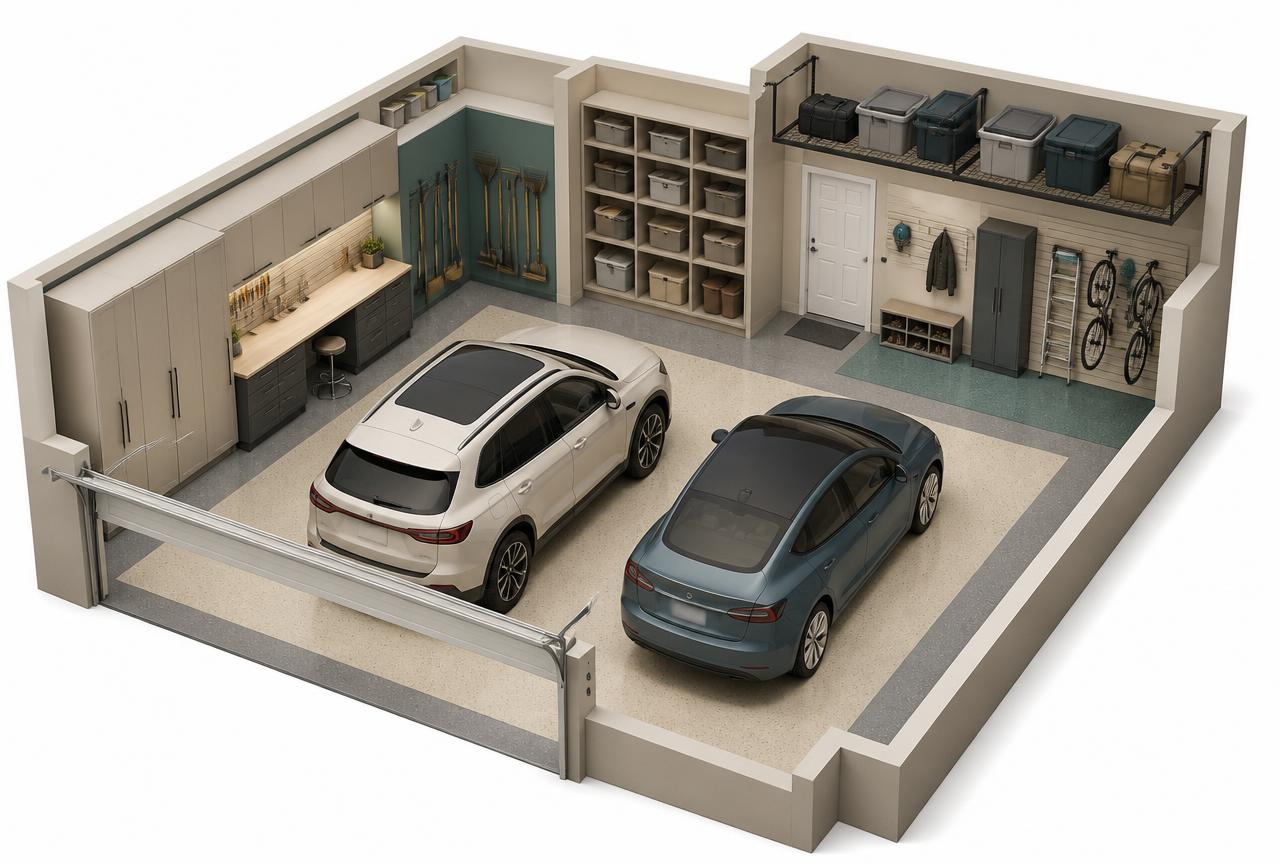
Racks above the parked cars, clear of the open door and opener rail.
- Hurricane shutters
- Off-season furniture
- Rarely used sports gear
Common mistake: Loading a rack without knowing its rated capacity, or mounting it into the wrong framing.

Total Home Fusion
Plan the garage around how you live, not around what stores want to sell you.
The garage is the most used and least planned room in the house. Work out your space, storage, flooring, organization, comfort, and upgrade options first — starting from your measurements, not a catalog — with specialized Florida guidance where local conditions genuinely change the decision.
Guidance from Maria Banou, Home Life Advisor, based in Naples, Florida. Electrical, structural, and garage door work is always referred to a licensed professional.
What You'll Find Here™
Every recommendation starts from what you measured, not from a catalog. The garage you have decides what fits.
The planning works in any garage. Where heat, humidity, salt air, or storm season change the answer, you get the Florida layer as well.
Shelving versus cabinets, coat versus seal, repair versus replace — with who each option actually suits.
Maria is a Home Life Advisor. Electrical, structural, and garage door work goes to licensed professionals, and she tells you exactly when.
Choose Your Path™
Pick the starting point that sounds like you and we'll take it from there.
Start here
Three starting points, in the order most homeowners use them. Everything else can wait.
14 plain questions, no contact details — you get what is working, what needs attention, and the order to tackle it.
Start with your space
Intent first, measurements second. Get those two right and the zoning and the buying decisions below mostly answer themselves.
“The cars fit, but nobody can open a door without turning sideways.”
Clearance first, storage second. Measure the parked footprint before buying a single cabinet.
“Everything that has no home in the house ends up on the garage floor.”
Decide what belongs in a garage at all — heat and humidity rule out more than people expect, and more still in Florida.
“Storm shutters, seasonal supplies, and patio furniture need somewhere to live twice a year.”
One reachable staging zone beats storing seasonal gear behind the holiday bins.
“There is a bench, but it is buried under whatever came in last.”
Protect one working zone that storage is never allowed to grow into.
“The second fridge, the freezer, and the laundry all share the wall.”
Heat, airflow, and outlet load decide where these can sit — and when to call an electrician.
“The step into the house is the hardest part of the day.”
Clear path width, lighting, and the entry step matter more than any storage system.
Twenty minutes with a tape measure saves a return trip, a restocking fee, and a weekend.
Park the way you normally do, then measure the space left on each side and behind the vehicles.
Cabinets, shelving, and bikes all live in what is left over — not in the empty garage you imagine.
Open every car door, the house door, and the trash path. Mark the floor with tape.
The most common regret is storage installed exactly where a door opens.
Measure floor to the lowest thing on the ceiling — track, opener, lights, ductwork.
Vertical space is the cheapest storage you own, but only up to the lowest obstruction.
Measure from the open garage door panels down, and note where the opener rail sits.
Overhead racks have to clear a fully open door, not a closed one.
Count outlets, note which wall they are on, and look at what is already plugged in.
A second fridge, freezer, and shop tools on one circuit is a conversation for a licensed electrician.
Look for staining at the slab edge, rust on the bottom of shelving, and musty smell.
Moisture decides what may be stored here and whether a floor coating will hold — and it decides it faster in a humid climate like Florida.
Next step: zone the space below, then use those numbers when you ask Maria about your layout.
Garage Zoning Model
Read it from the ceiling down. Each layer has a job, and the mistakes happen when a layer takes on the wrong one.
Numbers 1–5 run from the ceiling down. The parked footprint and the walking clearance beside it are not storage — they stay empty. Everything else is decided by which zone it belongs in.
Racks above the parked cars, clear of the open door and opener rail.
Common mistake: Loading a rack without knowing its rated capacity, or mounting it into the wrong framing.
Above reach, still visible. Light, labeled, and infrequent.
Common mistake: Unlabeled bins. If you cannot read it from the floor, you will not use it.
The one band you actually use every week. Guard it.
Common mistake: Filling the best real estate in the garage with things touched once a year.
Waist height and below, along walls the cars do not touch.
Common mistake: Storing heavy items overhead because the low wall was already full of light clutter.
Parking, walking, and rolling things in and out. Kept deliberately empty.
Common mistake: Letting bins live on the floor 'temporarily'. It is never temporary.
Next step: ask Maria about your layout or photograph the garage in AI Home Vision.
Browse everything
15 resource collections you can open right now. Several of them — the knowledge guides, comparisons and FAQs — hold many individual articles, which is why the library is larger than this list. Search or browse; each card says exactly what it does.
Showing all 15 resource collections.
Florida Garage Intelligence
Everything above applies to any garage. This is the regional layer: heat, humidity, mildew, salt air, storms, and pests decide more about garage storage in Florida than any product does. Outside a hot, humid, coastal climate you can read it lightly and move on.
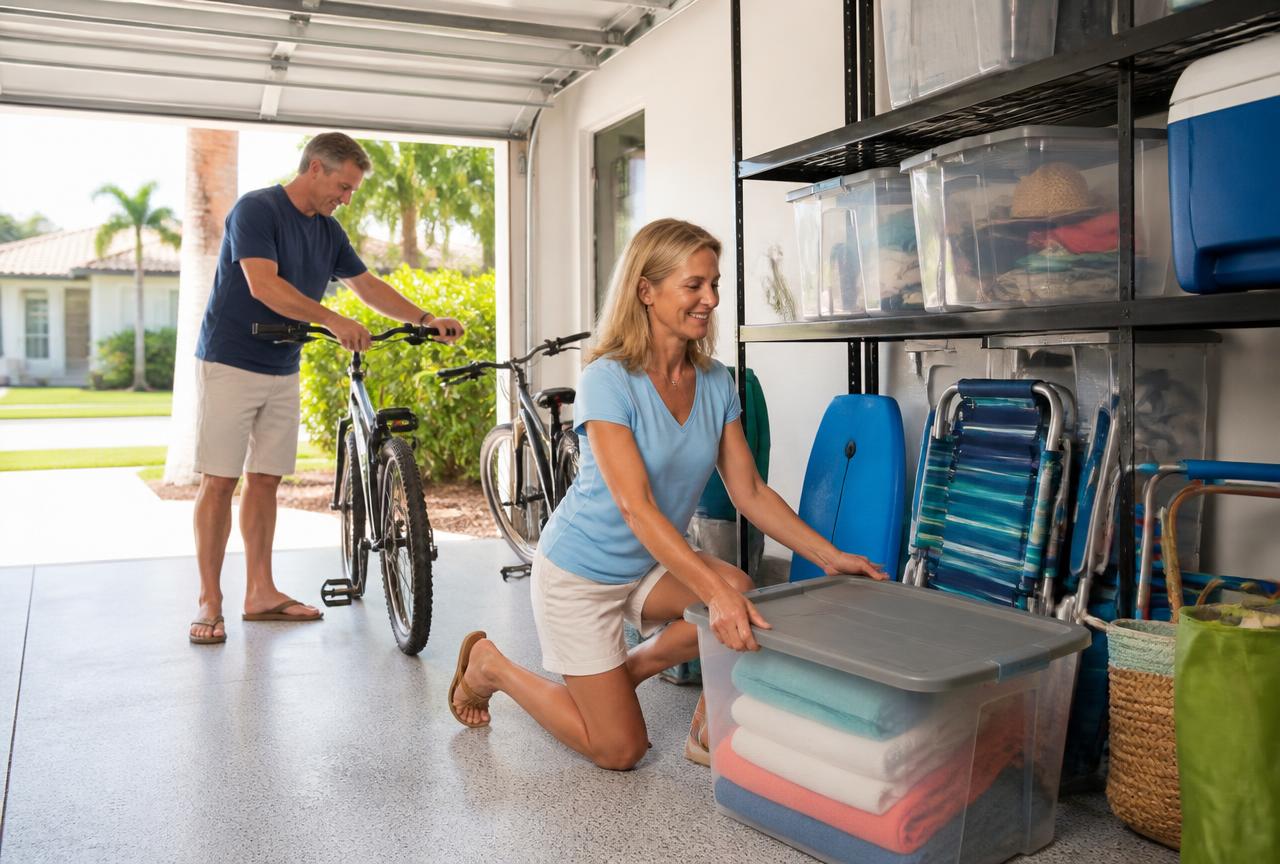
An attached Southwest Florida garage runs far hotter than the house for months at a time, and it stays hot overnight.
Keep anything heat-sensitive out: candles, paint, medications, batteries, vinyl records, wine, electronics, and most adhesives. Store them inside instead.
Humid air condenses on cool concrete and metal, which is why cardboard sags and tool surfaces bloom with rust.
Switch cardboard to sealed bins, lift everything off the slab, and leave air gaps behind shelving so the wall can breathe.
The humidity realityFabric, paper, and upholstered items stored in a garage rarely survive a Florida summer intact.
Treat the garage as unsuitable for textiles and documents. If it has to be here, seal it and check it seasonally.
Preventing mold and mildewCoastal homes see corrosion on hardware, hinges, springs, and shelving long before inland homes do.
Choose coated or stainless hardware near the coast and rinse beach gear before it comes back inside the garage.
Salt air and coastal livingThe garage door is often the largest opening on the house, and the garage becomes the staging area for the whole family.
Keep one reachable storm zone year-round, and have door reinforcement or rating questions answered by a licensed installer — not by a checklist.
Hurricane season playbookOpen bags, cardboard, and pet food are an invitation in a warm, humid space with a door that opens daily.
Hard-sided sealed containers for anything edible, including birdseed, pet food, and grill supplies.
Next step: photograph the garage in AI Home Vision or ask Maria about heat and humidity.
Garage Decisions
Every option here suits someone. The question is which one suits you and this garage. Open any decision for the full comparison.
Maria Recommends
Characteristics, not brands. No affiliate links, no pricing — just the reasoning.
Cardboard fails in humidity — fast in Florida — and a failed box is how good things quietly turn into trash.
Best for: Anything you actually intend to keep for more than one season.
It gets the floor clear immediately and costs a fraction of casework, so you learn your layout before committing.
Best for: Bikes, yard tools, beach gear, and anything awkward.
Storage only works when you can find things without moving three bins first.
Best for: High wall and overhead zones.
Most garages are lit for parking, not for using the space, and dark corners always become clutter.
Best for: Workbenches, laundry corners, and the path to the house door.
Next step: ask Maria with your measurements and the options you are weighing.
Advisory boundary
Maria is a Home Life Advisor. She helps you decide what the space should do and which conversation to have — the work below belongs to licensed professionals, and she can request a trusted referral when one is appropriate.
Popular Homeowner Journeys
Each journey is a sequence, not a sales funnel. Stop whenever you have your answer.
The most common garage project: get the cars in, get the piles off the slab, and keep it that way.
Decide what genuinely belongs in a Southwest Florida garage before another summer goes by.
Floors, doors, lighting, and comfort — in the order that avoids paying twice.
The closest neighbors elsewhere on Total Home Fusion.
Ask Maria
Share the garage dimensions, how you use the space and the options you are weighing. Maria answers as a Home Life Advisor — and tells you plainly when the next step belongs to a licensed professional.
Whether you're furnishing a room, improving sleep, relocating, downsizing, or simply trying to make smarter home decisions, Maria provides thoughtful guidance before you invest your time and money.