
You Toured the House. But Did You Test the Neighborhood?
Reviewed & curated by Maria Banou | Total Home FusionHome Life AdvisorPublished September 1, 20268 minute read
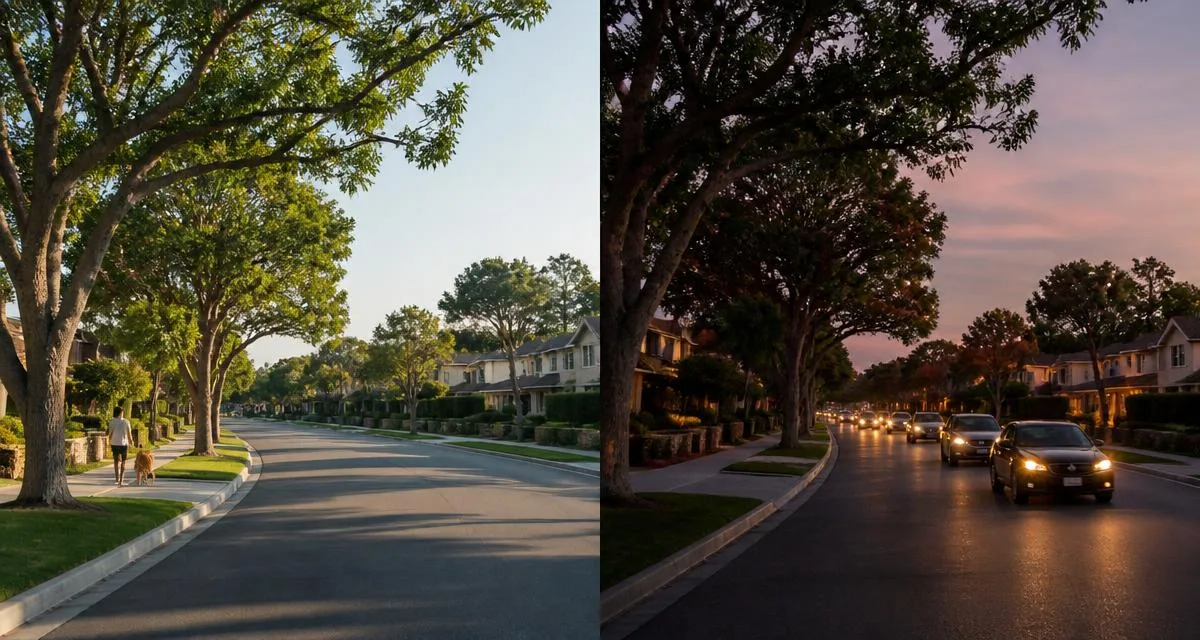
Editorial split-frame photograph comparing one residential street during a quiet weekend morning and during a weekday late afternoon, illustrating how the same address produces a different living experience depending on when it is observed.
A showing is a snapshot. Living somewhere is a time series. Here's how to evaluate the place around a house — traffic, light, water, and what's planned nearby — before you commit.
The showing was at 11 a.m. on a Saturday. The street was quiet. Two people were walking a dog. You could hear a lawnmower somewhere a few houses down, and that was about it. The kitchen was better than the photos. The primary bedroom got beautiful light. You stood in the driveway afterward and thought, this feels right.
Six weeks later you're living there, and Tuesday morning looks nothing like that Saturday. The road you thought was a quiet residential street is a cut-through at 7:40 a.m. The sun you loved in the great room is almost unbearable at 5 p.m. — the room faces west, and the afternoon light pours directly through the glass. The drainage swale at the back of the lot, which was dry and grassy when you toured, holds standing water for two days after every hard rain.
None of these things were hidden from you. You simply weren't there when they were visible.
The assumption many buyers make
Most buyers spend real effort evaluating the property and almost no structured effort evaluating the place around it. The property gets an inspection, an appraisal, a title search, a second showing. The neighborhood gets a vibe.
One side of the decision has a formal inspection process. The other side has a vibe.
That asymmetry exists for understandable reasons. The house is tangible and knowable: you can open every cabinet, flush every toilet, hire someone to climb into the attic. The neighborhood feels like atmosphere — something you absorb rather than evaluate. And the showing format quietly reinforces the imbalance, because a showing is optimized to present the house at its best, at a time chosen by someone else.
But you are not buying the house. You are buying the experience of living at that address — and that experience is produced by three things working together:
Property + Place + Time = Living Experience
The property is what the inspector sees. The place is everything outside the property line that affects daily life — traffic, light, drainage, activity patterns, what's planned for the empty lot two doors down. Time is the variable almost nobody tests for, and it's the one that changes the other two.
The overlooked variable is time
A showing is a snapshot. Living somewhere is a time series.
The same address produces a meaningfully different experience depending on when you observe it: weekday versus weekend, morning versus evening, school year versus summer, dry season versus wet season. In seasonal markets, the same street can experience very different traffic and activity in February than it does in July — seasonal residents, visitor patterns, community events, and weather can all change how an area functions at different times of year. Not every market works this way, but in the ones that do, the difference can be dramatic.
Almost every condition that surprises new homeowners is time-dependent:
- Traffic. A street can be empty at noon and saturated at rush hour, school pickup, or shift change at a nearby facility.
- Noise. Sirens, train horns, flight paths, lawn crews, and evening entertainment all operate on schedules.
- Sunlight. Light moves. The cheerful morning kitchen may be the blinding late-afternoon kitchen.
- Drainage. Some lots only reveal their water behavior during or after heavy rain.
- Activity. Trails, parks, pools, bars, and sports fields have peak hours that a midday showing will never intersect.
The condition existed before you moved in. It simply wasn't on display during your snapshot.
The hidden variables worth testing
Traffic and cut-through patterns
Navigation apps reroute commuters through residential streets every day. A road that looks like a neighborhood lane can function as an arterial during the two hours that matter most. The only way to know is to be there at 7:30 a.m. and 5:30 p.m. on a weekday — and, if you can, to stand still long enough to watch whether cars are neighbors leaving driveways or strangers using the street as a shortcut.

Isometric architectural visualization comparing two lots within one subdivision: a corner or entrance lot exposed to passing traffic and an interior lot buffered from through traffic, illustrating how position within a neighborhood can change the daily experience of a home.
Orientation and light
A home's orientation determines which rooms are usable at which hours. Western exposure is the classic example: afternoon sun loads west-facing glass and west-facing outdoor space with heat and glare precisely when many households want to use them — after work, at dinner time, on weekend evenings. This isn't a defect; some buyers love a bright western great room and a sunset lanai. But it's a preference you should discover before closing, not after.
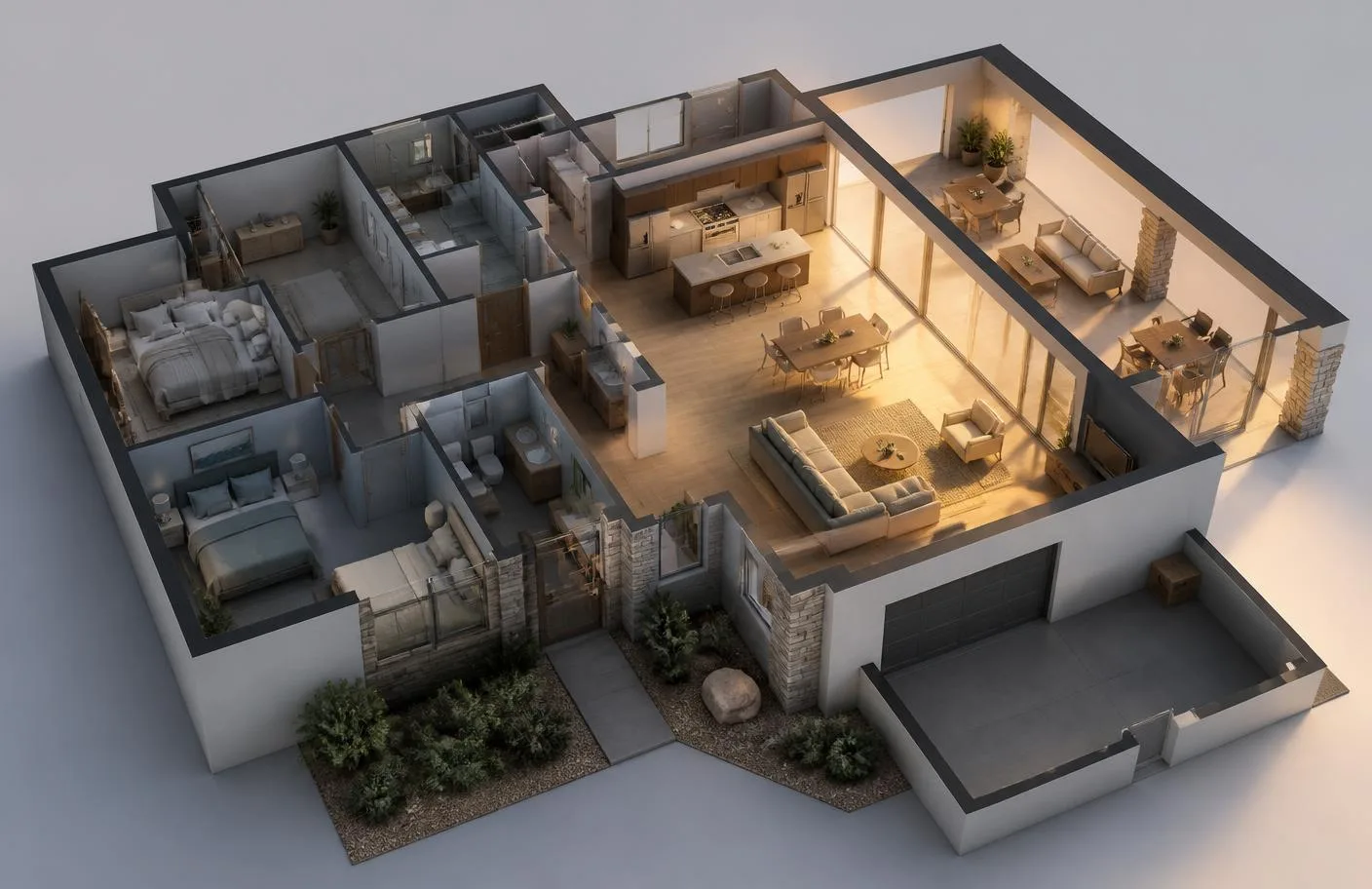
Architectural cutaway showing how late-afternoon western sunlight reaches a home's west-facing living spaces and outdoor area, illustrating the relationship between home orientation, sunlight, heat, glare, and room usability.
Water behavior
Drainage is a rain-dependent condition. A lot can look perfectly graded on a dry day and move water poorly when it matters. Look for the evidence that persists between storms: water stains on the foundation line, sediment patterns in the swale, mulch displaced toward low points, a neighbor's yard with a permanent pump hose. Then check what public records show — flood zone designations and, where available, local floodplain or stormwater maps — understanding that a flood zone designation is one data point, not a complete description of how a specific lot handles water.
What's planned nearby
The empty lot, the vacant commercial pad, the wooded buffer — these are futures, not scenery. Zoning describes what may currently be permitted on a parcel, not necessarily what will be built there; applications can be filed, changed, delayed, denied, withdrawn, or modified. Most jurisdictions publish zoning maps, land-use designations, and development applications through planning portals or GIS tools, and many post notices for proposed projects. The exact records and procedures vary by jurisdiction, so material information should be verified with the appropriate authoritative source. If the records are unclear, the relevant local planning department may be able to explain what has been filed or where to find the applicable public record.
Second-order effects
A mismatched place rarely announces itself as one big problem. It shows up as a series of small frictions:
- The room you stop using. The west-facing space that's too hot at the hour you're home becomes square footage you paid for and don't occupy.
- The schedule you inherit. If the road is loud at 6:45 a.m., that is now your alarm clock, whether or not you set one.
- The condition that stays. And the friction doesn't disappear when ownership changes; a future buyer may notice the same condition.
None of this means a home with a traffic pattern or a hot afternoon room is a bad purchase. It means you should choose it with your eyes open, at the right price, with the right expectations — rather than discover it.
How to actually test a neighborhood
You don't need special access or professional tools. You need a calendar.
- Visit at three different times. A weekday morning, a weekday evening, and a weekend. Fifteen minutes parked on the street tells you more than a second showing.
- Drive the commute you'd actually make. From the address, at the hour you'd leave. Test the route home, too.
- Walk one block in each direction. What's around the corner — a park, a bus stop, a bar, a drainage canal — shapes the block more than what's in front of the house.
- Visit after rain, if you can. Water behavior is the hardest condition to fake and the easiest to check after a storm.
- Check the public record. Look up the parcel and its surroundings in the local planning or GIS portal. Verify anything material with the authoritative source for that jurisdiction.
- Ask one open question. "What's it like living here?" posed to a neighbor walking a dog, will teach you things no document will. People are remarkably candid with someone who is clearly about to make a decision.
This is a half day of work spread across a week, against a decision you'll live with for years.
The rule
Every condition described in this article has the same signature: it was knowable before closing, and it was invisible during the showing. The inspection covered the property. Nobody inspected the place, and nobody tested it across time.
You cannot move the house.
Which is why the place around it deserves the same rigor as the roof over it:
Never make a long-term housing decision from a short-term snapshot.
Think it through before you decide
Planning a move, or evaluating whether a home and its location actually fit your life? Total Home Fusion builds complimentary educational tools, guides, and planning resources for homeowners and future homeowners — including our Moving Hub, neighborhood and lifestyle planning guides, and Ask Maria, where you can submit home and homeownership questions for educational guidance. Explore the resource library at your own pace; everything is designed to help you make the decision, not to make it for you.
Recommended Next Resource
Your Resource Journey — the next step homeowners take after a resource like this one.
- AssessmentCheck where you actually standA short evaluation that turns general guidance into your situation.Estimated reading time: 4 min assessmentWhy this is recommendedA short evaluation applies everything you've read to your own home rather than the general case.Continue
- Planning GuideTurn the decision into a planPlanners and estimators that size, budget and schedule the work.Estimated reading time: 6 min readWhy this is recommendedThis Planning Guide helps you prepare the space before you commit to a purchase.Continue
- Ask MariaGet a human second opinionWhen the decision is large or personal, ask someone who has seen it before.Estimated reading time: 3 min readWhy this is recommendedYou've covered the research — this is the point where a second opinion saves the most money.Continue
Keep going
Helpful next steps
Complimentary, no-pressure resources that follow the decision you're working through.
New Home Readiness Assessment
Check what a home still needs before and after you commit.
Learn morePrintable Checklists
Walkthrough and planning checklists you can take with you.
Learn moreBeyond the Closing — Buyer Guidance
What to evaluate, plan and prepare around a home purchase.
Learn moreAsk Maria
Talk through the decision you're actually making and get practical guidance.
Learn moreWas this guide helpful?
If you have an idea or suggestion that could help more homeowners, we'd love to hear it.
Talk it through
Planning your next home decision?
Whether you're evaluating a home, furnishing a room, improving sleep, relocating, downsizing, or simply trying to make smarter home decisions, Total Home Fusion provides practical guidance before you invest your time and money.
About the author
About Maria Banou
Maria Banou is the founder of Total Home Fusion, a homeowner decision platform focused on helping people think through the practical choices surrounding where they live, what they buy for their homes, and how their homes support everyday life. Her work includes furniture selection, sleep comfort, room planning, relocation, downsizing, Florida homeowner considerations, aging-in-place planning, and practical home decision guidance.
- Furniture Selection
- Sleep Comfort
- Room Planning
- Downsizing & Relocation
- Florida Homeowner Guidance
- Aging in Place Planning
- Home Decision Guidance
Connected guidance
More Homeowner Insights
Related resources from the Fusion Library™, chosen to continue the same decision.

Before You Fall in Love With the Kitchen, Find the Water
The kitchen is what you see. Water is what costs you. A 15-minute walkthrough test for the systems a showing never puts on display.
Decision GuideRead Article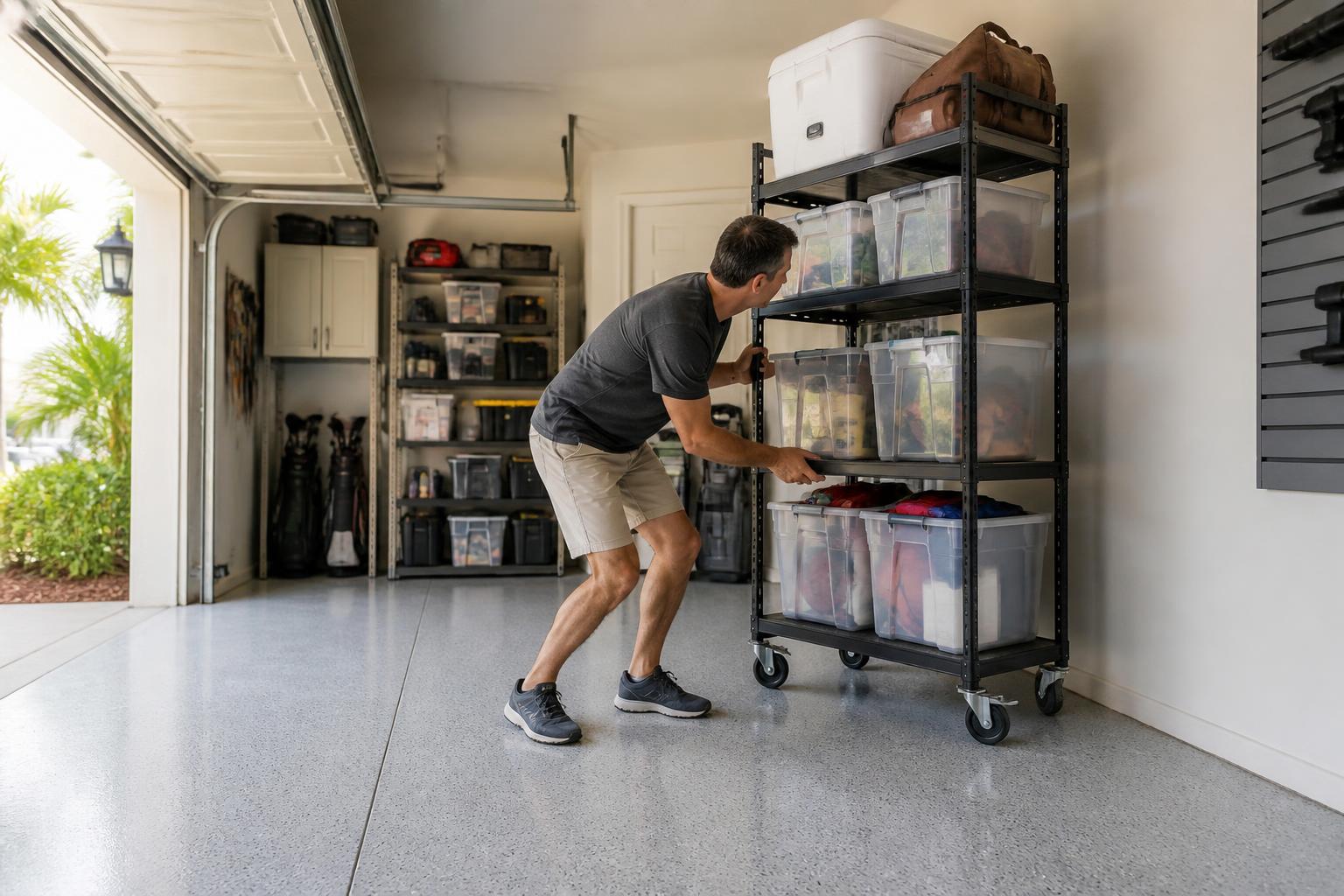
What Should Never Be Stored Against a Garage Wall?
Almost every homeowner pushes boxes, bins, shelving and cabinets tight against the garage walls, because every inch you move outward gives an inch back to the middle. It looks efficient, and in floor-space terms it is. But garage walls, corners and floor transitions are one of the few places a home is still plainly visible to you. Storage does not only occupy space — it can quietly remove your ability to notice a change. This guide introduces the Garage Perimeter Visibility Test, the Storage Visibility Tax, and the idea of an inspection gap instead of an arbitrary clearance number, so you can keep the storage you need without going blind to the building behind it.
Knowledge GuideRead Article
How Long Should a Sofa Last? What Really Determines Its Lifespan
Most homeowners ask the question the same way: how many years should a sofa last? It is a fair question, and it almost never has a clean answer. Two sofas purchased the same month, in the same neighborhood, can end up in very different condition. One still feels supportive and welcoming. The other sags in the middle and nobody wants to sit there. Age was identical. Everything else was not. This guide walks through what actually determines a sofa's useful life — frame, suspension, cushions, upholstery, household use, Florida conditions, and changing comfort needs — and gives you a calm way to decide whether to maintain, repair, reupholster, or replace the sofa you already own.
Knowledge GuideRead ArticleQuick answers
Frequently asked questions
How many times should I visit a neighborhood before buying?
At least three: a weekday morning, a weekday evening, and a weekend. Each reveals different traffic, noise, and activity patterns. If you can add a visit during or just after heavy rain, do — water behavior is the hardest condition to observe otherwise.
How do I find out what might be built near a home I'm considering?
Most jurisdictions publish zoning maps, land-use designations, and development applications through a planning portal or GIS tool. Zoning describes what may currently be permitted, not what will be built — applications can change, stall, or be withdrawn. Verify anything material with the local planning department or the authoritative record for that jurisdiction.
Does home orientation really matter that much?
It affects which rooms are comfortable at which hours. Western exposure loads afternoon sun and heat into west-facing rooms and outdoor space in the late afternoon and evening — often when households want to use them. Some buyers love it. The point is to know before closing rather than discover after.
How can I tell whether a lot drains poorly if it hasn't rained?
Look for evidence that persists between storms: staining along the foundation line, sediment patterns in swales, mulch or soil displaced toward low points, or a neighbor running a pump. Check flood zone and stormwater information in the public record, keeping in mind that a flood designation is one data point, not a full description of how one lot handles water.
What is a cut-through street and how do I spot one?
It's a residential street that navigation apps route commuters through during peak hours. Park on the street at 7:30 a.m. and 5:30 p.m. on a weekday and watch whether cars are pulling out of driveways or passing straight through. Volume during those two windows is the tell.