
Before You Fall in Love With the Kitchen, Find the Water
Reviewed & curated by Maria Banou | Total Home FusionHome Life AdvisorPublished September 2, 20267 minute read
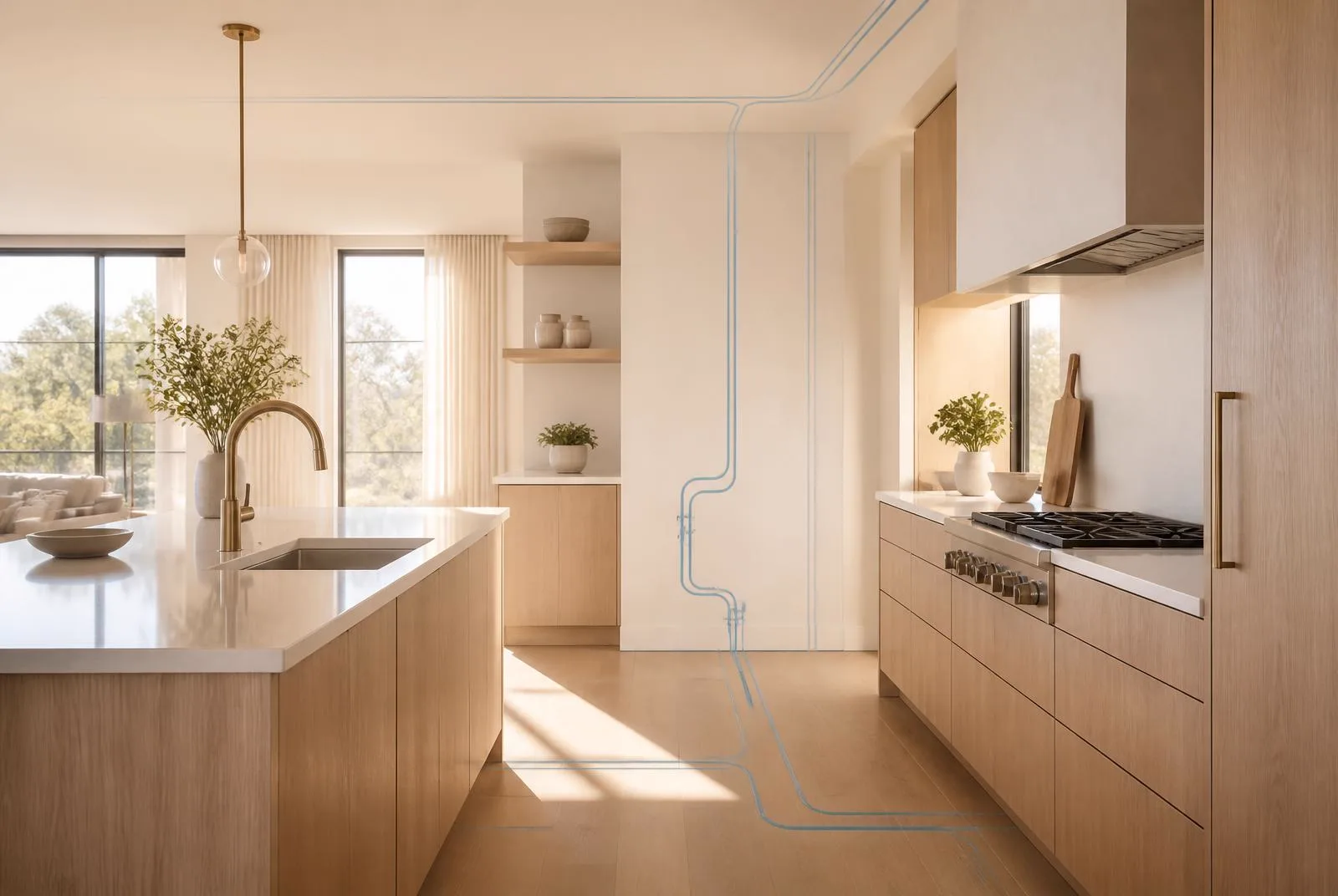
Editorial photograph of a warm, light-filled kitchen overlaid with a subtle architectural line showing where supply and drain lines travel behind the visible finishes.
The kitchen is what you see. Water is what costs you. A 15-minute walkthrough test for the systems a showing never puts on display.
The kitchen is the first thing you fall for. It is designed to be. Wide island, good light, the faucet that arcs just right. You picture Thanksgiving in it before you have finished walking through it.
Then you buy the house, and eleven months later a supply line behind the dishwasher lets go on a Wednesday while you are at work. The kitchen you fell in love with is the room that has to be torn out.
Nothing about that failure was hidden. It simply wasn't visible from the part of the house you were looking at.
Buyers inspect houses visually. Houses fail mechanically.
That sentence is the whole idea, and it is worth sitting with, because almost every expensive homeowner surprise lives in the gap between those two things.
You evaluate a house with your eyes. A house fails through its systems.
Finishes are what you can see: cabinetry, countertops, flooring, paint, tile. Systems are what you cannot: the roof plane and how it sheds, the grade around the slab, the supply lines inside the walls, the drain lines under them, the water heater, the condensate line from the air handler.
Finishes are also what a listing is staged around, what photographs well, and what a showing is arranged to display. Systems are quiet by design. They only announce themselves when they fail — and by then the announcement is a repair invoice.
Water is one of the most consequential forces in a house, because a small failure can travel far beyond the component where it started.
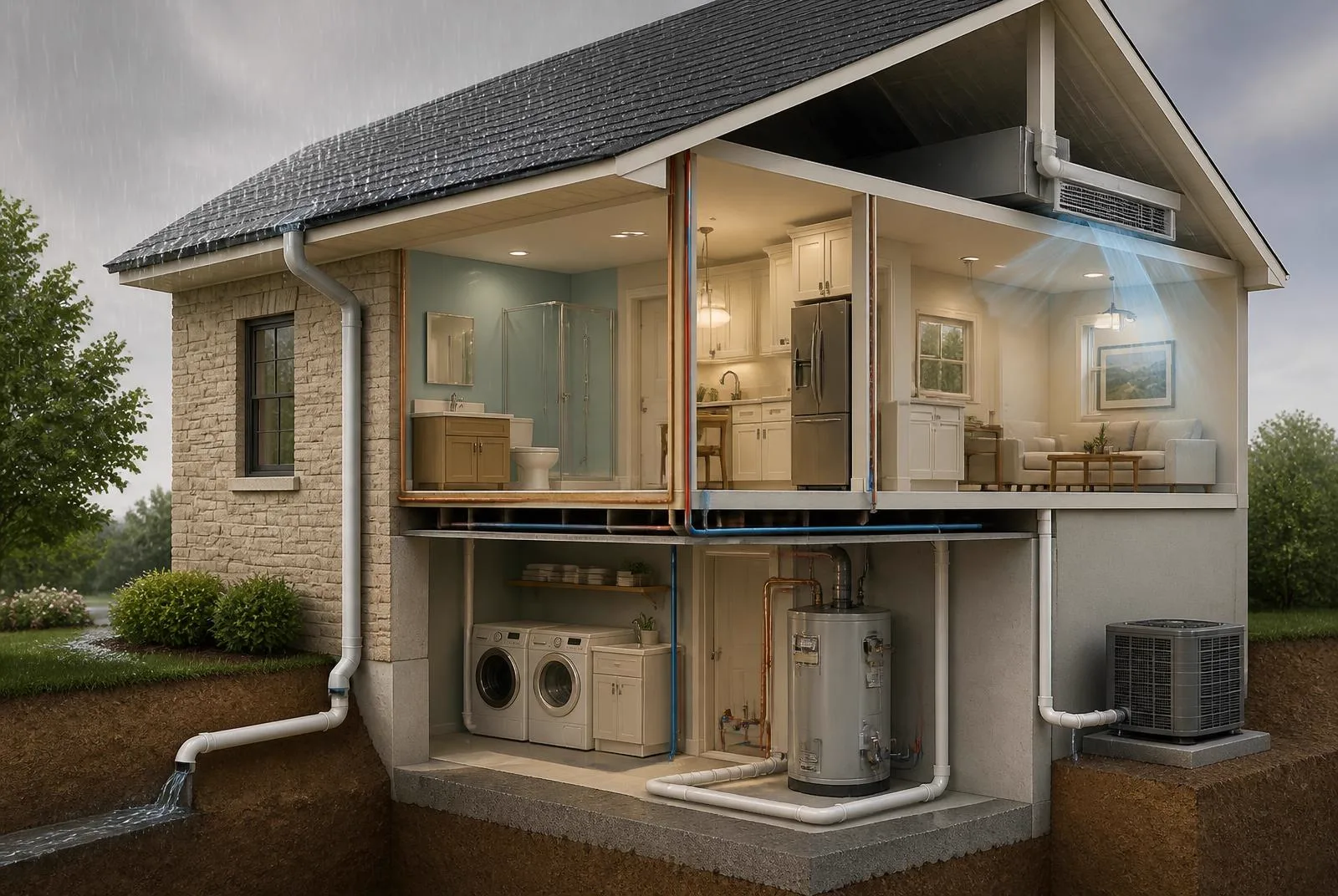
Educational cross-section showing the three ways water moves through a home: rainfall handled by roof, gutters and site drainage; pressurized supply piping serving fixtures and appliances; and moisture removed from indoor air by the cooling system's condensate line.
Water is not one system in a house — it is three
Those three paths fail in different ways, and they are worth separating.
Water from the sky. Rain lands on the roof, moves through gutters and downspouts, hits the ground, and then does whatever the grade tells it to do. If the grade sends it back toward the house, it will find the slab, the foundation, the crawlspace, or the stem wall — patiently, over years.
Water under pressure. Supply lines run through walls, ceilings, and cabinets, and they are pressurized every hour of every day. A pinhole in a pressurized line does not wait for you to be home. Common household connections such as washing-machine hoses, icemaker lines, dishwasher connections, toilet supply lines and aging water heaters are worth checking, because a failure in a pressurized line can release water until someone shuts the supply off.
Water in the air. In a humid climate, the cooling system is also a dehumidifier. Every gallon it pulls out of the air has to leave through a condensate line. When that line clogs — and clogs are routine, not exotic — the water backs up into a pan, an air handler closet, a ceiling, or a hallway wall.
Water problems are rarely dramatic. They tend to be ordinary, cumulative, and invisible until the drywall tells you.
The Water Path Test
You cannot open a wall during a showing. You can, however, follow water from where it starts to where it ends and see whether the path makes sense. This takes about fifteen minutes and requires no tools.
1. Start at the roof. Look at the roof plane from the street. Where does the water go when it rains? Are there gutters? Do they exist on every side that needs them, or only on the front?
2. Follow the downspouts. Where do they discharge? Into a splash block that moves water a few feet away, into a buried line that goes somewhere you can identify, or straight onto the soil against the foundation?
3. Read the grade. Stand at each corner. Does the ground fall away from the house, or toward it? Look for the tells: mulch washed into a fan shape, a rut in the soil, a stained band along the base of the wall, moss where the shade and moisture sit.
4. Find the low point of the lot. Every lot has one. Note whether it is comfortably away from the structure or immediately beside it. Note whether anything about it looks recently regraded.
5. Go inside and find the main shutoff. If you cannot find it during a showing, you will not find it during a leak. Ask where it is and whether it turns.
6. Open the cabinet under every sink. You are looking for staining, swollen particleboard, a warped cabinet floor, a patch of new paint in an old cabinet, or a faint musty smell.
7. Check the water heater. How old is it? Is there rust at the base, a pan under it, and a drain from that pan going somewhere useful? A water heater is a consumable, not a permanent fixture.
8. Find the condensate line. Locate the air handler and follow the small line out. Look at the pan under the unit and at the wall or ceiling directly below it. Discoloration there is a story.
9. Look at ceilings on the top floor. Stand in the middle of each room and look up, especially near exterior walls and around bathrooms above.
10. Ask the only question that matters. "Has water ever entered this house, and what was done about it?" Ask the agent. Ask it again in writing.
None of these steps require expertise. They require attention pointed at the right place.
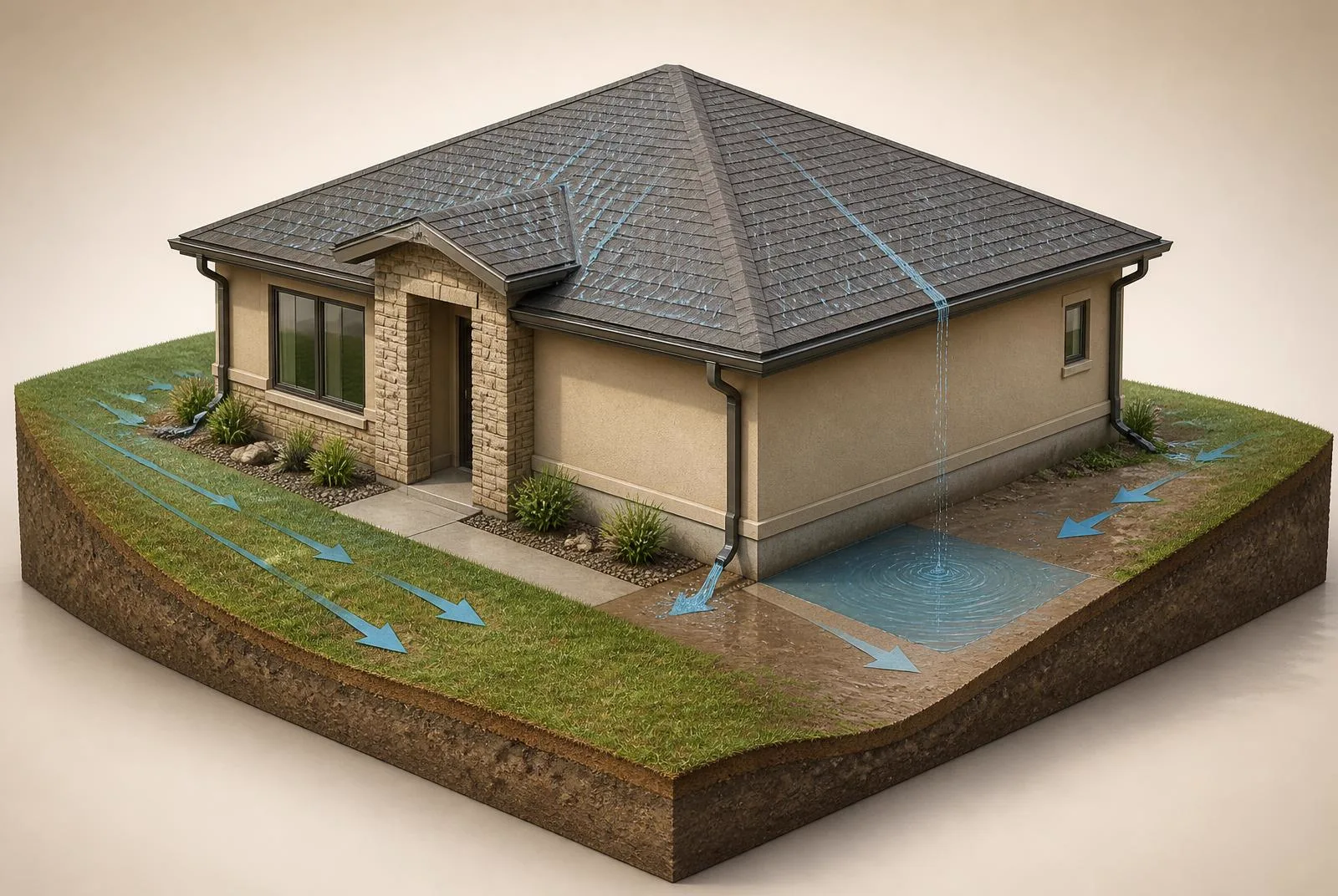
Isometric visualization of site drainage around a home: roof runoff collected by gutters and discharged through downspouts, positive grade carrying water away from the foundation on one elevation, and negative grade producing standing water against the slab on another.
What this looks like in Florida
Florida concentrates every one of these variables. Rain often arrives in volume rather than in drizzle, so a drainage path that is merely adequate can be overwhelmed quickly. Lots are frequently flat or close to it, so the difference between water leaving and water sitting can come down to an inch of grade. And because cooling systems run for much of the year in most of the state, the condensate line is not a seasonal detail — on many homes it is working nearly every day.
Two practical consequences follow. First, a dry-day walkthrough tells you very little about drainage; if you can get to the property during or just after a hard rain, that single visit will usually teach you more than several dry showings. Second, ask specifically about the age and service history of the air-conditioning system and its condensate line, not just the roof.
Anything material — flood zone, elevation certificate, permit history, prior insurance claims — should be confirmed in the authoritative public record for that jurisdiction rather than in conversation.
What a home inspection does and does not do
A home inspection is valuable and you should always get one. It is also a visual, point-in-time inspection performed on the day it happens, usually in whatever weather that day provides. An inspector does not open walls, does not run a hose on the lot for two hours, and cannot see a pinhole leak that has not started yet.
That is not a criticism of inspectors. It is a description of scope. The Water Path Test is not a substitute for an inspection — it is what you bring to the inspection, so your inspector's time is spent on the questions you already know to ask.
The reframe
Falling in love with the kitchen is not the mistake. The kitchen is a real part of how you will experience the house, and it deserves to matter.
The mistake is letting the most visible room stand in for the least visible systems. Look at the kitchen. Then go find the water.
You don't need to know the most about construction. You need to know which questions expose what a beautiful room can hide — and to ask one more of them, in one more place, before you sign.
Recommended Next Resource
Your Resource Journey — the next step homeowners take after a resource like this one.
- AssessmentCheck where you actually standA short evaluation that turns general guidance into your situation.Estimated reading time: 4 min assessmentWhy this is recommendedA short evaluation applies everything you've read to your own home rather than the general case.Continue
- Planning GuideTurn the decision into a planPlanners and estimators that size, budget and schedule the work.Estimated reading time: 6 min readWhy this is recommendedThis Planning Guide helps you prepare the space before you commit to a purchase.Continue
- Ask MariaGet a human second opinionWhen the decision is large or personal, ask someone who has seen it before.Estimated reading time: 3 min readWhy this is recommendedYou've covered the research — this is the point where a second opinion saves the most money.Continue
Keep going
Helpful next steps
Complimentary, no-pressure resources that follow the decision you're working through.
New Home Readiness Assessment
Check what a home still needs before and after you commit.
Learn morePrintable Checklists
Walkthrough and planning checklists you can take with you.
Learn moreBeyond the Closing — Buyer Guidance
What to evaluate, plan and prepare around a home purchase.
Learn moreAsk Maria
Talk through the decision you're actually making and get practical guidance.
Learn moreWas this guide helpful?
If you have an idea or suggestion that could help more homeowners, we'd love to hear it.
Talk it through
Planning your next home decision?
Whether you're evaluating a home, furnishing a room, improving sleep, relocating, downsizing, or simply trying to make smarter home decisions, Total Home Fusion provides practical guidance before you invest your time and money.
About the author
About Maria Banou
Maria Banou is the founder of Total Home Fusion, a homeowner decision platform focused on helping people think through the practical choices surrounding where they live, what they buy for their homes, and how their homes support everyday life. Her work includes furniture selection, sleep comfort, room planning, relocation, downsizing, Florida homeowner considerations, aging-in-place planning, and practical home decision guidance.
- Furniture Selection
- Sleep Comfort
- Room Planning
- Downsizing & Relocation
- Florida Homeowner Guidance
- Aging in Place Planning
- Home Decision Guidance
Connected guidance
More Homeowner Insights
Related resources from the Fusion Library™, chosen to continue the same decision.

You Toured the House. But Did You Test the Neighborhood?
A showing is a snapshot. Living somewhere is a time series. Here's how to evaluate the place around a house — traffic, light, water, and what's planned nearby — before you commit.
Decision GuideRead Article
UV Protection for Artwork and Family Photos: How to Preserve the Memories That Matter
Furniture gets replaced. Photographs usually do not. Most homeowners already know sunlight affects furniture, but far fewer think about it when they hang the things they love most — the wedding portrait, the heirloom watercolor, the child's first painting. This guide explains how ultraviolet light gradually changes artwork, photographs, certificates, and keepsakes, why some colors fade faster than others, what inexpensive framing does and does not protect against, and how to display treasured pieces thoughtfully in a bright Florida home — without living behind closed blinds.
Knowledge GuideRead Article
Can Sunlight Damage Furniture? What Every Homeowner Should Know
Sunlight is one of the things homeowners love most about a house and think about least when they arrange it. The light that makes a room feel open and alive is also, over years, quietly rearranging the color and condition of everything it touches. This guide explains how ultraviolet light and heat actually affect furniture, why two identical pieces in the same room can age differently, which materials are more sensitive than others, and what you can realistically do about it — without living behind closed blinds.
Knowledge GuideRead ArticleQuick answers
Frequently asked questions
What is the Water Path Test?
A 10-step walkthrough that follows water from the roof to the ground and from the main shutoff to every fixture: roof plane, gutters, downspout discharge, grade at each corner, the low point of the lot, the main shutoff, under-sink cabinets, the water heater, the air-conditioning condensate line, and top-floor ceilings. It takes about fifteen minutes and requires no tools.
Doesn't a home inspection already cover water?
Partly. A home inspection is a visual, point-in-time evaluation performed in whatever weather that day provides. Inspectors do not open walls, cannot flood-test a lot, and cannot see a pinhole leak that has not started. Always get an inspection — and use the Water Path Test to decide which questions your inspector should spend time on.
How can I judge drainage if it hasn't rained?
Look for evidence that persists between storms: mulch or soil washed into fan shapes, ruts, a stained band along the base of the wall, moss in shaded low spots, or a downspout discharging directly against the foundation. If you can visit during or just after a hard rain, that single visit will tell you more than several dry showings.
Why does the air-conditioning condensate line matter so much in Florida?
In a humid climate the cooling system runs most of the year and acts as a dehumidifier, so every gallon it removes from the air has to leave through the condensate line. Clogs are routine rather than exotic, and a backed-up line can push water into a pan, an air handler closet, a ceiling, or a hallway wall. Ask about the age and service history of the system, not just the roof.
Which water connections are worth checking inside a house?
Connections and appliances: washing-machine hoses, icemaker lines, dishwasher connections, toilet supply lines, and aging water heaters. These lines are pressurized every hour of every day, so a failure does not wait until someone is home. Knowing where the main shutoff is — and that it turns — is one of the cheapest protections a homeowner has.